Component Shift and Skew: Causes, Detection and Prevention
Shift and skew leave parts offset or rotated on their pads, reducing joint area. Here is what causes them, how AOI measures them, and how to prevent them.
28 กันยายน 2569
Tombstoning stands a small chip resistor or capacitor on one end, leaving an open circuit. Here is why it happens, how SPI and 2D/3D AOI find it, and how to prevent it.
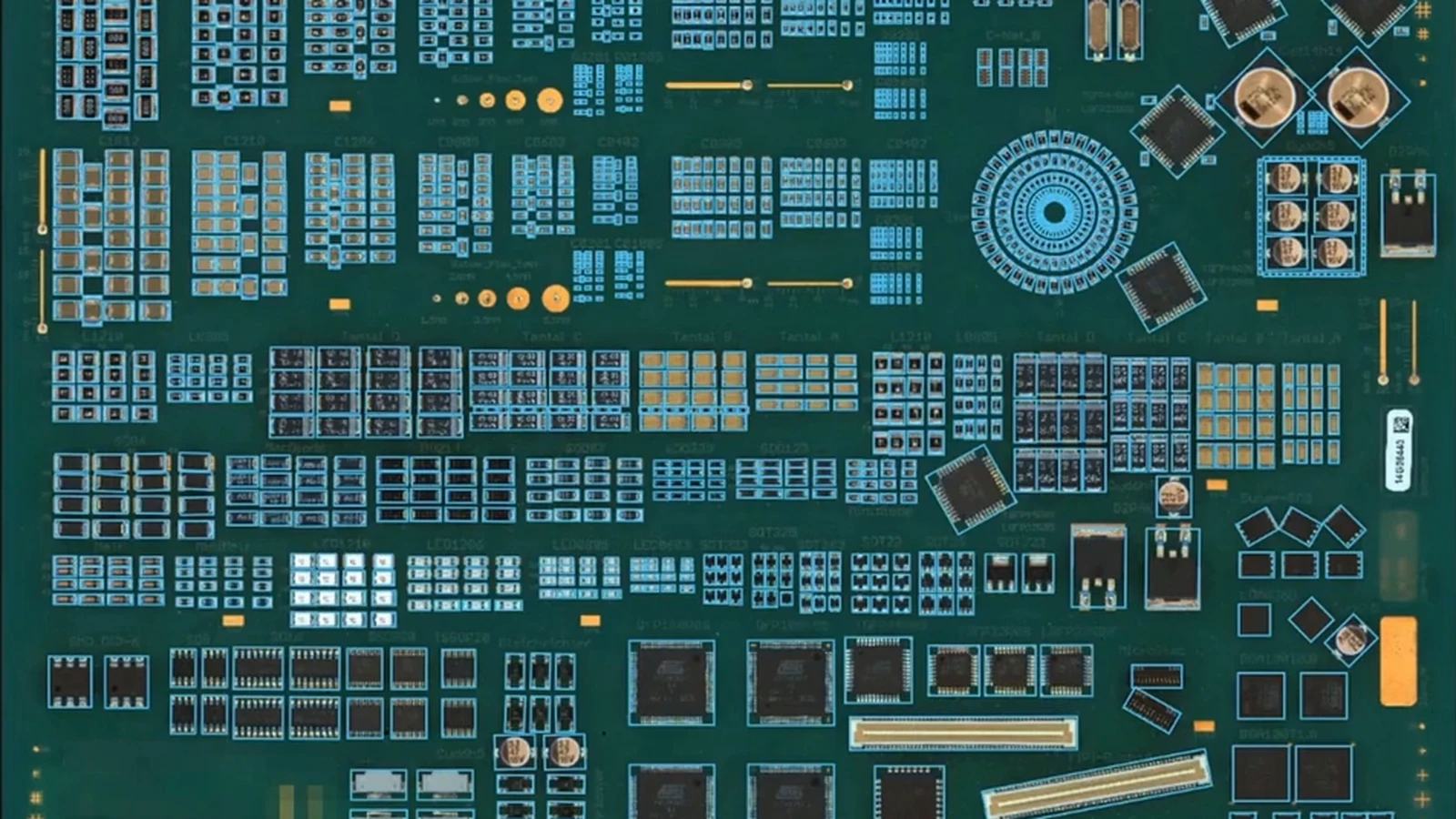
Tombstoning (a PCB tombstone, also called the Manhattan effect or drawbridging) is a reflow defect in SMT assembly in which a small two-terminal chip component, usually a resistor or capacitor, lifts off one pad and stands up on its other end. The raised termination has no solder connection, so the circuit is open even though the part appears to be on the board.
Tombstoning happens when the solder at one end of a chip melts and wets before the solder at the other end. The surface tension of the molten side pulls on its termination, and on a light part such as an 0402 or 0201 chip (imperial sizes), that pull is enough to rotate the component upright. Anything that makes the two ends unequal can start it:
Tombstoning is closely related to component shift and skew: the same imbalance that stands a chip on end often just drags it sideways instead.
Manual inspection finds a fully raised 0603 easily, but a partly lifted 0201 is hard to see without magnification.
SPI cannot see a tombstone, but it measures the most common cause: a volume or area imbalance between the two pads of a chip. Tracking pad-to-pad balance on small passives is one of the most useful SPI checks for this defect.
2D AOI sees a standing chip as a change in body footprint, a bare pad on one end and an unusual reflection from the upright termination. A part lifted only a few degrees is harder to judge from a top-down image. 3D AOI measures height, so a raised end becomes a measured step rather than an inference from shading. AXI is rarely needed, since tombstones are visible from above.
In DaoAI's inspection coverage, tombstoning is part of item 02, Placement, Orientation & Polarity, alongside billboarding (a chip resting on its side) and X/Y offset. AI auto-programming includes tombstoning among the component checks it generates from one golden board, so small passives are covered without teaching each package by hand. On DaoAI's 3D machines, item 04 also measures component height and detects lifted or tilted bodies.
A tombstoned chip is reworked by hand, usually with hot tweezers or a fine soldering iron tip:
Log the designator. Rework fixes one board; if the same designator tombstones again, the cause is in the pad design, paste or profile, so go to the prevention steps below.
Tombstoning is a balance problem: both ends of the chip need the same paste, heat and timing. If it repeats at the same designators, look at pad design and profile first.
| Cause | Prevention |
|---|---|
| Unequal paste on the two pads | Check pad-to-pad volume balance in SPI on 0402 and smaller; clean or replace stencils with partly blocked apertures. |
| One end melts first | Add a soak or slow the ramp just below liquidus (about 217 °C for SAC305) so both terminations reach melt together. |
| Thermal imbalance from copper | Use thermal relief on pads connected to planes, and avoid a via in one pad of a small chip. |
| Asymmetric land pattern | Use equal pad sizes and a pad gap matched to the termination length, per IPC-7351 land patterns. |
| Placement offset or poor seating | Verify placement accuracy (µm) and placement force so the part is centered and pressed into the paste. |
| Oxidized termination | Control component storage and floor life, and check suspect lots for solderability. |
Some lines see more tombstoning on very small chips in nitrogen reflow, because wetting is faster and less forgiving of imbalance. If the defect appeared after a change to nitrogen, test the profile in both atmospheres.
Want to see how your smallest passives are inspected? Send us one of your own boards and we will test it for you, free of charge.
A board with many chips standing on end looks like a skyline of tall buildings, which gave the defect the name Manhattan effect. It is also called drawbridging, because the part lifts like a drawbridge from one end.
Small, light two-terminal chips such as 0402, 0201 and 01005 resistors and capacitors are most prone. Their low mass means surface tension at one termination can easily outweigh the part.
A tombstoned chip stands upright on one end, with one termination off its pad. A billboarded chip lies on its long side, so both terminations may be soldered but the part is rotated 90° onto its edge.
2D AOI detects it once the lift changes the image enough, such as exposing bare pad or changing the body outline. 3D AOI measures the height difference between the two ends directly, which makes small lifts easier to confirm.
Shift and skew leave parts offset or rotated on their pads, reducing joint area. Here is what causes them, how AOI measures them, and how to prevent them.
28 กันยายน 2569
DaoAI vs Nordson YESTECH AOI: golden-board vs CAD-and-library programming, inline 3D, through-hole, on-machine AI, and how to test both on your boards.
7 ตุลาคม 2569
DaoAI vs CyberOptics (Nordson) SQ-series 3D AOI: golden-board vs library-based programming, inline 3D, through-hole, on-machine AI and how to test both.
7 ตุลาคม 2569
ข้อมูลเชิงลึกด้านการตรวจสอบด้วย AI ข่าวผลิตภัณฑ์ และบทวิเคราะห์อุตสาหกรรม เดือนละครั้ง เน้นสาระ
เราใช้ข้อมูลของคุณเพื่อตอบกลับข้อซักถามของคุณ ดูนโยบายความเป็นส่วนตัวของเรา