วิธีลด AOI False Call: สาเหตุที่แท้จริงและแนวทางแก้ไข
AOI False Call แบบไหนที่จูนแก้ได้ แบบไหนที่ติดอยู่ใต้ระดับ Threshold และวิธีแยกความแตกต่างให้ออก ก่อนที่คุณจะต้องเสียค่าใช้จ่ายกับชั่วโมงปรับจูนเพิ่มอีกรอบ
28 กรกฎาคม 2569
A sourced comparison of DaoAI and MIRTEC MV-6 OMNI / MV-3 OMNI AOI: programming inputs, 3D specifications, AI false-call handling and data, plus a checklist for testing both on your own boards.
DaoAI is an alternative to MIRTEC for inline and offline AOI: its machines build an inspection program from one verified golden board in 30 seconds to 5 minutes, without CAD files or a prebuilt component library, and retrain from operator feedback on the machine. According to MIRTEC's published materials, its MV-6 OMNI and MV-3 OMNI use deep-learning auto-teaching that matches components against a library by scanning the board. Sources are linked at the end.
| Topic | MIRTEC (MV-6 OMNI, MV-3 OMNI, INTELLI-PRO AI, per vendor materials) | DaoAI (per daoai.com) |
|---|---|---|
| Programming inputs | AI full-auto teaching: deep-learning Auto-Matching searches and matches components "from a vast library" by scanning the board; Teaching Wizard guides setup. | One verified golden board. AI detects and models each component and sets thresholds in 30 s to 5 min. CAD/BOM optional. Auto-programming does not require a prebuilt component library. |
| 3D method | 12-projection Digital Blue Light Moiré; 8-phase coaxial color lighting; optional 18 MP side cameras. | P5 and P5D inline 3D: four structured-light projection units, one per direction. Other models are 2D. |
| Height measurement range | 0–25 mm; Z-axis option for tall parts to 45 mm. | 25 mm (P5, P5D). |
| Published height metric | Not stated as a single figure on the pages reviewed. | ≤ 6 µm height accuracy with the calibration tool (P5, P5D). |
| Camera / optical resolution | 25 MP or 15 MP main camera; 7.7, 10 or 15 µm lens options (MV-6 OMNI). | 21 MP, 10 µm (P5). |
| AI features | INTELLI-PRO AI: deep-learning part search and teaching, AI OCR, AI auto defect classification with a feedback loop, user AI Training Tool. | Auto-programming, feedback learning that retrains the model from operator reports, on-machine model training, AI OCR/OCV. |
| Offline options | MV-3 OMNI benchtop 3D AOI. | P1, P1L, P2 offline 2D machines; boards up to 680 × 510 mm (P1L). |
| Through-hole (THT) | MV-3 OMNI measures SMT and THT assemblies in 3D. | A3: one machine performs pre-wave and post-wave inspection and can inspect both sides of the board. P3 and P5 also support DIP/through-hole inspection. |
| Deployment and data | SPC server collects data and images across lines; TRMS remote monitoring and control. Where AI training data is processed: check with the vendor. | All models run on-premise with no internet connection required. Remote support is optional and off unless the customer enables it; the system has no backdoor access. |
DaoAI hardware figures are reference (typical) values from daoai.com, not guaranteed limits. MIRTEC figures are as stated in its published materials.
According to MIRTEC, its Auto Matching Tool uses deep learning to find each component on the scanned board and match it to an entry in a large library. MIRTEC states this cuts teaching work by 90% versus manual teaching and 50% versus automatic teaching without deep learning, and that its Teaching Wizard helps new operators reach about 85% of the teaching quality of its most skilled operators.
DaoAI auto-programming does not require a prebuilt component library. The AI builds the program from the golden board itself: it detects and models each component, draws inspection windows and sets thresholds. A package it has never seen is modelled from the board in front of it, with no library entry to create first. DaoAI states this takes 30 seconds to 5 minutes per board.
The practical difference shows up on unusual parts. With library matching, the question is how often your boards carry packages the library does not yet cover and how long adding them takes. Time both systems on one of your odd-part boards.
Both vendors apply AI to false calls, at different points. According to MIRTEC, its AI Auto Classification makes a second judgment on each flagged defect, deciding whether it is real or a false call, with a continuous feedback-learning loop.
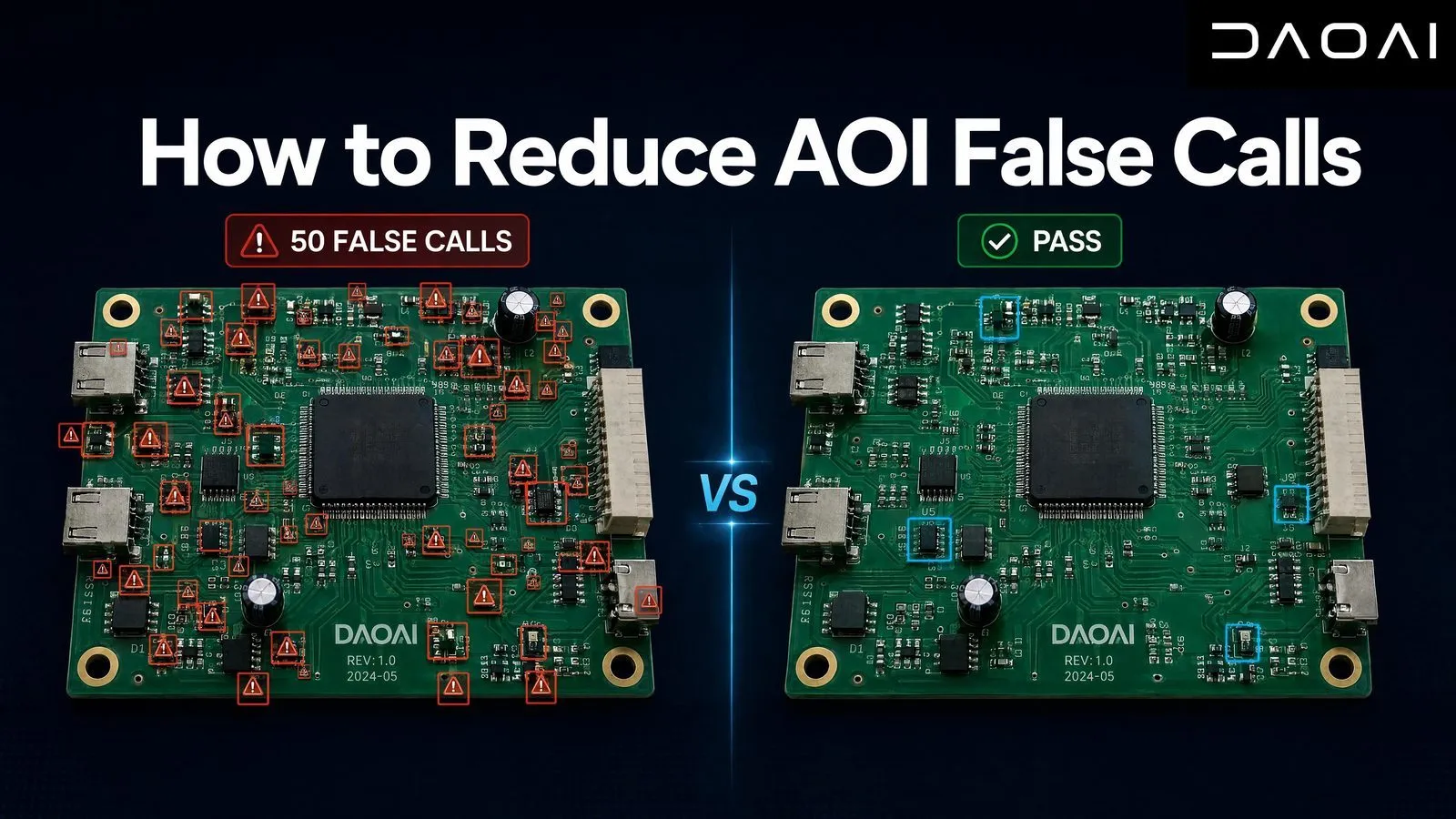
DaoAI's feedback learning works on the inspection model itself. An operator marks a call OK or NG, and an AI update retrains the model instead of loosening a threshold, so real defects near the same score are still caught. Hand-set parameters are kept, and an update can be undone. DaoAI states the false-call rate can reach about 1% after tuning; it depends on the board and process. See how to reduce AOI false calls for root causes.
MIRTEC's 3D machines combine Moiré projection, coaxial color lighting and optional side cameras for J-leads, coils and QFNs, and its published range also includes specialized models such as ART and GENESYS-AUTO.
DaoAI lists 16 inspection capabilities across all machines: presence, placement and polarity, component condition, height and coplanarity (3D), solder quality, open joints, lead condition, bridging, red glue, OCR/OCV, barcodes (1D, QR and Data Matrix), through-hole joints and bridges, and a whole-board pass for solder balls and foreign objects anywhere on the assembly. For a product-specific defect, you can train your own model offline on the machine, starting from a foundation model trained on over 1,000,000 real production images. MIRTEC also offers a user AI Training Tool for custom defects.
Run the same boards through both systems under the same conditions and record results side by side (see how to evaluate an AI AOI system before you buy):
No. DaoAI programs from one verified golden board and models each component directly from it. Component templates can be saved and reused, but nothing has to exist before programming.
DaoAI's 3D machines, the P5 and P5D, are inline and available for delivery now. Its offline machines (P1, P1L, P2) are 2D.
Yes. The A3 performs pre-wave and post-wave inspection in one machine, can inspect both sides of the board, and checks component bodies for missing, wrong or reversed parts. The P3 and P5 also support DIP/through-hole inspection.
No. All DaoAI models run on-premise with no internet connection required. Remote support is optional and off unless the customer enables it; the system has no backdoor access.
Competitor information reflects the vendors' public websites as of September 2026. Product names are trademarks of their respective owners.
With DaoAI, you can create an inspection program from one verified golden board without CAD files or a prebuilt component library. For inline 3D inspection, the P5 is available for delivery. Send us your board to evaluate programming time, inspection coverage and false-call review workload.
AOI False Call แบบไหนที่จูนแก้ได้ แบบไหนที่ติดอยู่ใต้ระดับ Threshold และวิธีแยกความแตกต่างให้ออก ก่อนที่คุณจะต้องเสียค่าใช้จ่ายกับชั่วโมงปรับจูนเพิ่มอีกรอบ
28 กรกฎาคม 2569
ตั้งแต่เวลาในการเขียนโปรแกรมและอัตรา false calls ไปจนถึงภาระด้านกำลังคน ประสิทธิภาพการ changeover และการมองเห็นข้อมูลด้านคุณภาพ — นี่คือแนวทางที่ทีม EMS ควรใช้ประเมิน AI AOI
14 เมษายน 2569
DaoAI vs Nordson YESTECH AOI: golden-board vs CAD-and-library programming, inline 3D, through-hole, on-machine AI, and how to test both on your boards.
7 ตุลาคม 2569
ข้อมูลเชิงลึกด้านการตรวจสอบด้วย AI ข่าวผลิตภัณฑ์ และบทวิเคราะห์อุตสาหกรรม เดือนละครั้ง เน้นสาระ
เราใช้ข้อมูลของคุณเพื่อตอบกลับข้อซักถามของคุณ ดูนโยบายความเป็นส่วนตัวของเรา