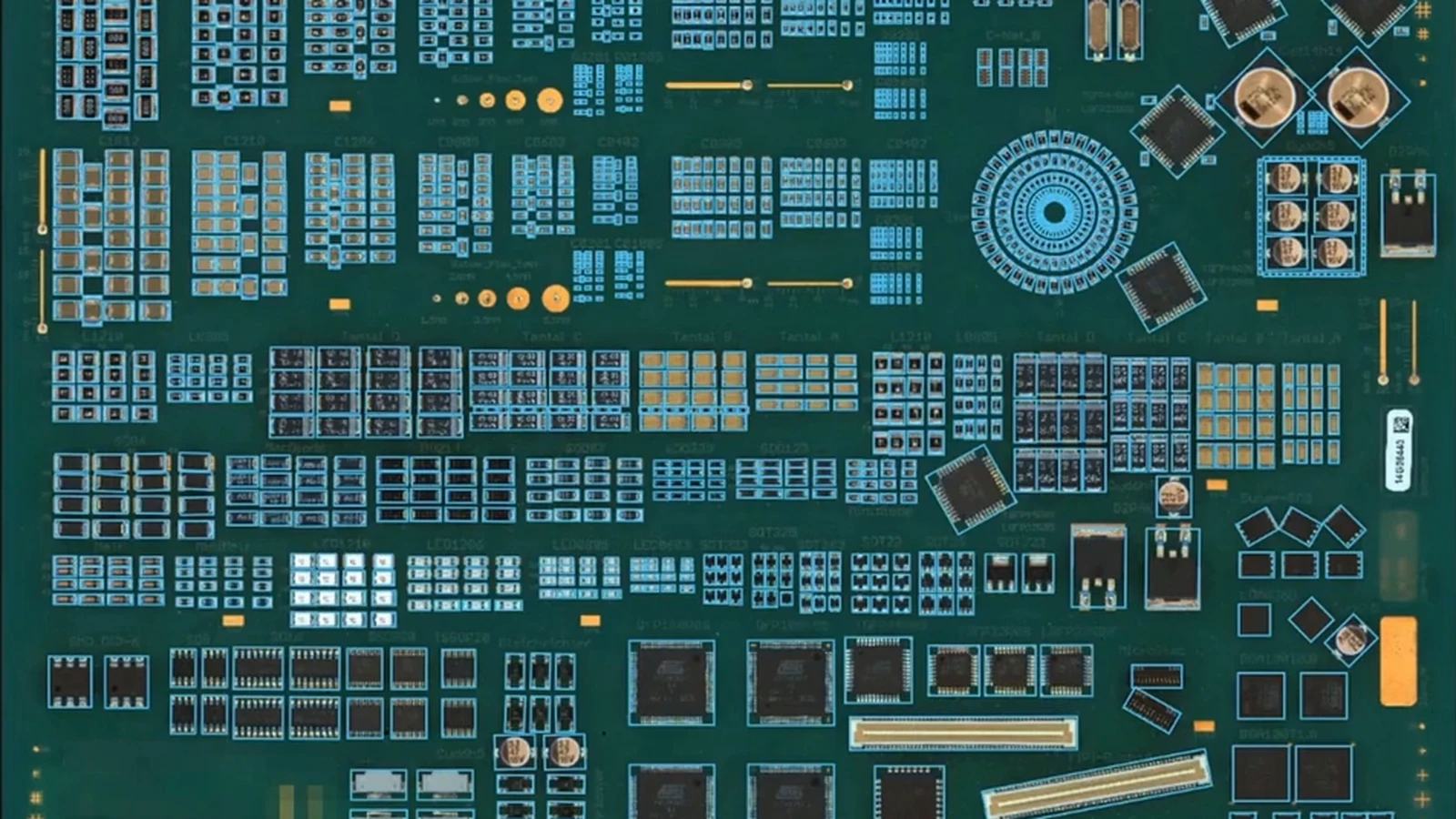
DaoAI is an alternative to Koh Young for inline 3D and 2D AOI: its machines build an inspection program from one verified golden board in 30 seconds to 5 minutes, without CAD files or a prebuilt component library, and its P5 and P5D inline 3D machines are available for delivery now. According to Koh Young's published materials, its Zenith True 3D AOI builds programs from imported Gerber data, with KAP AI auto-programming and reusable package libraries. Sources are linked at the end.
At a glance: DaoAI vs Koh Young
| Topic | Koh Young (Zenith series, per vendor materials) | DaoAI (per daoai.com) |
|---|
| Programming inputs | Imported PCB Gerber data; library thresholds defined as IPC-A-610 parameters (Class I, II or III). KAP AI auto-programming, "up to 90% faster" in customer cases, builds reusable package libraries. | One verified golden board. AI detects and models each component and sets thresholds in 30 s to 5 min. CAD/BOM optional (adds designators). Auto-programming does not require a prebuilt component library. |
| 3D method | True 3D using multi-projection Moiré; side-view camera option on Zenith 2. | P5 and P5D inline 3D: four structured-light projection units, one per direction. Other models are 2D. |
| Height measurement range | Tall components up to 25 mm (Zenith 2, Zenith Alpha). | 25 mm (P5, P5D). |
| Published height metric | Not stated as a single figure on the pages reviewed. | ≤ 6 µm height accuracy with the calibration tool (P5, P5D). |
| AI features | KAP (auto-programming), Smart Review (on-device AI judgment with tolerance feedback), KSMART (AI process control), KPO Printer and Mounter. | Auto-programming, feedback learning (operator OK/NG reports retrain the model), on-machine model training, AI OCR/OCV. Standard on every machine. |
| Offline options | Zenith S: offline 3D AOI for boards up to 650 × 600 mm, usable as an inspection-verification-repair cell. | P1, P1L and P2 offline 2D machines; boards up to 680 × 510 mm (P1L). |
| Through-hole (THT) | Zenith S lists through-hole and selective solder joint inspection. Check with the vendor for other models. | A3: one machine performs pre-wave and post-wave inspection and can inspect both sides of the board. P3 and P5 also support DIP/through-hole inspection. |
| Deployment and data | Smart Review learning runs on-device with no external servers. KSMART collects data from all equipment to a KSMART server. | All models run on-premise with no internet connection required. Remote support is optional and off unless the customer enables it; the system has no backdoor access. |
DaoAI hardware figures are reference (typical) values from daoai.com, not guaranteed limits. Koh Young figures are as stated in its published materials.
How long does it take to program a new board?
According to Koh Young's AOI technology page, importing PCB Gerber data lets the system measure components and solder joints to IPC-A-610, and Koh Young says this removes the need for a golden board. Its KAP software automates package registration, presets and inspection-condition setup. Koh Young reports up to 90% shorter programming time in customer cases (results may vary), and KAP turns package registrations and settings into reusable libraries.
DaoAI starts from a built board. You capture one verified golden board and the AI writes the program: it finds and frames each component, generates inspection windows and sets thresholds. DaoAI states this takes 30 seconds to 5 minutes. CAD or BOM data is optional and adds designators and part numbers.
What happens with a package the system has not seen?
DaoAI auto-programming does not require a prebuilt component library. A new package is detected and modelled from the board in front of it; templates and presets can still be saved and exported to other machines. In a trial, time both systems on a board with packages new to each.
What does each system inspect?
Koh Young's Zenith 2 page lists missing solder, offset, polarity, upside down, OCV/OCR, solder fillet, billboarding, lifted lead, lifted body, tombstone and bridging, judged from quantitative 3D measurement. Its published materials also describe whole-board foreign material inspection (WFMI) for solder balls and debris on models such as Zenith Alpha and Zenith S.
DaoAI lists 16 inspection capabilities: component presence, placement and polarity, component condition, height and coplanarity (3D), solder quality, open joints, lead condition, bridging, red glue, OCR/OCV, barcodes (1D, QR and Data Matrix), through-hole joints and bridges, and a whole-board pass for solder balls and foreign objects. Height-based checks use the P5 or P5D; the 2D machines judge from images with AI models.
How does each system handle false calls?
According to Koh Young, Smart Review uses on-device AI to automate judgment from 3D measurement data and feed tolerance data back to the AOI, with false calls falling as learning accumulates.
DaoAI's feedback learning lets an operator mark a call OK or NG, then an AI update retrains the model rather than widening a threshold, and hand-set parameters are kept. DaoAI states the false-call rate can reach about 1% after tuning. It depends on the board and process, so measure it in your trial.
What drives total cost of ownership?
Over a machine's life, these usually weigh more than purchase price:
- Engineering hours per new board. Programming and debug time times new boards per month.
- False-call review labor. Operator minutes per board, and the risk that operators stop looking closely.
- Software packaging. DaoAI states auto-programming, feedback learning, model training and offline operation are standard on every machine. Koh Young presents KAP, Smart Review, KSMART and KPO as named solutions; check which are included in your quote.
- Matching hardware to each line. DaoAI offers offline 2D, inline 2D, inline 3D and through-hole machines on the same core software. Ask each vendor which configuration fits each of your lines.
- Support. Ask where service engineers are based. DaoAI's engineering team is in Vancouver, BC.
DaoAI's AOI ROI and payback guide walks through the math.
How to evaluate DaoAI against Koh Young on your own boards
Run the same boards through both systems under the same conditions and record results side by side (see how to evaluate an AI AOI system before you buy):
- Programming time. Measure from board arrival to a released program, including any wait for Gerber data or library work.
- Detection. Use boards with known defects (missing, shifted, reversed, bridged, insufficient solder) and count escapes.
- False-call review workload. Log operator review minutes per board over several hundred boards, before and after tuning.
- 3D results. If height matters, measure the same components on both systems and note which metric each vendor quotes.
- Repeatability. DaoAI's built-in Gauge R&R and Cpk analyze placement accuracy on X offset (mm), Y offset (mm) and rotation (degrees).
- Data handling. Confirm where images and models are stored, remote access, and MES export format.
FAQ
What is a good Koh Young alternative for a mid-size EMS company?
For a mid-size EMS running many customers' boards, the deciding factors are usually programming time per new board, review labor from false calls, and whether one vendor covers both inline and offline needs. DaoAI is one alternative: its machines program from one golden board in 30 seconds to 5 minutes without Gerber or CAD data, its inline 3D (P5, P5D) and inline 2D (P3, P3D) machines run the same software as the offline P1, P1L and P2 and the through-hole A3, and DaoAI states the false-call rate can reach about 1% after tuning. Run your own boards through each shortlisted system before choosing.
Is DaoAI's inline 3D comparable to a Koh Young Zenith?
DaoAI's P5 and P5D are its inline 3D machines and are available for delivery now. If your acceptance criteria are written as IPC-A-610 measurements, run the same boards on both systems and compare the measured results.
Does Koh Young need CAD data to program?
According to Koh Young's published materials, programs are built from imported Gerber data, with KAP automating package registration and inspection setup. Whether a program can be built with no CAD or centroid data is a question to check with the vendor.
Does DaoAI need CAD files or a component library?
No. One verified golden board is the only required input, and DaoAI auto-programming does not require a prebuilt component library. CAD or BOM data is optional and adds designators and part numbers.
Do both vendors keep AI training on-premise?
Koh Young states Smart Review learning runs on-device without external servers or cloud connections. DaoAI runs all models on-premise with no internet connection required; remote support is optional and off unless the customer enables it, and the system has no backdoor access.
Sources
Competitor information reflects the vendors' public websites as of September 2026. Product names are trademarks of their respective owners.
With DaoAI, you can create an inspection program from one verified golden board without CAD files or a prebuilt component library. For inline 3D inspection, the P5 is available for delivery. Send us your board to evaluate programming time, inspection coverage and false-call review workload.