YESTECH AOI Alternative: DaoAI vs Nordson YESTECH Compared
DaoAI vs Nordson YESTECH AOI: golden-board vs CAD-and-library programming, inline 3D, through-hole, on-machine AI, and how to test both on your boards.
7 octobre 2026
OCR reads text it has not been told about; OCV checks that text matches what should be there. Why marking checks matter, when to use each, and how DaoAI's two text models work.
OCR (optical character recognition) reads the text printed on a component or board without being told what to expect, such as a serial number or date code. OCV (optical character verification) checks that the text matches what should be there, such as the part code for that position. On a PCB assembly, AOI uses both to catch wrong parts, flag suspicious markings and record each unit for traceability.
This guide explains why marking checks matter, when to use OCR and when to use OCV, how barcode and serial reading fits in, and how DaoAI's two text models work.
A component can be present, perfectly placed and well soldered, and still be the wrong part. Many passive and IC packages look identical from above; the only difference is the printed marking. A marking check is often the only automated way to catch this before test.
The short version: OCR asks "what does this say?" and OCV asks "does this say what it should?"
| OCR (recognition) | OCV (verification) | |
|---|---|---|
| Question it answers | What does this text say? | Does this text match the expected content? |
| Needs the expected text first | No | Yes |
| Typical targets | Serial numbers, date codes, lot codes, component markings | Component codes, designators, fixed board markings |
| Output | The recognized text, saved with the inspection result | Pass/fail: expected text present, correct and legible |
| Best for | Variable text that changes on every unit or batch | Fixed text that must be the same on every board |
| Main risk | Misreading similar characters (0/O, 5/S, 8/B) | Rejecting an acceptable marking variation from a second supplier |
Most lines need both. Use OCR to capture what varies, such as serial numbers. Use OCV to confirm what should never vary, such as the part code at a given position. Both can run on the same board.
Use OCR when you cannot know the text in advance. Serial numbers, date codes and lot codes change from unit to unit or batch to batch, so there is nothing fixed to verify against. OCR reads them and stores the result with the inspection record.
The weak point of OCR is look-alike characters. Depending on the font and print quality, a zero and a letter O, or a 5 and an S, can be hard to tell apart. A good OCR setup lets you define which characters count as equivalent for a given marking, so an ambiguous character does not trigger a false call.
Use OCV when you know exactly what should be printed. The inspection program holds the expected text for each position, and the machine checks that the marking is present, correct and readable. Because it compares against a reference instead of identifying each character from scratch, verification is the natural tool for catching wrong parts.
The weak point of OCV is legitimate variation. The same part number from a second supplier can carry a different font, logo or layout. The inspection needs a way to accept that variation without loosening the check for every other part.
Beyond printed text, AOI can read 1D barcodes, QR codes and other 2D codes such as Data Matrix on boards and panels during the same inspection pass. The decoded serial number becomes the key for that unit's record: its images, its verdict and any defects found.
On panelized boards this matters after depaneling. If each sub-panel's code is linked to its own inspection results, every individual board stays traceable once the panel is cut apart. DaoAI's panel inspection links each sub-panel's barcode or serial number to its results in this way.
DaoAI machines read 1D barcodes, QR codes and other 2D codes such as Data Matrix, so the same inspection pass covers whichever code format your customer specifies.
DaoAI's AI OCR and OCV uses two separate models, one for each job, and you choose recognition or verification to match the inspection task.
The OCR model reads serial numbers, date codes, lot codes and component markings without the expected text being entered first. The recognized text is saved with the inspection results, including serial numbers for unit-level traceability. Character equivalence groups reduce false calls from look-alike characters.
The OCV model verifies known text such as component codes, designators and fixed board markings. It returns whether the expected text is present, correct and legible.
Four equivalence groups are set up by default, and you can edit them:
| Group | Why they get confused |
|---|---|
| 0 · O | Zero and the letter O can look alike |
| 1 · I · L | Similar strokes make these hard to distinguish |
| 5 · S | Print quality can obscure the difference |
| 8 · B | Ink spread makes the shapes look similar |
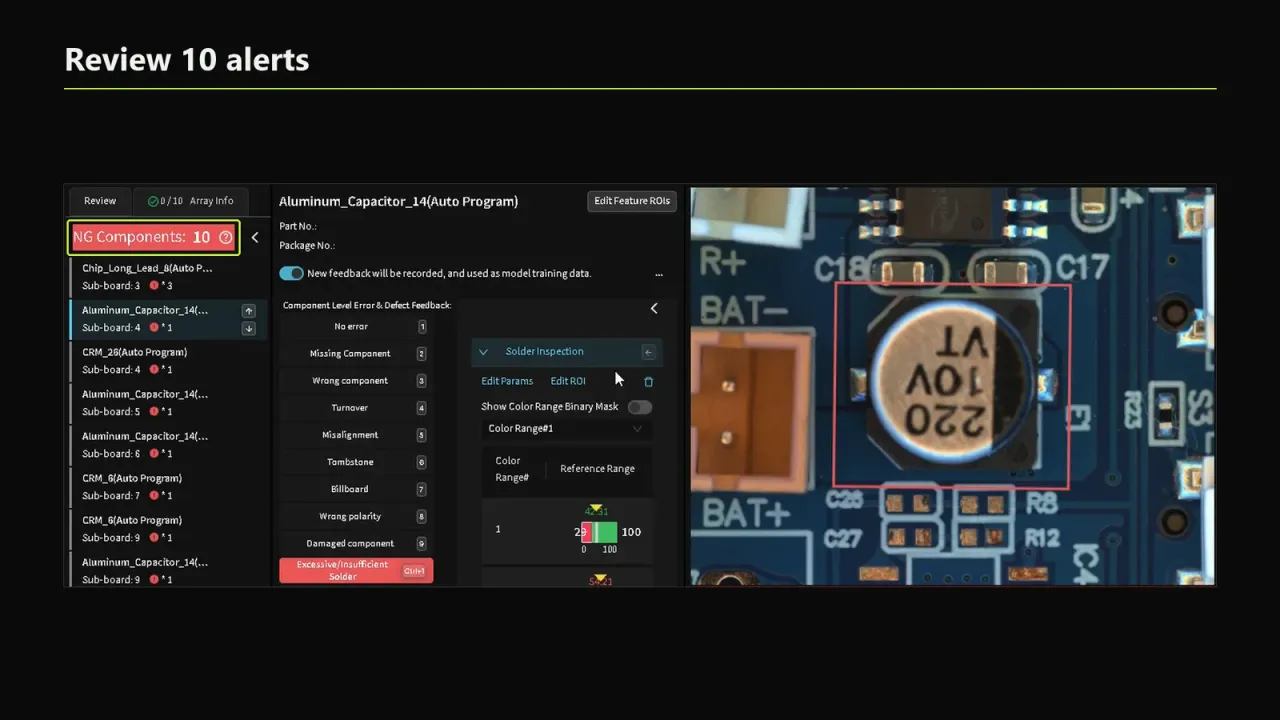
When a second supplier's part carries a different marking font or body color, an operator can mark it OK at the review screen. Feedback learning then teaches the model that this variation is acceptable across the component group, instead of loosening the check for every part. Recognized text is saved with the inspection results, which export to your MES as CSV.
These are the cases to test before you buy. Bring your worst samples, not your cleanest.
OCR reads text the machine has not been told about, such as a serial number. OCV checks that printed text matches what is expected at that position, such as a component part code.
AOI marking checks can flag components whose markings do not match the expected code or format, which is a common sign of remarked or wrong parts. They cannot prove authenticity alone; supplier control and lab analysis are still needed.
Define character equivalence groups so similar-looking characters, such as 0 and O or 8 and B, are treated as a match for that marking. DaoAI ships four default groups that you can adjust.
Yes. AOI can read 1D barcodes, QR codes, other 2D codes such as Data Matrix, and printed serial numbers and store them with each unit's inspection result, so every board can be traced later.
Marking performance is best judged on your own parts. Send us one of your own boards and we will test it for you, free of charge, including your faded, low-contrast or hard-to-read markings.
DaoAI vs Nordson YESTECH AOI: golden-board vs CAD-and-library programming, inline 3D, through-hole, on-machine AI, and how to test both on your boards.
7 octobre 2026
DaoAI vs CyberOptics (Nordson) SQ-series 3D AOI: golden-board vs library-based programming, inline 3D, through-hole, on-machine AI and how to test both.
7 octobre 2026
DaoAI vs ViTrox V510 3D AOI: how each handles AI programming without CAD, inline 3D, through-hole after wave, where the AI runs, and how to test both.
7 octobre 2026
Éclairages sur l’inspection par AI, actualités produits et analyses du secteur. Une fois par mois, sans superflu.
Nous utilisons vos coordonnées pour répondre à votre demande. Consulter notre Politique de confidentialité.