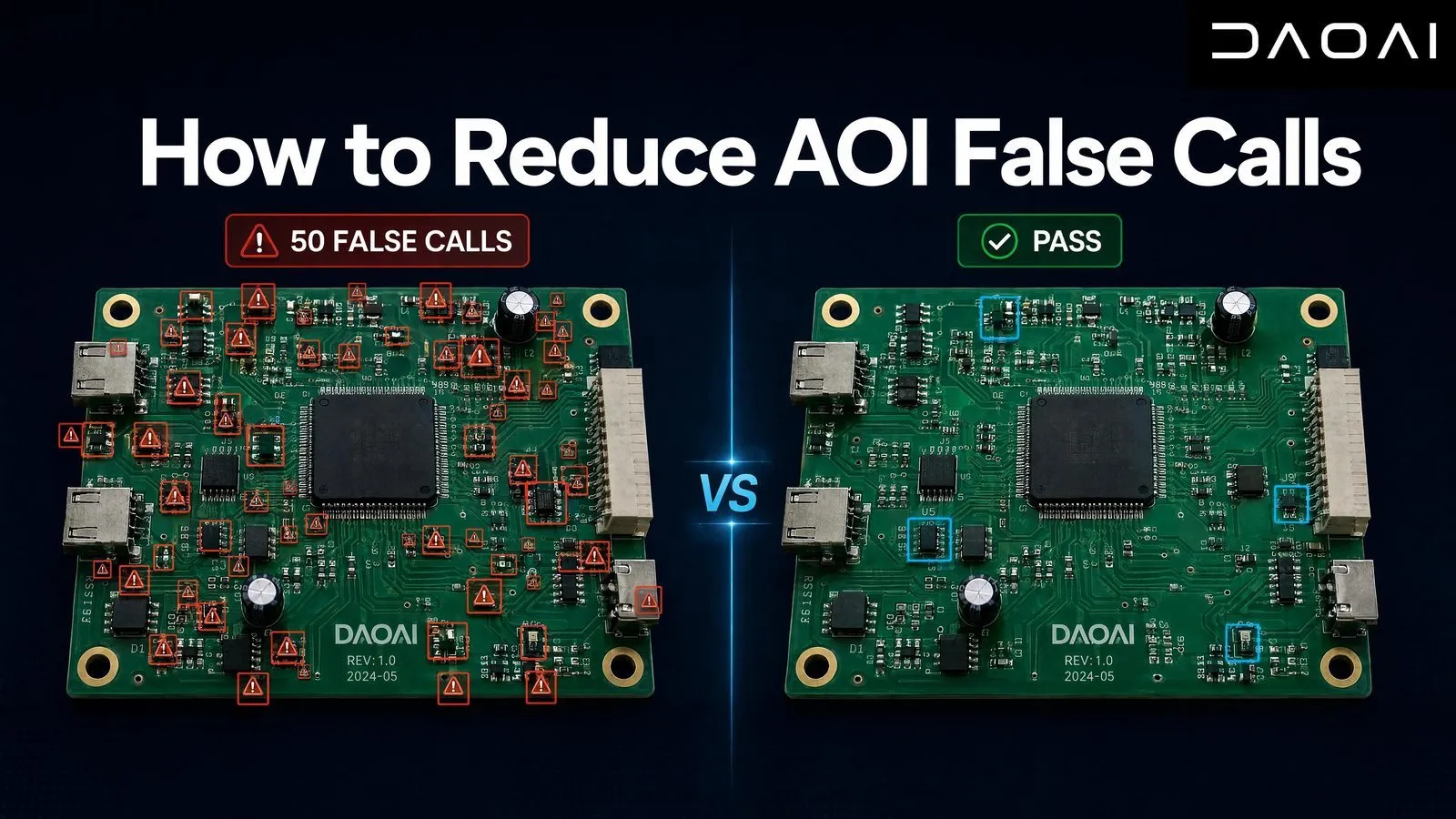
On an AI AOI, false calls drop when reviewed calls are fed back to the AI, but only if the reviews are right. An operator confirms each flagged part as a real defect or as a false call, and a programmer then runs an AI update that retrains only the inspection items that received new feedback. Good review habits make false calls fall without letting real defects through. Careless reviews do the opposite: a defect marked "OK" teaches the AI to pass it next time. This guide covers how to review calls, when to update, and the mistakes to avoid.
For the causes of false calls and the general fixes, see how to reduce AOI false calls. For how to measure them, see AOI metrics.
Why does the review step decide the false-call rate?
An AI AOI does not improve on its own as boards go by. It improves from confirmed examples. Every false call an operator confirms is a labeled example of an acceptable part that the AI misjudged. Every real defect an operator confirms stays a defect, so nothing is loosened by mistake. If nobody reviews, or reviews are rushed, there is nothing reliable to learn from. With good reviews and regular updates, the false-call rate can reach about 1% on a tuned program, depending on the board.
How does false-call review work on a DaoAI AOI?
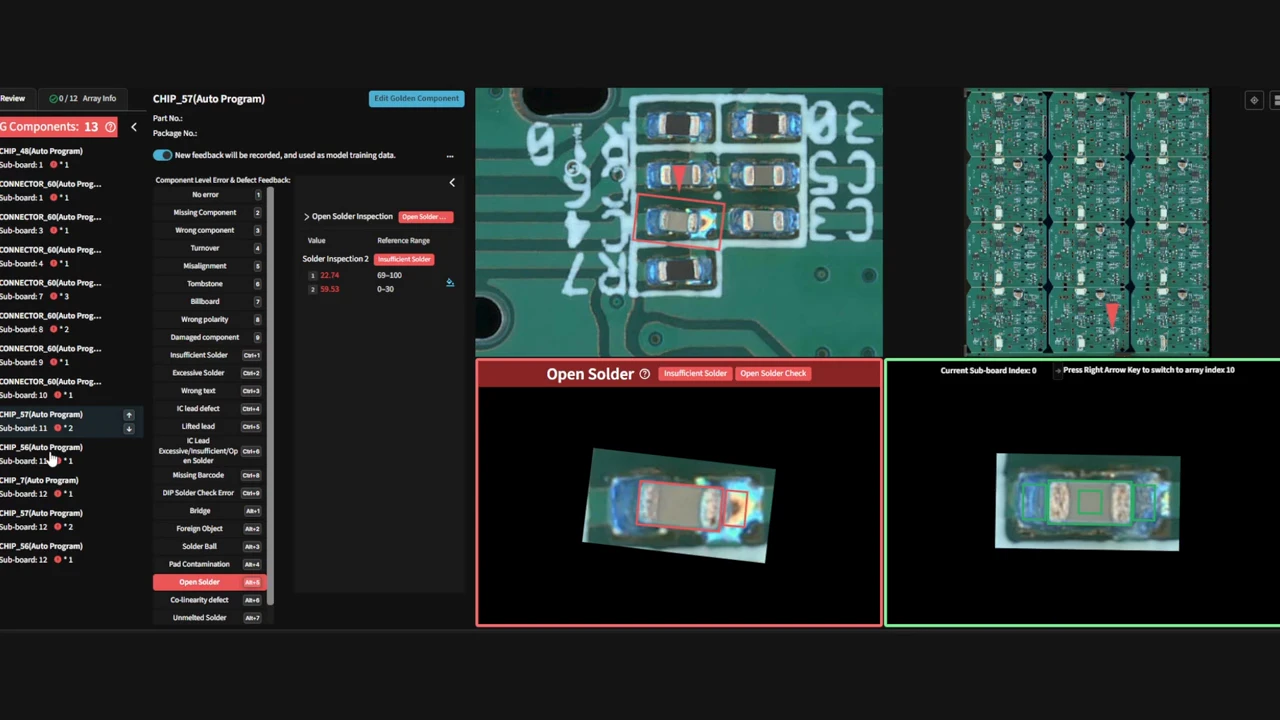
- The AOI flags parts. After inspection, the review screen lists the components the AOI judged NG, with images.
- The operator labels each call. Each flagged part is marked either as a specific defect type (for example missing, shifted or a solder defect) or as "No error", which records a false call.
- Optionally, the operator confirms the whole board. With second confirmation turned on, the operator also confirms the board as pass or fail, and the line can be set to wait for this before the next board is inspected.
- A programmer runs AI Update. One click retrains and regenerates parameters only for the inspection items that received new false-call feedback. Other inspection items, other products and parameters you tuned by hand stay as they are.
- The programmer checks the result. The next boards show whether the false calls on those items went down.
Who should review, and who should run updates?
Split the two jobs. Operators review and label, because they see every board. Running AI Update changes the program, so on DaoAI it is limited to programmer and administrator accounts. A short daily routine works well: operators label everything during the shift, and the programmer runs the update and checks the effect at a set time, for example after the first production boards of a new program and then once per shift or per day.
What rules should operators follow when labeling?
- Look before labeling. Confirm under magnification, or at the rework station, before calling anything "No error".
- When in doubt, do not mark it OK. Escalate it to the programmer or quality engineer. A false call costs seconds; an escape can cost a field return.
- Choose the correct defect type. A wrong defect type records the wrong problem for that component, so the report and the trend point the programmer at the wrong fix.
- Label every call, not just some. Unreviewed calls are not learned from, and they distort the false-call statistics.
- Use the same standard on every shift. Agree on borderline cases (for example a slightly offset part that is still within your acceptance class) and write them down.
What does an AI update change, and what does it not?
An AI update re-optimizes the inspection items that received new false-call feedback, for the current product only. It does not loosen a global threshold, and it does not touch the items nobody gave feedback on. Because it works on the whole inspection item, not on a single pin or joint, check the next few boards after each update: false calls on that item should drop, and the item should still catch real defects.
Some false calls are better handled in other ways:
- A new supplier makes the same part look different: accept it as an alternate part from the review screen and retrain.
- One part number or package keeps causing calls: tune its parameters directly. Parameters can be set per component, per part number or per package.
- The calls come from the board or the process (warp, flux residue, a reflow change): fix the cause. Retraining around a process problem only hides it.
How do you track whether false calls are going down?
The live screen shows yield, defect rate and false-call rate per component, and the data analysis report breaks results down by board and by component. Two habits keep the numbers honest:
- Review every call. A flagged part that nobody has reviewed yet counts as a false call on the live screen.
- Report the false-call rate both per board and per component, so boards with different part counts can be compared. The formulas are in AOI metrics.
All AI runs on the machine, and inspection images and results stay in your factory.
Which review mistakes make things worse?
- Marking real defects as "No error" to clear the screen: the AI learns to pass that defect.
- Running updates after one or two boards: collect the false calls from several boards first, so the AI learns the normal variation, not a single example.
- Never running updates: reviews alone do not change the program. Nothing improves until someone runs AI Update.
- Widening limits by hand to silence a call: this lets real defects through for every board, not only the one in front of you.
Frequently asked questions
How many boards should I review before running an AI update?
Several. Collect the false calls from a few boards first, so the update learns the normal variation of the part rather than one example, then check the next boards.
Does the AOI learn from false calls automatically?
Not by itself. Operators label each call in review, and a programmer then runs AI Update, which retrains only the inspection items that received new false-call feedback.
Can marking a call as OK cause escapes?
Yes, if the part was really defective: the AI learns to pass that defect. When in doubt, escalate the call instead of marking it OK.
Who can run an AI update on a DaoAI AOI?
Programmer and administrator accounts. Operators review and label calls; running the update changes the program.
How low can the AOI false-call rate go?
With good reviews and tuning, the false-call rate can reach about 1%, depending on the board.
Test it on your own board
Send us one of your own boards and we'll test it free of charge. Learn more about feedback learning.