
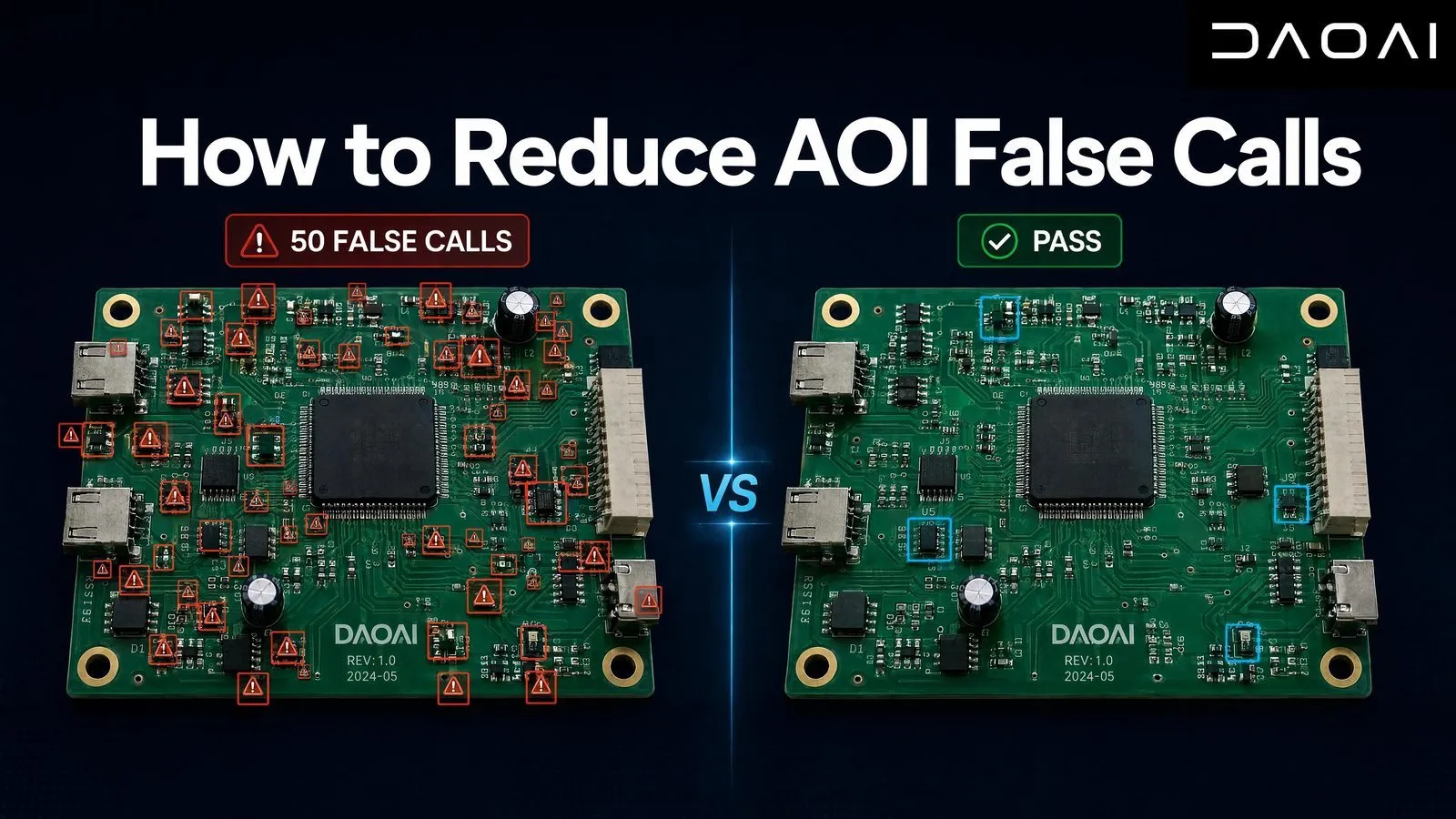
AOI 오검출(False Call) 줄이기: 근본 원인과 해결책
튜닝으로 잡을 수 있는 AOI 오검출과 임계값 계층 자체의 한계로 발생하는 오검출을 구분하고, 추가 튜닝 공수를 투입하기 전에 이를 명확히 판별하는 기준을 확인하십시오.
2026년 7월 28일
An AI AOI cuts false calls by learning from reviewed calls, so the review decides the result. Labeling rules, when to run an AI update, and the mistakes to avoid.
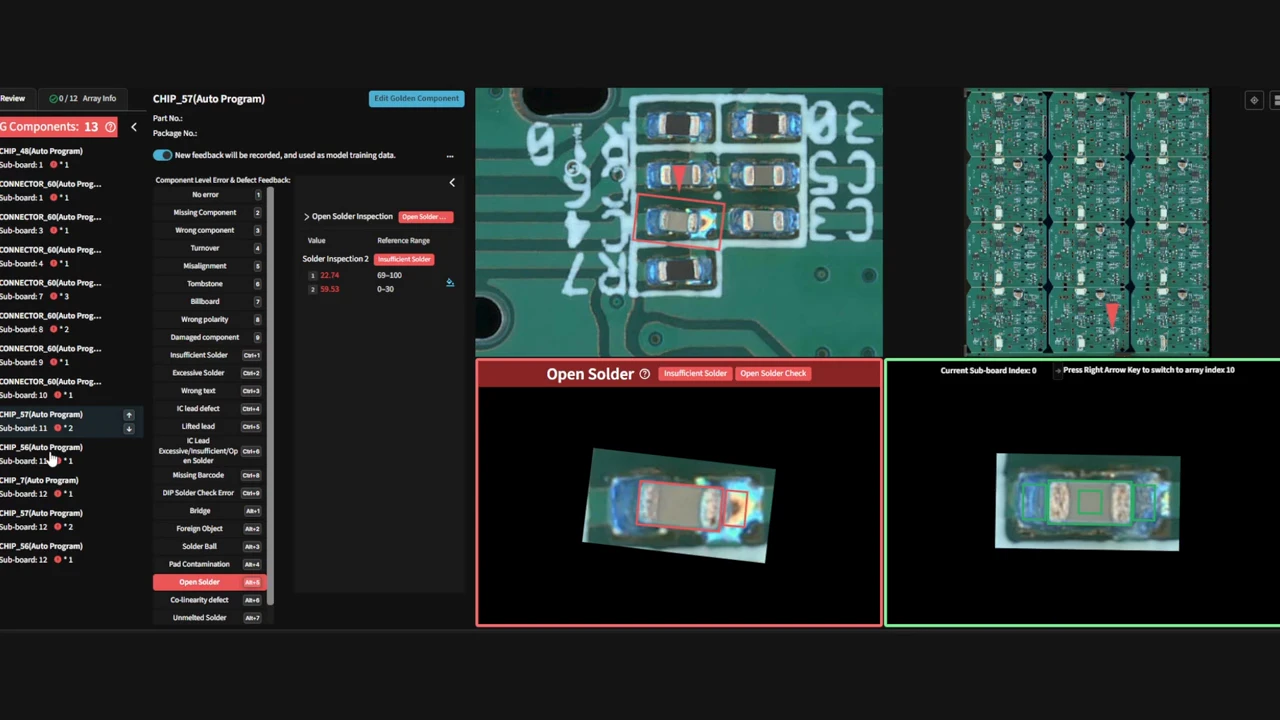
On an AI AOI, false calls drop when reviewed calls are fed back to the AI, but only if the reviews are right. An operator confirms each flagged part as a real defect or as a false call, and a programmer then runs an AI update that retrains only the inspection items that received new feedback. Good review habits make false calls fall without letting real defects through. Careless reviews do the opposite: a defect marked "OK" teaches the AI to pass it next time. This guide covers how to review calls, when to update, and the mistakes to avoid.
For the causes of false calls and the general fixes, see how to reduce AOI false calls. For how to measure them, see AOI metrics.
An AI AOI does not improve on its own as boards go by. It improves from confirmed examples. Every false call an operator confirms is a labeled example of an acceptable part that the AI misjudged. Every real defect an operator confirms stays a defect, so nothing is loosened by mistake. If nobody reviews, or reviews are rushed, there is nothing reliable to learn from. With good reviews and regular updates, the false-call rate can reach about 1% on a tuned program, depending on the board.
Split the two jobs. Operators review and label, because they see every board. Running AI Update changes the program, so on DaoAI it is limited to programmer and administrator accounts. A short daily routine works well: operators label everything during the shift, and the programmer runs the update and checks the effect at a set time, for example after the first production boards of a new program and then once per shift or per day.
An AI update re-optimizes the inspection items that received new false-call feedback, for the current product only. It does not loosen a global threshold, and it does not touch the items nobody gave feedback on. Because it works on the whole inspection item, not on a single pin or joint, check the next few boards after each update: false calls on that item should drop, and the item should still catch real defects.
Some false calls are better handled in other ways:
The live screen shows yield, defect rate and false-call rate per component, and the data analysis report breaks results down by board and by component. Two habits keep the numbers honest:
All AI runs on the machine, and inspection images and results stay in your factory.
Several. Collect the false calls from a few boards first, so the update learns the normal variation of the part rather than one example, then check the next boards.
Not by itself. Operators label each call in review, and a programmer then runs AI Update, which retrains only the inspection items that received new false-call feedback.
Yes, if the part was really defective: the AI learns to pass that defect. When in doubt, escalate the call instead of marking it OK.
Programmer and administrator accounts. Operators review and label calls; running the update changes the program.
With good reviews and tuning, the false-call rate can reach about 1%, depending on the board.
Send us one of your own boards and we'll test it free of charge. Learn more about feedback learning.
튜닝으로 잡을 수 있는 AOI 오검출과 임계값 계층 자체의 한계로 발생하는 오검출을 구분하고, 추가 튜닝 공수를 투입하기 전에 이를 명확히 판별하는 기준을 확인하십시오.
2026년 7월 28일
False call rate, escape rate and first pass yield describe how well an AOI performs, but only if everyone uses the same denominator. Formulas, measurement steps and what good looks like.
2026년 9월 28일
With CAD-free programming, the golden board is the only input the AOI needs, so a defect on it is learned as normal. How to choose, verify and prepare the board.
2026년 11월 5일
AI 검사 인사이트, 제품 소식, 산업 분석. 불필요한 정보 없이 월 1회.
문의에 답변하기 위해 입력하신 정보를 사용합니다. 개인정보 처리방침 확인.
