
วิธีประเมินระบบ AI AOI ก่อนตัดสินใจซื้อ
ตัวเลขความแม่นยำของผู้ขายไม่มีความหมายจนกว่าคุณจะทำซ้ำได้บนบอร์ดของตัวเอง บอร์ด 6 แผ่นที่ต้องเตรียม สิ่งที่ต้องวัด 5 อย่าง และเกณฑ์ผลลัพธ์ที่ถือว่าผ่าน
11 สิงหาคม 2569
A sourced comparison of DaoAI and Viscom iS6059 3D AOI: programming inputs, 3D metrics (kept separate where they differ), AI verification and data handling, plus a checklist for testing both on your own boards.
DaoAI is an alternative to Viscom's iS6059 3D AOI: its machines build an inspection program from one verified golden board in 30 seconds to 5 minutes, without CAD files or a prebuilt component library, and its P5 and P5D inline 3D machines are available for delivery now. According to Viscom's published materials, vAI ProVision generates AOI programs from E-CAD data and a database of inspection strategies, and vAI verification uses deep learning to review defect calls. Sources are linked at the end.
| Topic | DaoAI (per daoai.com) | Viscom (iS6059, vVision/vAI, per vendor materials) |
|---|---|---|
| Programming inputs | One verified golden board; AI auto-programming in 30 s to 5 min. CAD/BOM optional; it adds designators and part numbers only. Auto-programming does not require a prebuilt component library. | vVision/EasyPro with global libraries. vAI ProVision generates AOI programs "in minutes" from E-CAD data and Viscom's database of inspection strategies, then optimizes them with AI. |
| 3D method and views | P5 and P5D inline 3D: four structured-light projection units, one per direction. | iS6059 PCB Inspection: one orthogonal plus eight angled cameras. iS6059 PCB Inspection Plus: XMplus-II 3D camera, nine views. |
| Height measurement range | 25 mm (P5, P5D). | Z-range up to 30 mm (iS6059 PCB Inspection). |
| Z-resolution (vendor-stated) | Not published as a Z-resolution figure. | 0.5 µm (iS6059 models). |
| Height accuracy (vendor-stated) | ≤ 6 µm with the calibration tool (P5, P5D). | Not stated on the pages reviewed. |
| AI features | Per-component AI scoring, feedback learning from operator reports, custom model training on the machine. | vAI: AI-based verification trained on "millions of qualified images" plus customer data; AI-supported image processing; AI-assisted inspection plan creation (NPI). |
| Offline options | P1, P1L (680 × 510 mm) and P2 offline machines with the same software. | Desktop AOI for prototypes and medium lot sizes (S2088-II F, 2D, boards up to 600 × 457 mm); offline programming station. |
| Through-hole (THT) | A3: one machine performs pre-wave and post-wave inspection and can inspect both sides of the board. P3 and P5 also support DIP/through-hole inspection. | iS6059 THT Inspection: 3D inspection of the board underside after wave or selective soldering. |
| Deployment and data | All models run on-premise with no internet connection required. Remote support is optional and off unless the customer enables it; the system has no backdoor access. | AI plan creation runs inside vVision's program editor. Check with the vendor on where vAI verification models are trained. |
Z-resolution (the smallest height step a sensor resolves) and height accuracy (how close a measured height is to the true height) are different metrics and are not directly comparable. DaoAI hardware figures are reference (typical) values from daoai.com, not guaranteed limits; Viscom figures are as stated in its published materials.
According to Viscom, vAI ProVision, part of vVision, creates AOI programs from E-CAD data, drawing on templates and a database of inspection strategies that AI then optimizes. Its AI-assisted plan creation identifies component and solder joint types and assigns inspection patterns, which Viscom positions for prototypes and high-mix work.
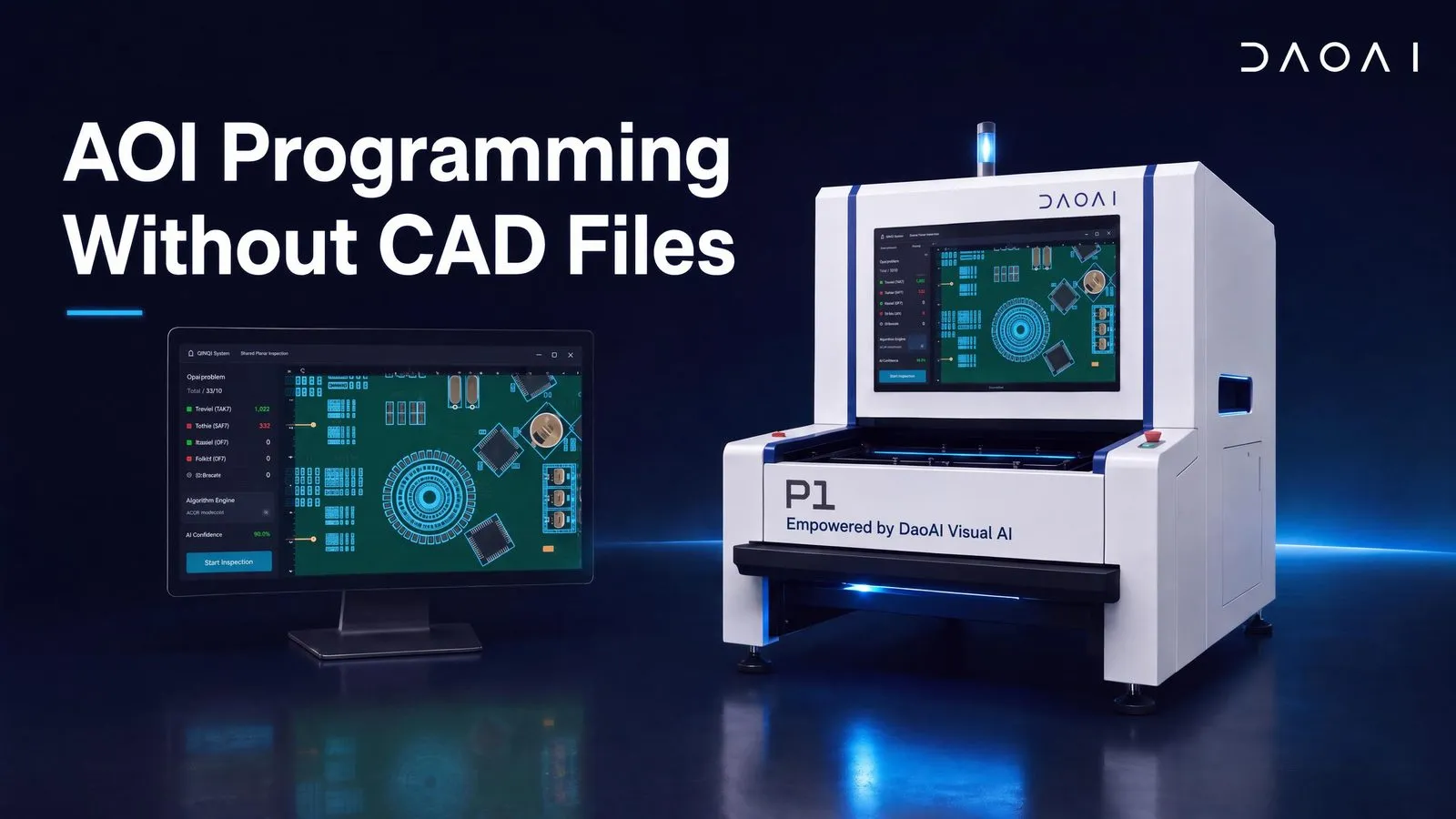
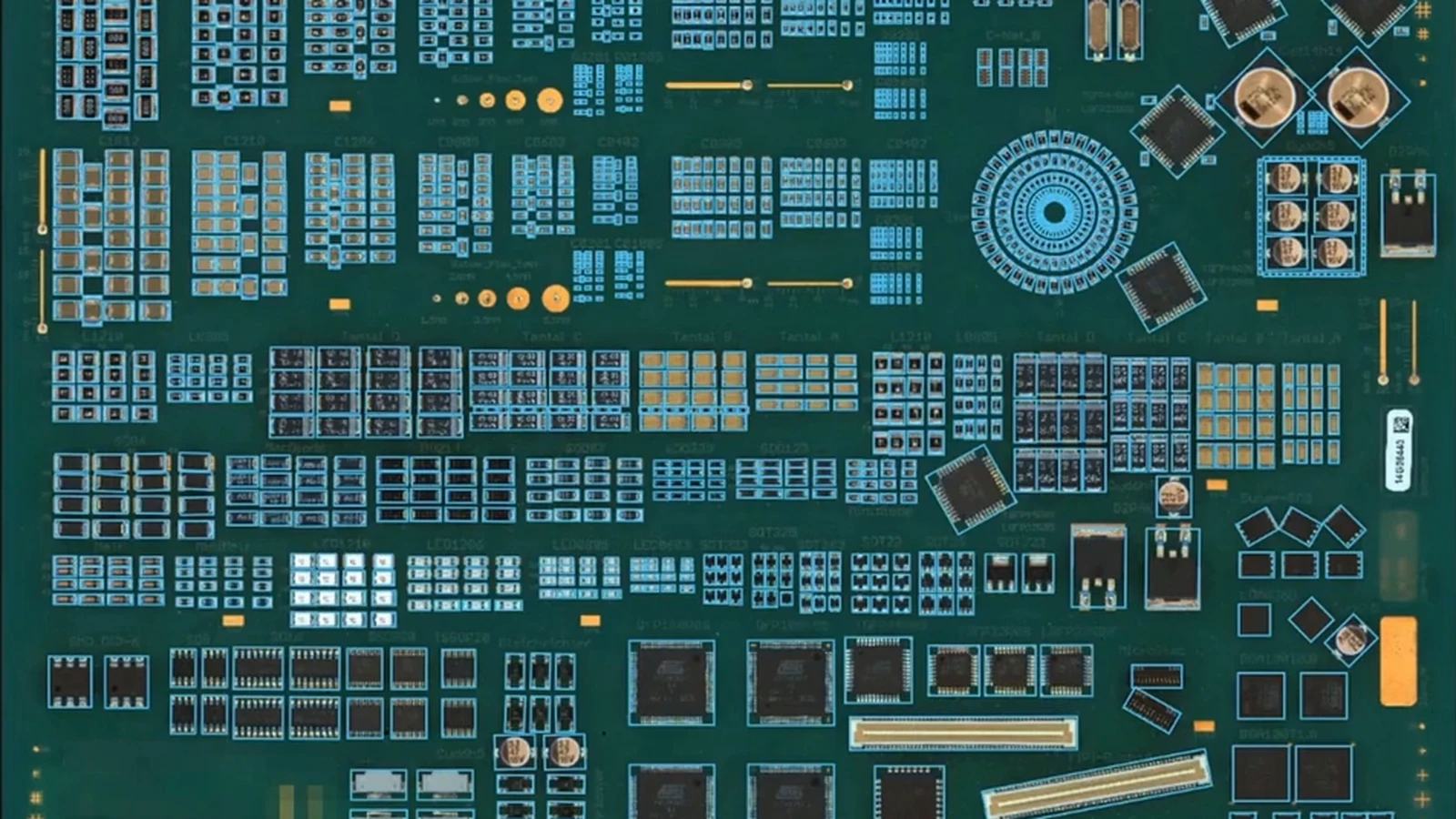
DaoAI starts from the board instead of the design data. The machine images one verified golden board, detects and models every component, draws the inspection windows and sets thresholds. CAD or BOM data can be imported at any time to add designators and part numbers, and it does not change what is detected. A package the system has never seen is modelled from the board, so nothing has to be added to a library first.
If boards arrive before the CAD data, or the data is incomplete, golden-board programming removes the wait. See AOI programming without CAD files and how to cut AOI changeover time.
Viscom's AI-based verification compares the AI's decision with the operator's under a "four-eyes principle", and in a second mode reclassifies clear false alarms automatically. Viscom says the model is trained with millions of qualified images from real production environments, supplemented with customer data, and each model comes with a vAI Quality Report.
DaoAI takes a local route with feedback learning. An operator marks a call OK or NG at the machine, and an AI update retrains the model on that example rather than loosening a threshold. Manual settings are kept, updates can be undone, and training data stays on the machine. DaoAI states the false-call rate can reach about 1% after tuning; it depends on the board and process. For product-specific defects, engineers can train their own model offline, starting from a foundation model trained on more than 1,000,000 real production images.
According to Viscom, its inline 3D systems perform IPC-compliant 3D assembly inspection with angled-camera views, and its range also includes bottom-side THT inspection and desktop AOI.
DaoAI covers 16 inspection capabilities across components, solder joints and leads, markings, barcodes (1D, QR and Data Matrix), through-hole joints and the whole board. The whole-board pass looks for solder balls and foreign objects on bare laminate, outside any component window. Machines span offline 2D (P1, P1L, P2), inline 2D (P3, P3D), inline 3D (P5, P5D) and through-hole (A3), all on the same core software.
Over a machine's life, these usually cost more than the purchase price:
Run the same boards through both systems under the same conditions and record results side by side (see how to evaluate an AI AOI system before you buy):
No. DaoAI programs from one verified golden board in 30 seconds to 5 minutes, and auto-programming does not require a prebuilt component library. CAD or BOM data is optional and only adds designators, part numbers and grouping.
No. All DaoAI models run on-premise with no internet connection required, and model training runs offline on the machine. Remote support is optional and off unless the customer enables it; the system has no backdoor access.
Yes. The A3 performs pre-wave and post-wave inspection in one machine and can inspect both sides of the board. The P3 and P5 also support DIP/through-hole inspection.
Yes. The P5 and P5D inline 3D machines are available for delivery now.
Competitor information was checked on the pages below on September 27, 2026. Specifications and features change; confirm details with the vendor.
With DaoAI, you can create an inspection program from one verified golden board without CAD files or a prebuilt component library. For inline 3D inspection, the P5 is available for delivery. Send us your board to evaluate programming time, inspection coverage and false-call review workload.
ตัวเลขความแม่นยำของผู้ขายไม่มีความหมายจนกว่าคุณจะทำซ้ำได้บนบอร์ดของตัวเอง บอร์ด 6 แผ่นที่ต้องเตรียม สิ่งที่ต้องวัด 5 อย่าง และเกณฑ์ผลลัพธ์ที่ถือว่าผ่าน
11 สิงหาคม 2569
ไม่ต้องใช้ไฟล์ CAD ไม่ต้องมีไลบรารีชิ้นส่วน — การเขียนโปรแกรม AI ด้วย golden-board ทำงานจริงอย่างไรทีละขั้นตอน พร้อมการเปรียบเทียบกับเวิร์กโฟลว์ AOI แบบดั้งเดิมที่ใช้เวลา 3–5 ชั่วโมง
21 กรกฎาคม 2569
DaoAI vs Nordson YESTECH AOI: golden-board vs CAD-and-library programming, inline 3D, through-hole, on-machine AI, and how to test both on your boards.
7 ตุลาคม 2569
ข้อมูลเชิงลึกด้านการตรวจสอบด้วย AI ข่าวผลิตภัณฑ์ และบทวิเคราะห์อุตสาหกรรม เดือนละครั้ง เน้นสาระ
เราใช้ข้อมูลของคุณเพื่อตอบกลับข้อซักถามของคุณ ดูนโยบายความเป็นส่วนตัวของเรา