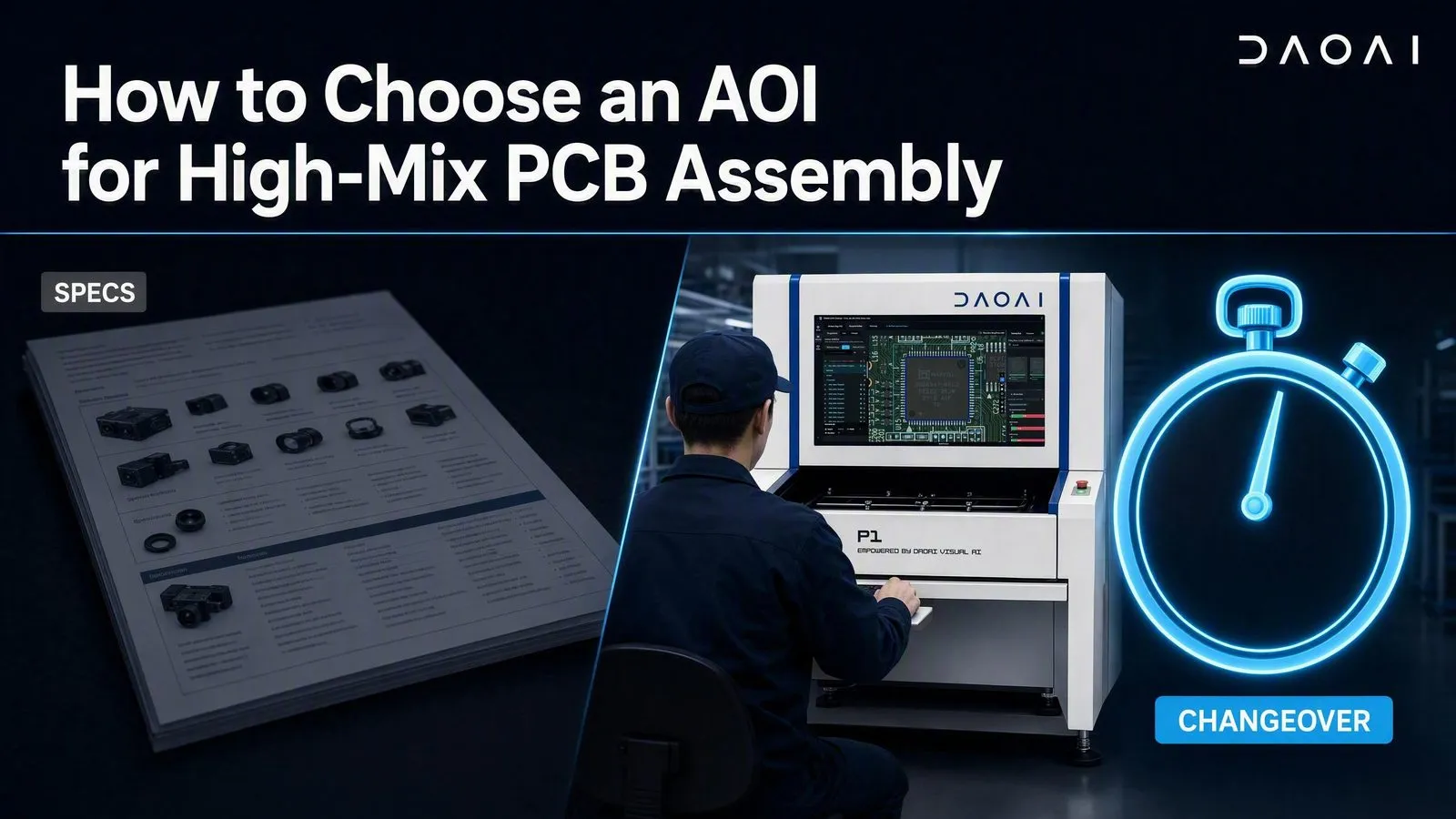
Choose offline AOI when your product mix changes often, runs are short, or you need inspection for NPI and rework away from the SMT line. Choose inline 2D AOI when volume justifies inspecting every board at line speed without an operator loading it, and choose inline 3D AOI when height-driven defects such as lifted leads, coplanarity and solder volume are the ones that escape. Board size, the number of conveyor lanes and whether you run through-hole parts narrow the choice from there. DaoAI covers all three on the same core software: offline 2D (P1, P1L, P2), inline 2D (P3, P3D) and inline 3D (P5, P5D), plus the A3 for through-hole, each programmed from one golden board in 30 seconds to 5 minutes.
What is the difference between offline, inline and 3D AOI?
The three categories differ in how the board gets to the camera and in what the camera measures. The inspection logic, on DaoAI machines at least, is the same software across all of them.
- Offline AOI sits beside the line. An operator loads each board by hand, the machine clamps it, inspects it and hands it back. No conveyor integration is needed.
- Inline 2D AOI sits in the SMT conveyor, usually after reflow. Boards flow in and out automatically, and failed boards can be routed without an operator.
- Inline 3D AOI is inline AOI with a height sensor added. It measures component and joint height rather than inferring it from reflected light.
Through-hole lines add a fourth case: inspection before and after wave soldering, covered at the end of this guide.
How do production volume and product mix change the answer?
Volume decides whether hand-loading is acceptable. If a line builds a few dozen boards per job, an operator can load each board into an offline machine without becoming the bottleneck. When the line runs hundreds or thousands of identical boards per shift, inline handling removes that labor and keeps inspection at line pace.
Mix decides how much programming time you can afford. On a rule-based AOI, each new board variant needs hours of programming and tuning, which is why many high-mix shops end up running AOI on only their largest jobs. With AI auto-programming from one golden board in 30 seconds to 5 minutes, programming stops being the deciding factor, and the offline-or-inline choice comes down to throughput and floor space.
A useful rule of thumb:
- High mix, low volume, NPI, labs: offline. The machine also keeps working when the line is down or changing over.
- Medium to high volume, stable products: inline 2D.
- High reliability, fine-pitch or height-sensitive parts: inline 3D.
- Mixed shop: inline on the high-volume line, plus an offline machine for NPI and short runs. Offline programming lets you build a program on one machine and import it on another.
What board size and thickness do you need to cover?
List the largest board and panel you build today and the largest you expect to quote in the next few years. Max board size cannot be tuned around, so check it first. DaoAI's published hardware figures are reference values; confirm them on your own boards.
In the DaoAI range, the P1 and P2 take boards from 50 × 50 mm to 470 × 330 mm. The P1L extends offline inspection to 680 × 510 mm for large boards. Inline, the single-track P3 and P5 take up to 500 × 600 mm, while the dual-track P3D takes up to 500 × 325 mm per track and the P5D up to 500 × 300 mm per track.
Check thickness and clearance too. The P3 and P3D accept boards from 0.3 to 6 mm thick with 30 mm top and 20 mm bottom clearance; the P5 and P5D accept 0.6 to 5 mm with component height up to 50 mm on top and 40 mm below. Thick backplanes and tall electrolytic capacitors are the usual edge cases.
When do you need 3D AOI height measurement?
A 2D machine infers height from how multi-angle light reflects off a part. That works well for presence, offset, polarity, bridges and most solder fillets, but it is an inference.
3D AOI projects structured-light patterns and measures a height map. That turns lifted leads, tilted bodies, coplanarity and solder volume into measured values. DaoAI's P5 and P5D use four Scheimpflug structured-light projection units, one per direction, with height accuracy of 6 µm or better using the calibration tool and a 25 mm measurement range.
3D is worth it when:
- You build fine-pitch gull-wing ICs, connectors or other parts where a lifted lead can pass a 2D check.
- Your customers are in automotive, industrial or other high-reliability markets where coplanarity must be demonstrated, not assumed.
- Field returns or ICT failures trace back to joints that looked fine from above.
If none of those apply, a 2D machine with good lighting and a well-trained model usually covers the defect list at lower cost. Either way, golden-board programming and feedback learning work the same on 2D and 3D models.
Single track or dual track?
Dual-track machines inspect two lanes of boards through one machine. They make sense when your placement line is already dual-lane, or when a single-lane AOI would become the slowest step in the line.
The trade-off is board size. The P3D uses the same optics as the P3 but takes up to 500 × 325 mm per track instead of 500 × 600 mm. The same applies to the P5D against the P5. If a large board runs on your dual-lane line, check it against the per-track limit.
Which DaoAI machine fits which scenario?
| Scenario | Machine | Camera / resolution | Max board | Handling |
|---|
| High-mix, short runs, NPI, labs, rework | P1 | 5 MP, 15 µm/px | 470 × 330 mm | Offline, manual load, auto-clamp |
| Large boards, offline | P1L | 5 MP, 15 µm/px | 680 × 510 mm | Offline, manual load, auto-clamp |
| Offline with finer imaging detail | P2 | 12 MP, 10 µm/px | 470 × 330 mm | Offline, manual load, auto-clamp |
| Inline, every board inspected, single lane | P3 | 26 MP global shutter, 10 µm/px, 51 × 51 mm FOV | 500 × 600 mm | Inline, single track |
| Inline, dual-lane or high throughput | P3D | 26 MP global shutter, 10 µm/px, 51 × 51 mm FOV | 500 × 325 mm per track | Inline, dual track |
| Height-sensitive, high-reliability boards | P5 | 21 MP, 10 µm optical; 3D height ≤ 6 µm | 500 × 600 mm | Inline, single track |
| 3D inspection on a dual-lane line | P5D | 21 MP, 10 µm optical; 3D height ≤ 6 µm | 500 × 300 mm per track | Inline, dual track |
| Through-hole, pre-wave and post-wave (one machine, both sides) | A3 | 26 MP color, 18 mm lens | 420 × 420 mm | Bench-top straddle over existing line |
For 0201 or 01005 chips (imperial sizes), the inline 2D machines list 0201 and 0.3 mm pitch ICs as the smallest components, with 01005 as an option. The 3D machines list 0603 metric (0201 inch). Every model includes auto-programming, feedback learning, model training and offline operation as standard; the machines differ in optics and handling.
The P5 and P5D inline 3D machines are available for delivery now. Their listed specifications, like those of every model in the range, are reference values rather than guaranteed limits.
What about through-hole and wave-soldered boards?
Through-hole assemblies need two checks that SMT AOI does not cover: before the wave, that every part is present, correct, the right way round and inserted; after the wave, that each joint is properly soldered and not bridged.
DaoAI's A3 is built for this. One A3 performs both pre-wave and post-wave inspection and can inspect both sides of the board. It sits as a bench-top unit straddling the existing wave line, with adjustable height and width, so no line modification is needed. The P3 and P5 also support DIP/through-hole inspection.
How should budget factor into the choice?
Hardware price is only one part of the cost. In general, offline machines cost less than inline ones, and 3D costs more than 2D. The bigger variables are labor and engineering time.
- Loading labor: an offline machine needs an operator at the machine for every board. Price that against an inline conveyor.
- Programming time: hours per new board on a rule-based machine, multiplied by your new part numbers per month, is often larger than the price difference between models.
- False-call review: every false call costs operator time, and a machine that cries wolf gets ignored.
- Paid options: ask which software features cost extra. On DaoAI machines, auto-programming, feedback learning and fully local operation are included on every model, not sold as add-ons.
Our AOI ROI and payback guide walks through the math with your own numbers.
FAQ
Is offline AOI good enough for production?
Yes, when volume allows an operator to load each board. Offline AOI is common for high-mix, low-volume production, NPI, prototypes and rework verification, and it runs the same inspection software as inline machines on DaoAI's range.
Do I need 3D AOI if I already have SPI?
SPI measures solder paste before placement; 3D AOI measures components and joints after reflow. They catch different defects, so SPI does not replace 3D AOI for lifted leads or coplanarity.
Is inline 3D AOI worth it for two SMT lines?
It depends on what escapes today. If lifted leads, coplanarity or solder-volume defects reach test or the customer, inline 3D on the line that builds those boards is usually worth it; if escapes are mostly presence, polarity and offset, inline 2D covers them at lower cost. Many two-line shops put 3D on the line that builds height-sensitive or high-reliability boards and 2D on the other. DaoAI's P5 (single track) and P5D (dual track) inline 3D machines are available for delivery now, and the P3 and P3D cover inline 2D on the same core AI software, so operators use one workflow on both lines.
What is the difference between single-track and dual-track AOI?
A dual-track machine inspects two lanes of boards through one machine for higher throughput. The maximum board size is set per track, so it is usually smaller than on the single-track model.
Can I program inline AOI without stopping the line?
Yes. DaoAI supports offline programming: build the program on a machine away from the line, export it, and import it on the production machine.
Board size, mix and cycle time decide the right machine better than any table. Send us one of your own boards and we will test it for you, free of charge, or book a demo and an engineer will tell you which machine it needs.