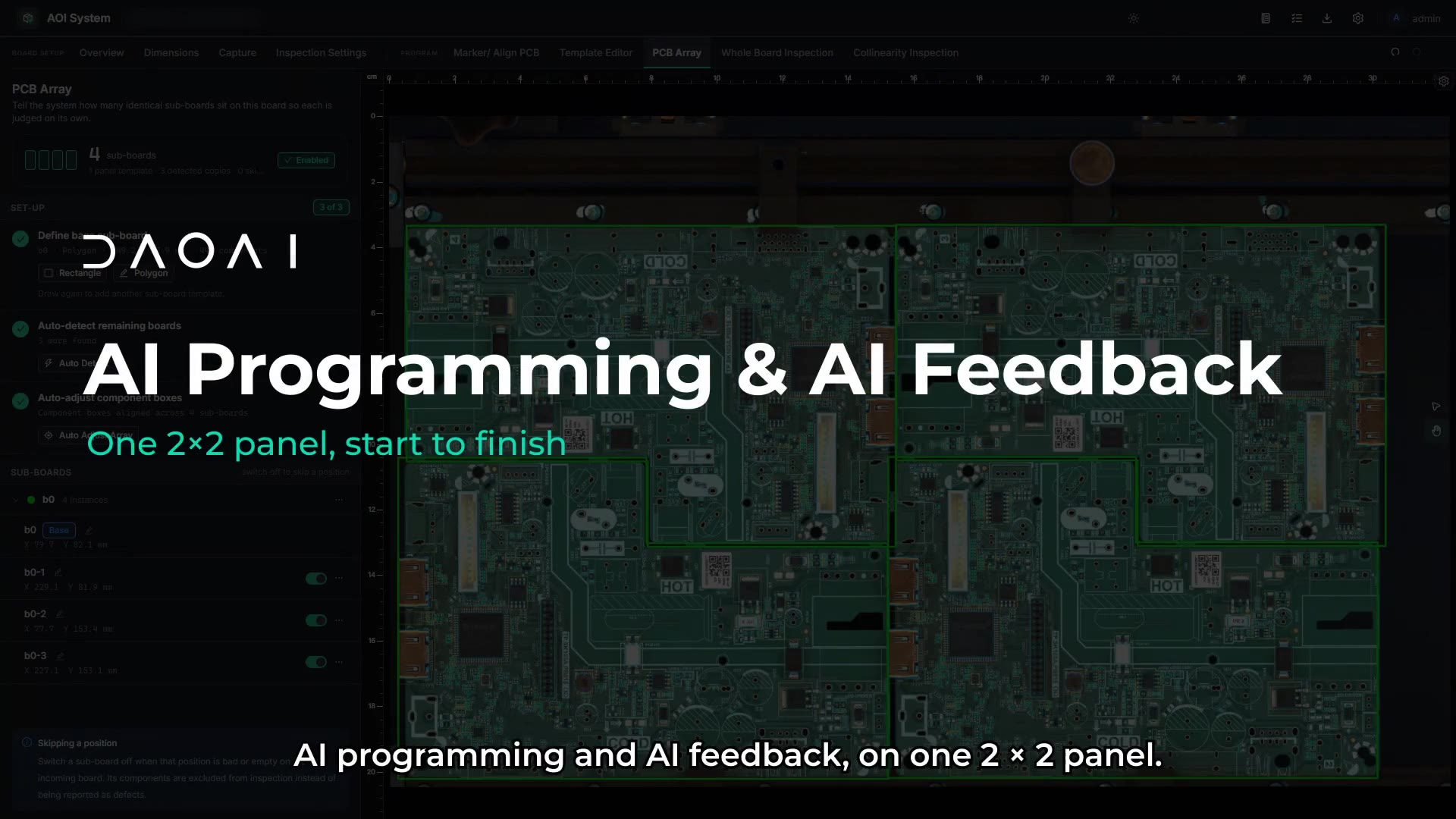
2:21 · AI Programming on a 2×2 panel, then AI Feedback from 1:41.
What is automated optical inspection (AOI)?
Automated optical inspection is a camera-based check of an assembled board. The machine images the PCBA under controlled lighting, compares what it sees with what should be there, and flags components or joints that fall outside the acceptance criteria.
AOI catches defects that are visible from above: missing, wrong, shifted or rotated parts, reversed polarity, tombstoning, solder bridges, insufficient or excess solder, lifted leads and open joints. It cannot see joints hidden under BGA or QFN bodies. That is the job of automated X-ray inspection (AXI).
An AOI does not repair anything. It sorts boards into pass and fail and shows the operator an image behind every call. Its value comes down to two numbers: how many real defects it catches, and how many good parts it flags as bad (false calls).
How does traditional rule-based AOI work?
A rule-based AOI inspects each component with a program that an engineer builds by hand. The program typically rests on four inputs.
- CAD or centroid data. X/Y positions, rotations, designators and part numbers from the design files tell the machine where each part should sit.
- A component library. Every package, from an 0402 chip to a 64-pin QFP, needs a library entry describing its body, leads and pads. New packages are added by hand and must be kept correct from then on.
- Inspection windows. The engineer places boxes over each body, lead, pad and gap where a bridge could form. Each window runs an algorithm such as template matching, color ratio, edge detection or OCR.
- Thresholds. Every window has pass/fail limits. These are tuned against a golden board, then retuned against real production variation, one parameter at a time.
This approach works, and many high-volume lines run it well. The cost is engineering time: DaoAI's own comparison puts initial programming on a rule-based machine at 3 to 5 hours per board variant, and several days for a board with thousands of components.
The second cost shows up in production. When a good joint gets flagged, the quickest fix is to widen the threshold. That silences the false call, but it also widens the accept band for every part judged by that parameter, which is how real defects start to slip through.
What changes with AI AOI?
AI AOI keeps the optics but replaces most of the hand-built program with learned models. Four differences matter on the shop floor.
1. Auto-programming from one golden board
Instead of starting from CAD and a library, the machine images one known-good board, finds every component, and generates the inspection windows and thresholds itself. On DaoAI machines this takes 30 seconds to 5 minutes, with 98% detection accuracy straight out of auto-programming, before any tuning.
DaoAI auto-programming does not require a prebuilt component library, and CAD or BOM data is optional. That data adds real designators and part numbers for MES export and repair sheets, but it does not change what is detected or how it is judged. See how AI auto-programming works.
2. Learned models instead of pixel rules
A rule-based window compares pixels against a template or a color range. A learned model scores the component or joint as a whole, based on many examples of good and defective parts.
DaoAI's models start from a visual foundation model trained on more than 1,000,000 real production images, then adapt to your board. That is why a second supplier's slightly different body color or marking font does not have to trigger a call, while a lifted lead still does.
3. Whole-board inspection
Every conventional check runs inside a window around a component. A solder ball sitting on bare laminate, or a wire clipping between two parts, falls inside none of them.
AI AOI can add a pass that looks at the board between components for solder balls, particles and foreign object debris (FOD), not only at the regions around each part.
4. Feedback learning
When an operator marks a false call as OK, an AI system can add that image to the product's dataset and retrain, instead of widening a threshold. The model learns what an acceptable variant looks like, and a real defect near the same score is still caught.
With this approach, DaoAI's false call rate can reach about 1% after tuning on a product. Details are on the feedback learning page.
What else does a modern AI AOI cover?
Beyond auto-programming and feedback learning, a modern AI AOI brings these checks and production tools into the same workflow.
Panel and array inspection
Panel and array inspection lets you program one board and inspect the whole panel: rows, columns and spacing are read from the image, with every sub-panel reported on its own. The demo above shows a 2×2 panel.
AI OCR & OCV for component markings
AI OCR & OCV handle component markings in the inspection program. OCR reads print it was not told about, such as a serial number; OCV confirms that the expected marking is present and correct.
Open solder joint detection
Open solder joint detection uses a pretrained 2D AI model for visible open-solder defects. Fine-tune it locally with your own samples to adapt it to your production.
Custom defect models
Custom defect models can be trained offline, on the machine, using your own images. This lets you build models for defects specific to your product.
Full engineering control
Full engineering control keeps 21 settings across six areas editable. Your manual settings survive every AI reprogram, and locked parameters stay at the values you choose.
Production integration
Production integration includes MES export and Cpk quality analysis. A dedicated repair station screen and line handling connect inspection to the rest of the production workflow.
Coverage
Inspection coverage includes 16 inspection capabilities, selected per package type. These checks all run on the auto-generated program.
The DaoAI lineup includes offline P1, P2 and large-format P1L; inline 2D P3 and dual-lane P3D; inline 3D P5 and P5D, available for delivery now; and A3 for through-hole component inspection only—missing, wrong, reversed and misplaced through-hole parts.
An AOI is production equipment, not just an algorithm
A strong model on its own does not make a good AOI. The machine has to be running on a new product quickly, simple enough for operators on every shift, and able to keep up as materials, suppliers and board revisions change. Judge any AI AOI on those three things together: fast setup, stable calls under real lighting and material variation, and a feedback loop that keeps improving the model after go-live.
Rule-based AOI vs AI AOI: how do they compare?
| Aspect | Rule-based AOI | AI AOI (DaoAI example) |
|---|
| Programming input | CAD/centroid file, component library, hand-placed windows | One golden board; CAD/BOM optional |
| Programming time per new board | 3–5 hr; several days for boards with thousands of parts | 30 s – 5 min |
| New package type | Added to the library by hand first | Detected and modelled from the board |
| How a part is judged | Pixel, template or color rules per window | Trained model scores each component; threshold set against the scores |
| Accuracy before tuning | Depends on the programmer | 98% detection accuracy from auto-programming |
| Reducing false calls | Loosen the threshold, which also passes real defects | Mark OK once; the model retrains on the example |
| Area between components | Not inspected unless a window is drawn | Whole-board pass for solder balls and FOD |
| Who can make a correction | Whoever holds the threshold knowledge | Any operator can report; permissions control program edits |
| Where board images stay | On the machine | On the machine; no cloud connection or account needed |
| Panels and arrays | Program each board position or step-and-repeat by hand | Program one board; the panel layout is read from the image |
| Component markings | Separate OCR set-up per part | AI OCR & OCV in the same program |
| Product-specific defects | Wait for the vendor or write a custom rule | Train your own model on the machine |
Where does AOI fit in the SMT line?
A typical SMT line runs: stencil printer, solder paste inspection (SPI), pick-and-place, reflow oven, AOI, then test. Post-reflow is the standard AOI position, but AOI can sit at several points along the line, and X-ray (AXI) is added where hidden joints matter. For a side-by-side of the three methods, see AOI vs SPI vs AXI.
- After printing: SPI measures paste volume, height and area. It is a separate machine, not AOI, but it prevents many solder defects that AOI would otherwise find later.
- Before reflow: an optional AOI catches placement errors while a part can still be nudged by hand.
- After reflow: the most common position. The machine sees placement and solder quality together on the finished joint.
- Before and after wave soldering: through-hole boards get a pre-wave check for insertion and polarity, and a post-wave check for joints and bridges.
- Offline, beside the line: manual-load machines for NPI, prototypes, short runs, labs and rework verification.
Choosing between those formats is a separate decision. Our guide to offline vs inline vs 3D AOI walks through when each one fits.
AOI results are most useful when they flow onward. Defect codes, crop images and whole-board images exported to MES let the repair station and quality engineers trace any call to a specific board and position.
What is the difference between 2D and 3D AOI?
2D AOI works from color images taken under multi-angle lighting. It infers shape from how light reflects off a joint or body, which is enough for presence, polarity, offset, bridges and most solder fillet checks.
3D AOI adds a measured height map, usually by projecting structured-light patterns from several directions. Lifted leads, coplanarity, tilted bodies and solder volume become measurements instead of inferences. DaoAI's P5, for example, uses four Scheimpflug structured-light projection units, one per direction, with height accuracy of 6 µm or better (a reference specification). The P5 and dual-track P5D are available for delivery now.
3D earns its extra cost when height-driven defects actually reach your customers: fine-pitch gull-wing ICs, connectors and high-reliability assemblies. For many boards, a well-programmed 2D machine covers the defect list.
What should you ask an AOI vendor?
- What does programming need before the first board runs? CAD, a component library, defect samples, or only a good board?
- How long does a new board take, measured on one of my boards? Ask to watch it, not to read a brochure number.
- How are false calls reduced? By widening thresholds, by the vendor retraining a shared model, or by retraining on my own examples? Can an update be undone?
- Can my engineers see and override every threshold? Are manual edits kept when the AI reprograms?
- Where do board images and trained models live? On the machine, or in a cloud service outside the plant?
- What is standard and what is a paid option? On DaoAI machines, auto-programming, feedback learning, model training and offline operation are standard across the range.
- What data comes out? CSV or MES export, defect codes, Gage R&R and Cpk reports, a repair station view.
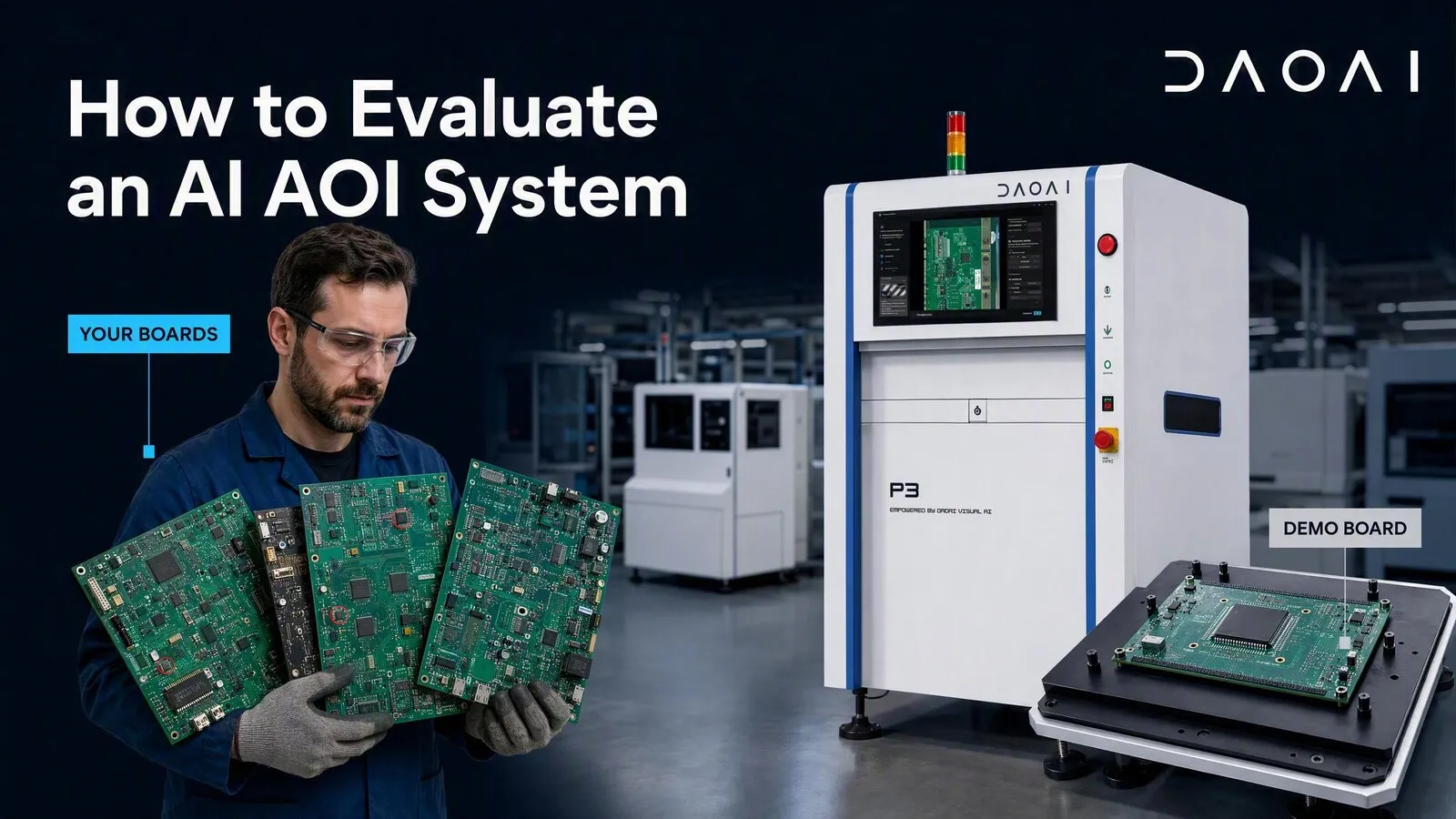
A longer checklist is in our guide on how to evaluate an AI AOI system before you buy.
FAQ
What does AOI stand for?
AOI stands for automated optical inspection: a camera-based machine that checks assembled PCBs for visible component and solder defects, usually right after reflow on an SMT line.
What is the difference between AOI, SPI and AXI?
SPI measures solder paste after printing, before parts are placed. AOI checks placed components and visible solder joints, usually after reflow. AXI uses X-rays to check joints hidden under component bodies, such as BGAs. Most lines use SPI and AOI, and add AXI where hidden joints matter.
Does AI AOI need CAD files?
Not necessarily. DaoAI's AI AOI programs a board from one golden board without CAD files, and DaoAI auto-programming does not require a prebuilt component library. CAD or BOM data can be added later to supply real designators and part numbers.
Does AI AOI replace X-ray inspection?
No. AOI, AI-based or not, only sees what is visible from the camera's viewpoint. Joints hidden under BGA, LGA or QFN bodies still need X-ray (AXI).
Can AI AOI run without an internet connection?
It depends on the vendor. DaoAI machines run entirely on-premise, with no cloud, account or connection out of the plant, and model training happens on the machine itself.
Is AI AOI only for high-volume production?
No. Fast programming, feedback learning and whole-board inspection help high-volume and high-mix lines alike, and high-mix work is a strong fit because rule-based setup there can exceed the run. AI AOI is available in offline, inline 2D, inline 3D and through-hole formats.
How are false calls handled on AI AOI?
The operator marks the flagged part as OK, and the system adds that image to the product's dataset. An AI update retrains the model so it stops calling that acceptable variation, without widening the threshold for real defects.
Can AI AOI inspect a panel with several boards?
Yes. Program one board, then let auto-detection find the remaining sub-panels from the image without entering rows, columns or spacing. Each sub-panel is aligned against its own features and reported separately; matching positions can share program edits, while one position can also be edited independently.
The quickest way to judge any AOI is on your own product. Send us one of your own boards and we will test it for you, free of charge, or book a 30-minute demo with a DaoAI engineer and watch a board you choose become an inspection program live.