Through-Hole Inspection Pre-wave and post-wave.
Before soldering, detect wrong, missing, reversed and skewed components. After soldering, inspect solder quality at each through-hole pad. The A3 runs the pre-wave component checks. The A5 and A6 inspect the solder joints after the wave.
AI inspection before and after soldering.
Check for wrong, missing, reversed and skewed parts before soldering, then inspect solder quality at each pad after soldering. Dedicated AI algorithms handle these different inspection tasks.
Missing, wrong and reversed components.
Detect missing, wrong and reversed through-hole components with AI. Set up inspection from one known-good board, with no component library to build or maintain.
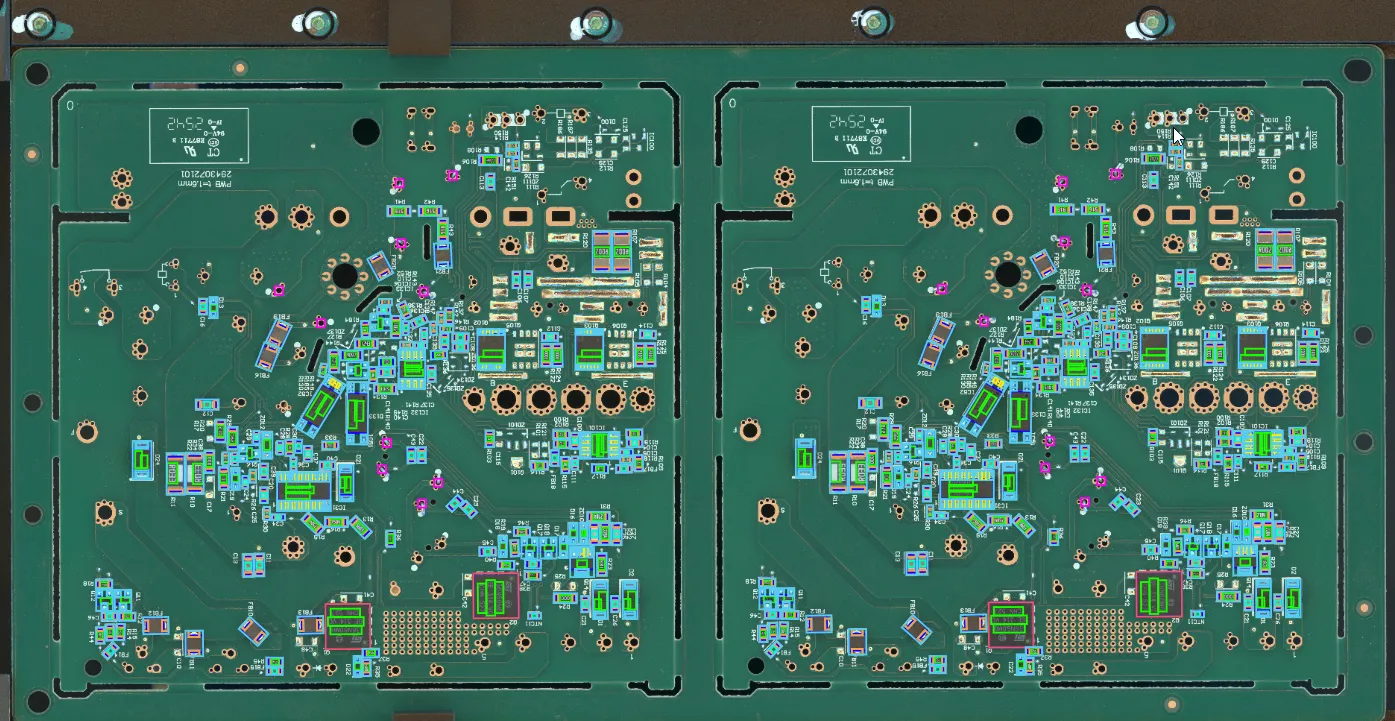
Train for your specific solder joints.
Extend the solder model with examples from your own production. Train it to recognize niche defects and acceptable variations in wave, selective or hand-soldered joints.
Add individual solder joint images or all matching solder joint images from a product to your training dataset.
Label solder joint images as OK or NG to teach the model your acceptance criteria.
Apply the trained model to selected pads or set it as the default for a component group. It runs alongside the existing joint and bridge checks.
Collect images, label examples, train and evaluate models directly on the machine. No internet connection or cloud account required. Model training.
Frequently asked questions
What is the difference between pre-wave and post-wave through-hole AOI?
Pre-wave inspection runs before soldering and checks for wrong, missing, reversed and skewed components. Post-wave inspection runs after soldering and checks solder quality at each through-hole pad.
Which DaoAI machine do I need for through-hole inspection?
The A3 runs the pre-wave component checks. After the wave, the A5 inspects the solder side from below, and the A6 inspects the top and bottom of the board in one pass. The A3 does not inspect solder joints.
Do I need a component library to program through-hole inspection?
You don't need a component library. The A3 is set up from one known-good board. The A5 and A6 program themselves from one golden board with no XY data required.
Can it inspect selective or hand-soldered joints?
Yes. You can extend the solder model with images from your own production and train it to recognize niche defects and acceptable variations in wave, selective or hand-soldered joints.
Does model training need the internet?
No. Images are collected, labeled, trained and evaluated directly on the machine, with no internet connection or cloud account.
Can you test my through-hole board?
Yes. Send us a few photos of your inserted boards, taken straight down at about 0.08 mm per pixel, and we'll show you what the A3 would flag. Evaluations can also be arranged through DaoAI or its local distributors.
See it work on your through-hole board.
Join an engineer for a live demo of programming and through-hole inspection. Review component checks and solder quality results at each pad.
See how DaoAI fits into your production line, from machine integration and operator workflows to ongoing support.