Short answer. For high-mix, low-volume (HMLV) PCB assembly, the best AOI is the one that turns a new board into a working inspection program fastest, with the inputs you actually receive from customers, run by the people you actually have. Camera specs matter less than three questions: what does programming require (CAD, a component library, or one good board), how long does it take per new job, and does false-call tuning carry over to the next board or start again.
Disclosure: DaoAI makes AOI machines and wrote this page. Every claim about another vendor below is quoted or summarised from that vendor's own published material, listed in the Sources section and checked on October 5, 2026. Vendor performance claims are the vendor's, not ours, and none of them are independently verified here.
What makes an AOI right for high-mix, low-volume work?
A high-volume line programs a board once and runs it for months, so it can afford hours of setup. An HMLV shop may introduce several new jobs a week, often from customers who send Gerbers late, partial or not at all. Five things decide whether an AOI keeps up:
- Programming input. Does a new job need CAD or placement data, a maintained component library, or only a physical known-good board?
- Programming time per job, end to end. Not the time to generate a program, the time until it runs in production with an acceptable false-call rate.
- Who can do it. A dedicated AOI programmer, or the operator on shift.
- Form factor. Offline benchtop machines program and inspect without stopping the SMT line. Inline machines inspect every board at line speed.
- 2D or 3D. 3D adds measured height, which matters for lifted leads, coplanarity and solder volume. Many HMLV defect lists are dominated by presence, polarity, offset and solder bridges, which 2D covers.
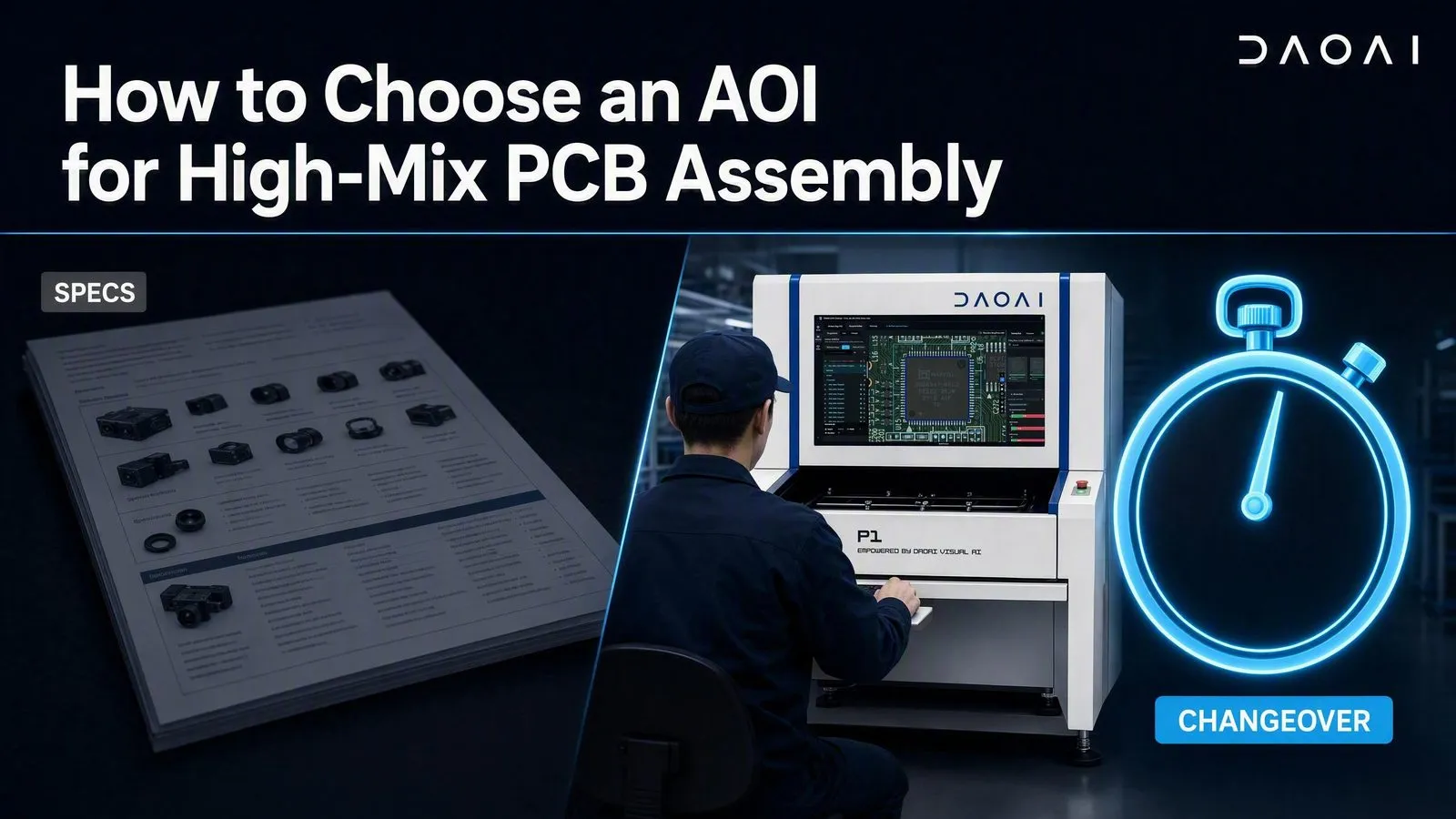
We cover the selection method in detail in How to Choose an AOI for High-Mix PCB Assembly. This page applies it to six AOI platforms that are often compared.
How do the main AOI platforms compare for HMLV?
| Platform | Form factor | Imaging | How programming starts (per vendor) | Published programming time |
|---|
| DaoAI P1 / P2 | Offline, manual load | 2D; P1 5 MP at 15 µm, P2 12 MP at 10 µm; boards to 470 × 330 mm | One known-good golden board; no CAD file or prebuilt component library required | 30 seconds to 5 minutes to generate a program |
| DaoAI P3 / P5 | Inline (P3 2D, P5 3D) | P3 26 MP at 10 µm; P5 4-direction projection, height accuracy 6 µm or better with the calibration tool (reference spec); boards to 500 × 600 mm | Same golden-board workflow | Same as above |
| MIRTEC MV-3 OMNI MARK-II | Benchtop | 3D, 12-projection moiré, 0 to 25 mm range | AI Auto-Matching | Given as a percentage saving, not a time |
| Koh Young Zenith family + KAP | Inline | 3D profilometry | KAP auto programming, using the machine's 3D measurement data | Given as a percentage saving, not a time |
| SAKI 3Di EX series | Inline | 3D; 8 or 15 µm | Automated program creation tools; program data shared across SPI, AOI and AXI | Not stated |
| Viscom iS6052 | Inline | 3D | Not stated | Not stated |
| Manncorp Sherlock range | Benchtop and inline | 2D (Sherlock); 3D on the RV2-3DH | Not stated | Not stated |
What does each platform emphasise?
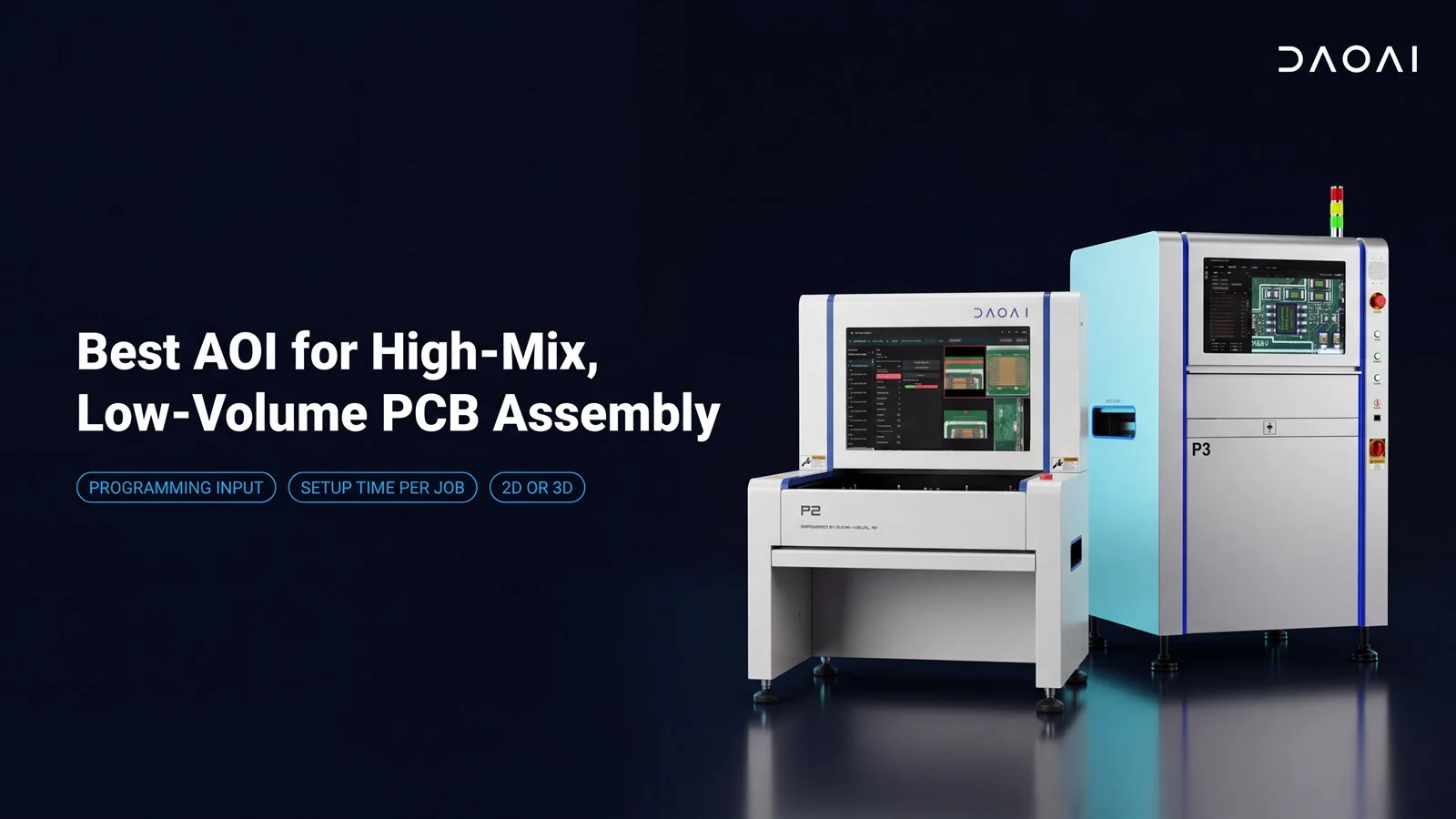
DaoAI (offline P1, P1L, P2; inline P3, P3D; inline 3D P5, P5D; through-hole A3, A5, A6). The whole range shares one software stack built around golden-board programming: the operator scans one verified good board and the software generates the inspection program without CAD data or a prebuilt component library. DaoAI states program generation takes 30 seconds to 5 minutes, and that a new board is typically ready for production inspection in about 5 to 10 minutes (DaoAI-reported). Models run on the machine and do not need an internet connection. See AOI programming without CAD files for how the workflow runs.
MIRTEC MV-3 OMNI MARK-II. A benchtop 3D AOI for SMT and THT assemblies. Programming uses MIRTEC's AI Auto-Matching. Our full comparison is in DaoAI vs MIRTEC.
Koh Young Zenith family with KAP. KAP is Koh Young's auto-programming software, which uses the machine's 3D measurement data. The Zenith range is inline 3D. See DaoAI vs Koh Young.
SAKI 3Di EX series. Inline 3D AOI. SAKI describes automated program creation tools and a program data format shared with its SPI and AXI systems. See DaoAI vs SAKI.
Viscom iS6052. Inline 3D AOI that Viscom positions for large-scale manufacturing. See DaoAI vs Viscom.
Manncorp Sherlock range. Manncorp offers benchtop and inline AOI. The Sherlock line is 2D for pre-reflow and post-reflow inspection; Manncorp's inline 3D option is the RV2-3DH.
Why can't you compare vendor programming-time claims directly?
Because each claim is measured against a different baseline. MIRTEC and Koh Young state a percentage saving against earlier programming methods, such as manual teaching. DaoAI states an absolute generation time and a typical time to production-ready inspection. The vendors do not use the same start and stop points, and none says how long it takes to tune false calls down to a level your verify station can live with.
For an HMLV shop the number that matters is time from receiving a new board to a production-ready program, done by your own operator, on your own board. If you introduce N new jobs a week and each takes T hours to program and tune, the AOI costs you N × T hours of skilled time every week. At 4 new jobs a week, the difference between a 3 hour and a 30 minute setup is 10 hours of engineering time, every week, before any false-call rework.
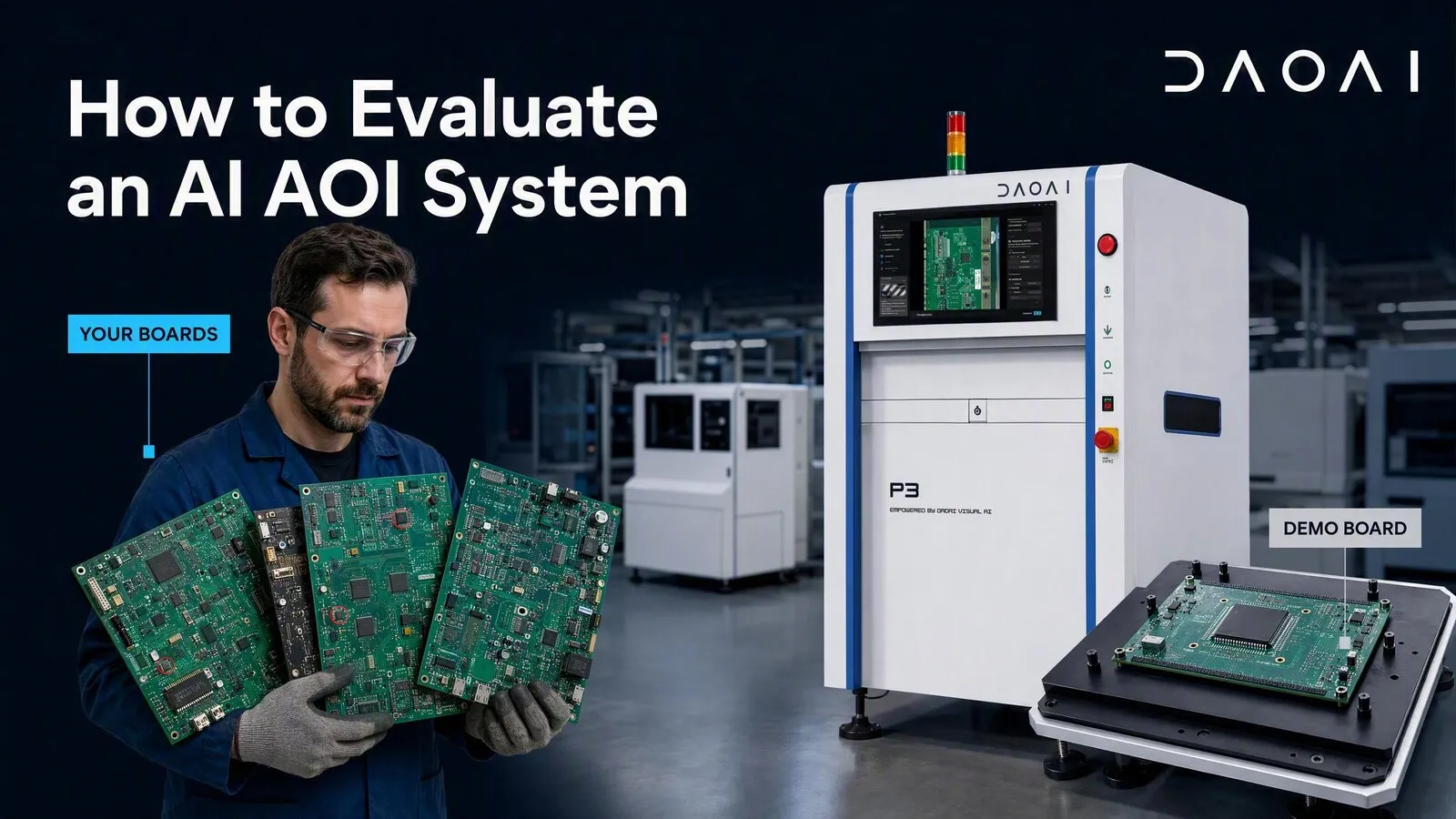
Measure it during a demo. How to Evaluate an AI AOI System Before You Buy lists the boards to bring and the five numbers to record.
Which kind of platform matches which HMLV shop?
| If your main constraint is... | What to prioritise | Platforms in this comparison built around it |
|---|
| New jobs every week, customer CAD often missing | Programming that starts from a physical board | DaoAI (golden board, no CAD required) |
| High-reliability work, solder volume and lifted leads | Inline 3D | DaoAI P5/P5D, Koh Young Zenith, SAKI 3Di, Viscom iS6052 |
| No dedicated AOI programmer on staff | A workflow an operator can run | DaoAI (golden board scan, program generated automatically) |
| Board images must stay inside the plant | On-machine models, no cloud dependency | DaoAI (no internet connection required) |
This table maps what each vendor says its product is built for. It is not a ranking.
Where does DaoAI fit?
If your HMLV line needs measured height, start with DaoAI's inline 3D AOI, available now: the P5 on a single-track conveyor and the P5D on a dual-track conveyor. Both measure component height rather than inferring it, using four structured-light projection units, one per direction. DaoAI specifies height accuracy of 6 µm or better with the calibration tool and a 25 mm measurement range; the P5 takes boards up to 500 × 600 mm, and the P5D up to 500 × 300 mm per track. Hardware specifications are reference values and may vary by configuration.
For high-mix work, programming is what decides the fit. Every DaoAI AOI programs itself from one golden board in 30 seconds to 5 minutes. No CAD, Gerber or component library is required, so a late or missing customer data pack does not hold up inspection. With tuning, the false-call rate can reach about 1%.
The same software covers the rest of the range: offline 2D (P1, P1L, P2), inline 2D (P3, P3D) and through-hole inspection. The A3 checks through-hole parts before soldering for missing, wrong, reversed or offset components. After soldering, the A5 inspects the solder side from below, and the A6 inspects the top and bottom of the board in one pass.
All AI runs on the machine; inspection data never leaves your factory. Sales and engineering support comes from DaoAI's North American team in Vancouver, plus authorized partners, and DaoAI has 1,000+ systems in the field across Asia.
Whichever platforms you shortlist, test the numbers on your own boards before they go into a purchase decision. Send us one of your own boards and we'll test it free of charge.
FAQ
What is the best AOI machine for high-mix, low-volume production?
There is no single best machine. The best fit is the platform that turns your new boards into production-ready programs fastest with the inputs you receive and the staff you have. Start from programming input, end-to-end setup time per job, and whether you need measured 3D, then test the shortlist on your own boards.
Do I need 3D AOI for high-mix, low-volume assembly?
Only if your escapes or customer requirements involve height: lifted leads, coplanarity, solder volume, tall or tilted parts. If your defect history is mainly missing parts, polarity, offset and bridges, 2D covers it at lower cost. Check your last quarter's defect Pareto before paying for 3D.
How much does an AOI machine cost?
It depends on the configuration: 2D or 3D, offline or inline, single or dual lane, the board sizes you need to inspect, and which software options are included. Ask each vendor, DaoAI included, for a quote against the same scope. What drives the price is covered in How Much Does an AOI Machine Cost?
Can an AOI be programmed without CAD files?
Yes. DaoAI's machines generate the inspection program from one physical golden board with no CAD file or prebuilt component library. For any other platform, ask the vendor which inputs are optional and which are required, because "auto programming" can still depend on CAD or a library.
Is a benchtop AOI enough for a high-mix shop?
Often, yes. Offline benchtop machines program and inspect without stopping the SMT line, which suits frequent changeovers. Inline AOI becomes necessary when every board must be inspected at line speed. See Offline vs Inline vs 3D AOI.
Sources
Checked October 5, 2026; DaoAI P5 and P5D pages rechecked October 19, 2026. Specifications are the vendors' own.