
How to Evaluate an AI AOI System Before You Buy
Vendor accuracy numbers mean nothing until you reproduce them on your own boards. Six boards to bring, five things to measure, and what a passing result looks like.
August 11, 2026
A sourced comparison of DaoAI and Saki 3Di-EX 3D AOI: programming inputs, height range, board size, AI features and data handling, plus a checklist for testing both on your own boards.
DaoAI is an alternative to Saki's 3Di-EX 3D AOI: its machines build an inspection program from one verified golden board in 30 seconds to 5 minutes, without CAD files or a prebuilt component library, and its P5 and P5D inline 3D machines are available for delivery now. According to Saki's published materials, its 3D AOI uses automated program development tools and inspection program data standardized across SPI, pre-AOI, post-AOI and AXI. Sources are linked at the end.
| Topic | DaoAI (per daoai.com) | Saki 3D AOI (3Di-EX series, per vendor materials) |
|---|---|---|
| Programming inputs | One verified golden board; AI auto-programming in 30 s to 5 min. CAD/BOM optional; it adds designators and part numbers only. Auto-programming does not require a prebuilt component library. | Automated program development tools; program data standardized across SPI, pre-AOI, post-AOI and AXI. Saki's 2018 release describes Self-Programming from Gerber and centroid CAD data with its Golden Library (300,000+ components) and no golden board. |
| 3D method | P5 and P5D inline 3D: four structured-light projection units, one per direction. | 3Di-EX platform with side cameras and upgradeable optical units. |
| Height measurement range | 25 mm (P5, P5D). | Up to 25 mm standard; up to 40 mm with the Z-axis option. |
| Published height metric | ≤ 6 µm height accuracy with the calibration tool (P5, P5D). | Not stated as a single figure on the pages reviewed. |
| Optical resolution | 10 µm (P5). | 8 or 15 µm (3Di-MS3EX, 3Di-LS3EX); 15 µm (3Di-ZS3EX). |
| Board size | Offline: up to 680 × 510 mm (P1L). See each machine page for inline limits. | 50 × 60 mm up to 330 × 330 mm (3Di-MS3EX), 510 × 510 mm (3Di-LS3EX) or 686 × 1016 mm (3Di-ZS3EX). |
| Max. PCB clearance | P1, P1L, P2: 25 mm above the board, 110 mm below. | 3Di-EX: 40 mm top, 60 mm bottom. |
| AI features | Per-component AI scoring, feedback learning from operator reports, custom model training on the machine. | AI combining supervised and unsupervised learning with human judgment; AI Solution for defect judgment and character recognition; QD Analyzer analytics. |
| Through-hole (THT) | A3: one machine performs pre-wave and post-wave inspection and can inspect both sides of the board. P3 and P5 also support DIP/through-hole inspection. | 3D AOI serves SMT and through-hole processes; 3Di-LS3BX bottom-side AOI announced for 2026. |
| Deployment and data | All models run on-premise with no internet connection required. Remote support is optional and off unless the customer enables it; the system has no backdoor access. | IPC-CFX connectivity and a Remote Management System are described. Check with the vendor on where AI training runs. |
DaoAI hardware figures are reference (typical) values from daoai.com, not guaranteed limits. Saki figures are as stated in its published materials. The clearance rows describe different machine types (DaoAI offline, Saki inline).
Saki's current 3D AOI page describes automated inspection program development tools, and its 2025 announcements describe "One Programming" across platforms and AI that speeds inspection programming. Saki's 2018 release describes a Self-Programming workflow: "All you need is the Gerber and centroid CAD data," with components selected from its Golden Library and no golden board needed. Check with Saki which inputs the current 3Di-EX software uses.
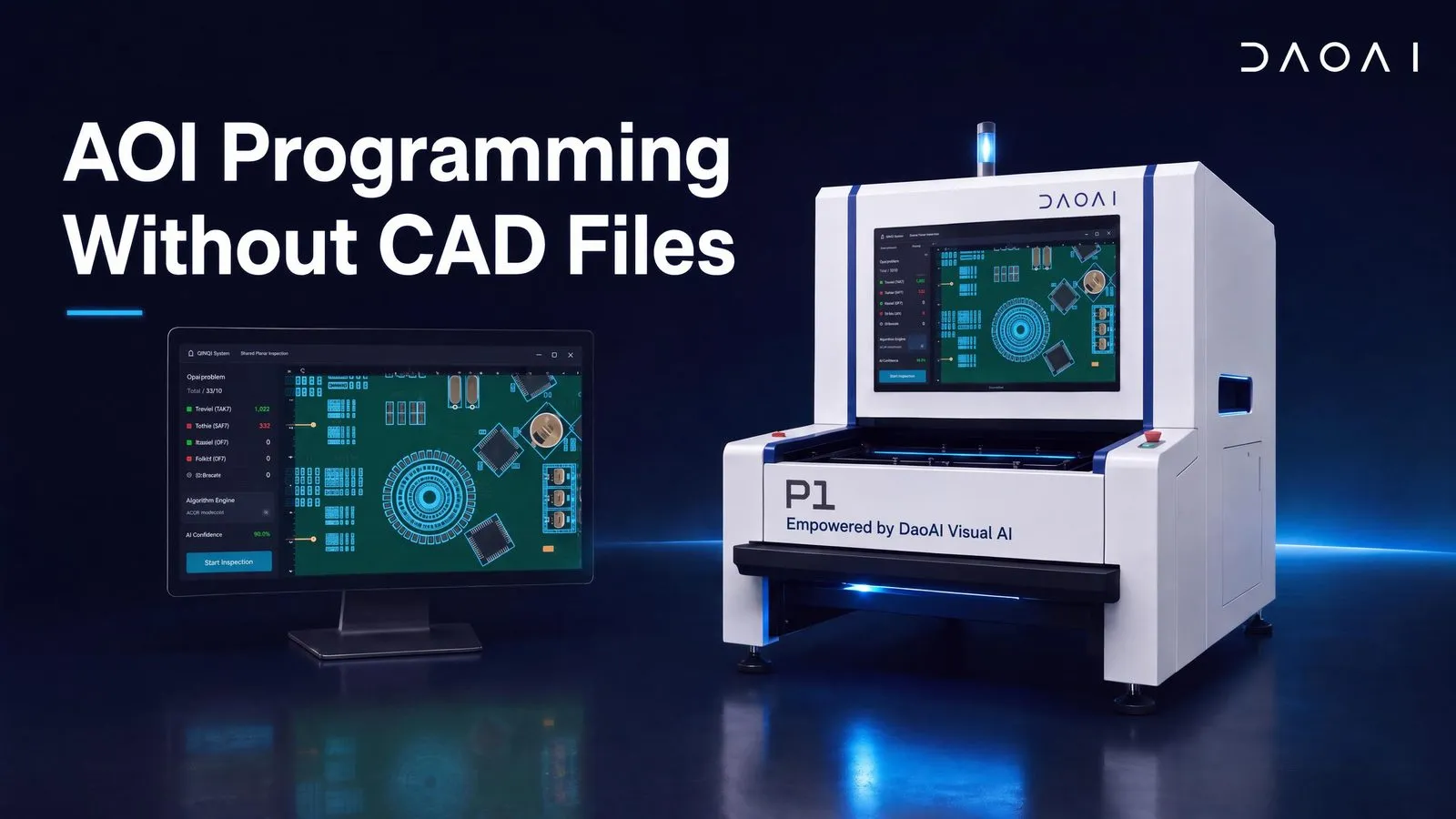
DaoAI starts from a built board. The machine images one verified golden board, detects and models every component, draws inspection windows and sets thresholds. CAD or BOM data can be imported at any point to add designators and part numbers without losing tuning. A package the system has never seen is modelled from the board, so there is no library entry to create first.
The practical question is which input you have first. If boards often arrive before usable CAD data, or the data never comes, golden-board programming removes the wait. We cover this in AOI programming without CAD files.
Saki says its AI combines supervised and unsupervised models with human judgment, and that its AI Solution automates defect judgment and character recognition. QD Analyzer adds data collection and analytics aimed at reducing false calls across the line.
DaoAI uses feedback learning at the machine. An operator marks a call as OK or NG, and an AI update retrains the model on that example instead of widening a threshold. Manual settings are kept, updates can be undone, and the line does not stop while it retrains. DaoAI states the false-call rate can reach about 1% after tuning; it depends on the board and process.
According to Saki, its current 3D AOI serves SMT and through-hole processes, including high-density boards with very small and tall components.
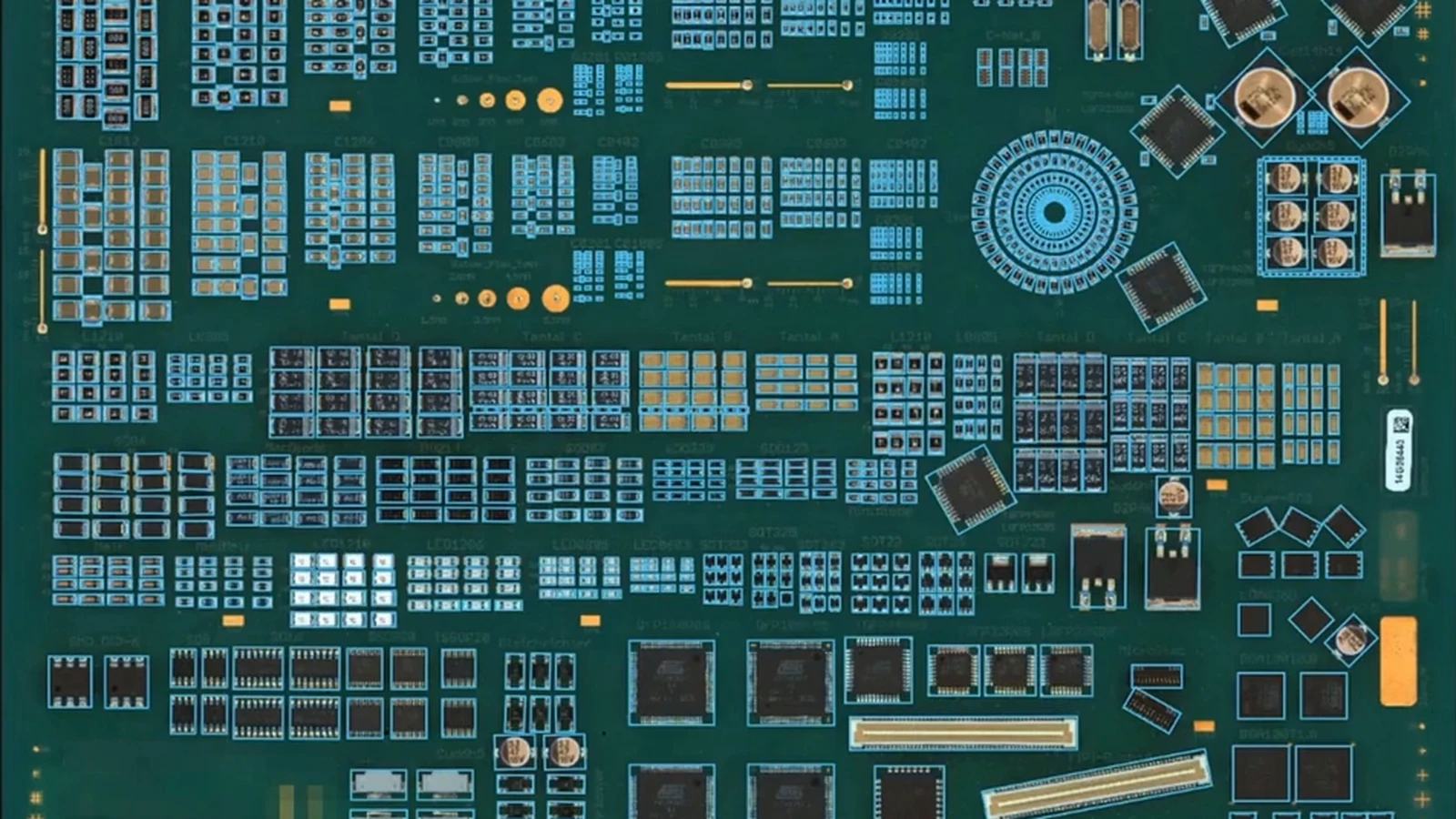
DaoAI covers 16 inspection capabilities across components, solder joints and leads, markings, barcodes (1D, QR and Data Matrix), through-hole joints and the whole board. The whole-board pass finds solder balls and foreign objects on bare laminate, outside any component window. Machines span offline 2D (P1, P1L, P2), inline 2D (P3, P3D), inline 3D (P5, P5D) and through-hole (A3), all on the same core software. See inspection coverage for the full list.
Over a machine's life, these usually cost more than the purchase price:
Use our AOI ROI and payback guide to put numbers on each line.
Run the same boards through both systems under the same conditions and record results side by side (see how to evaluate an AI AOI system before you buy):
For a US contract manufacturer, compare programming time on a board the vendor has never seen, operator review minutes per board from false calls, and who supports the machine locally. Saki and Mirtec are established 3D AOI vendors; our DaoAI vs Mirtec comparison covers the second. DaoAI is another option for high-mix lines: it programs from one golden board in 30 seconds to 5 minutes with no CAD file, its P5 and P5D inline 3D machines are available for delivery now, and it provides sales and engineering support in North America from its team in Vancouver, plus authorized partners.
Saki's 2018 release describes self-programming from Gerber and centroid CAD data plus its Golden Library, without a golden board. Its newer materials describe automated programming tools and "One Programming"; check with Saki which inputs the current software requires.
No. DaoAI programs from one verified golden board in 30 seconds to 5 minutes, and auto-programming does not require a prebuilt component library. CAD or BOM data is optional and only adds designators, part numbers and grouping.
Yes. The A3 performs pre-wave and post-wave inspection in one machine, can inspect both sides of the board, and straddles the existing line. The P3 and P5 also support DIP/through-hole inspection.
Yes. The P5 and P5D inline 3D machines are available for delivery now, with a 25 mm height measurement range (reference value).
Competitor information was checked on the pages below on September 27, 2026. Specifications and features change; confirm details with the vendor.
With DaoAI, you can create an inspection program from one verified golden board without CAD files or a prebuilt component library. For inline 3D inspection, the P5 is available for delivery. Send us your board to evaluate programming time, inspection coverage and false-call review workload.
Vendor accuracy numbers mean nothing until you reproduce them on your own boards. Six boards to bring, five things to measure, and what a passing result looks like.
August 11, 2026
No CAD files, no component library — how golden-board AI programming actually works step by step, and how it compares to the traditional 3–5 hour AOI workflow.
July 21, 2026
DaoAI vs Nordson YESTECH AOI: golden-board vs CAD-and-library programming, inline 3D, through-hole, on-machine AI, and how to test both on your boards.
October 7, 2026
AI inspection insights, product news, and industry analysis. Once a month, no noise.
We use your details to reply to your enquiry. See our Privacy Policy.