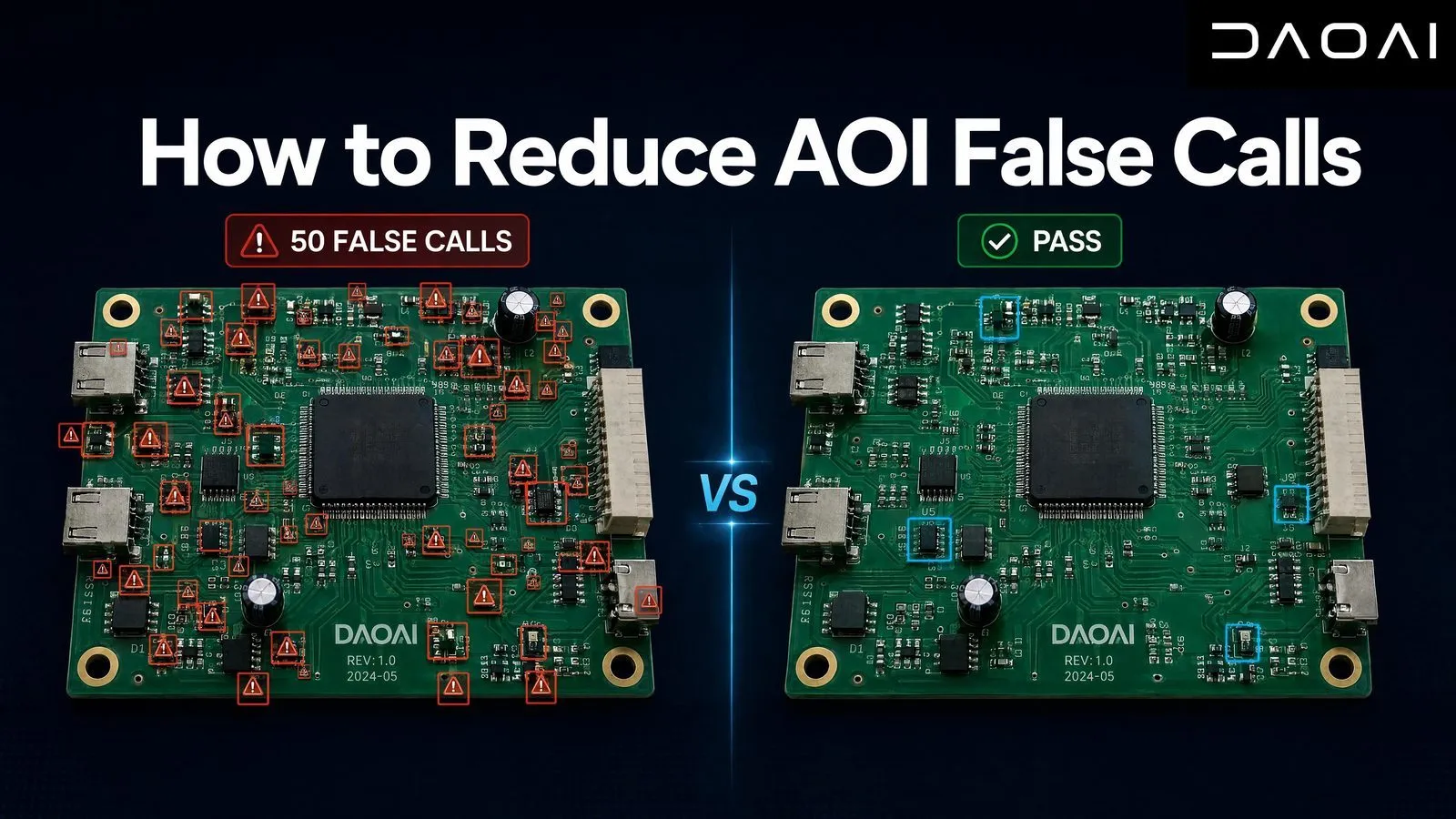
How to Reduce AOI False Calls: Root Causes & Fixes
Which AOI false calls you can tune away, which ones live below the threshold layer, and how to tell the difference before you buy another round of tuning hours.
July 28, 2026
Through-hole AOI checks insertion and polarity before the wave and solder joints after it. This guide covers THT defects, why manual inspection misses them, and how a straddle-mount AOI fits an existing wave line.
Through-hole (THT) AOI inspects through-hole assemblies at two points: before wave soldering, to confirm every component is present, correct, the right way round and fully inserted; and after wave soldering, to check each joint for missing, insufficient or excess solder and for bridges. Running both checks catches insertion errors while they can still be fixed by hand, and joint defects before the board reaches test or the customer. DaoAI's A3 runs both checks in one bench-top machine that straddles the existing wave line, inspects both sides of the board, and is programmed from one golden board in 30 seconds to 5 minutes with no CAD file or component library.
THT defects fall into two groups: errors made when parts are inserted, and errors made when they are soldered. Most insertion errors are still visible and cheap to correct before the wave. Once soldered, the same error means desoldering, rework and a second heat cycle on the board.
Insertion defects (found pre-wave):
Soldering defects (found post-wave):
Pre-wave inspection looks at the component side of the board after insertion and before the wave. Its job is to confirm the board is ready to solder.
The checks are presence, identity, polarity and insertion. Is the part there? Is it the right part? Is it the right way round? Are its pins actually in the holes? On DaoAI's through-hole inspection, dedicated AI algorithms detect missing, wrong and reversed components and check pin presence and insertion, with the program generated from one golden board.
A pre-wave call is the cheapest call on the line. The operator pulls the part, reinserts it, and the board continues with no rework record and no extra heat.
Post-wave inspection looks at the soldered joints. Its job is to confirm each through-hole pad has an acceptable joint and that no solder has formed where it should not.
On DaoAI machines, post-wave inspection covers missing, insufficient and excess solder at each through-hole pad, plus solder bridges between adjacent through-hole pads.
Wave, selective and hand-soldered joints do not look the same, and acceptance criteria differ between plants. That is why post-wave inspection benefits from a model that can be trained on your own joints, covered below.
| Pre-wave inspection | Post-wave inspection | |
|---|---|---|
| When | After insertion, before wave soldering | After wave, selective or hand soldering |
| Main question | Is every part there, correct, oriented and inserted? | Is every joint soldered correctly, with no bridges? |
| Typical defects | Missing, wrong or reversed parts; pins not inserted; parts not seated | Missing, insufficient or excess solder; bridges; solder balls |
| Cost to correct | Low: pull and reinsert by hand | Higher: desolder, rework, re-inspect |
| DaoAI checks | Missing, wrong, reversed components; pin presence and insertion | Solder quality at each through-hole pad; through-hole bridging |
Many THT lines still rely on an operator with a magnifier, before the wave, after it, or both. It is flexible and needs no programming, but it has known limits.
Rule-based AOI has struggled with THT for related reasons. Through-hole parts come in far more shapes than SMT chips, so building library entries and windows for every connector, transformer and relay takes a long time, and wave joint appearance varies more than reflow joints. Many plants simply left THT to operators.
Three things change with an AI approach.
The program is generated from one good board. DaoAI auto-programming does not require a prebuilt component library, so there are no library entries to build for each connector or odd-form part. On DaoAI machines, auto-programming takes 30 seconds to 5 minutes, and pre-wave and post-wave inspection run on the same machine and the same program.
You can extend the solder model with examples from your own production. Collect individual joint images, or all matching joint images from a product, label them OK or NG to your acceptance standard, then train the model to recognize niche defects and acceptable variation in wave, selective or hand-soldered joints.
The trained model is applied to selected pads, or set as the default for a component group, and runs alongside the existing joint and bridge checks. Training happens directly on the machine with no internet connection or cloud account. See model training for the full workflow.
When a good joint is flagged, the operator marks it OK, and an AI update learns from it. The false call goes away without widening the accept band for the defects you still need to catch.
The DaoAI A3 is built for through-hole assemblies before and after wave soldering. It is a bench-top unit that straddles the existing line, so no line modification is needed.
Height is adjustable from 1435 to 1635 mm and width from 1000 to 1200 mm, so the frame can be set to suit the conveyor it straddles. One A3 performs both pre-wave and post-wave inspection, and it can inspect both sides of the board.
| A3 specification | Value |
|---|---|
| Camera | 26 MP color industrial camera |
| Lens | 18 mm (≈ 0.709 in) industrial imaging lens |
| Lighting | High-brightness LED open-aperture flat light plus low-angle light |
| Board size | 50 × 50 mm to 420 × 420 mm (≈ 1.97 × 1.97 in to 16.54 × 16.54 in) |
| Handling | Bench-top straddle over the existing line, no line modification |
| Adjustable height / width | 1435–1635 mm / 1000–1200 mm |
| Machine depth | 841 mm (≈ 33.11 in) |
| Weight | 100 kg (≈ 220.5 lb) |
| Power | 220 V, 10 A, 50–60 Hz |
The A3 covers pre-wave and post-wave inspection plus component-body missing, wrong and reversed checks; it does not inspect SMT components, and a future model is planned to add SMT inspection. If you need through-hole checks on an inline machine, the P3 and P5 also support DIP/through-hole inspection. Specifications above are reference values.
The A3 runs the same core AI software as the rest of the DaoAI range: auto-programming, feedback learning, model training and offline operation are standard. More on the checks themselves is on the through-hole inspection page.
Pre-wave AOI checks that through-hole components are present, correct, correctly oriented and inserted before soldering. Post-wave AOI checks each solder joint for missing, insufficient or excess solder and for bridges after soldering.
Yes. DaoAI's solder model can be extended with labelled images from your own production so it recognizes defects and acceptable variation in wave, selective or hand-soldered joints.
Not on DaoAI machines. The inspection program is generated from one golden board; CAD or BOM data is optional and adds designators and part numbers.
No. The A3 is a bench-top unit that straddles the existing line, with adjustable height and width, so no line modification is required. One A3 handles both pre-wave and post-wave inspection.
Through-hole boards vary more than SMT boards, so the best test is your own product. Send us one of your own boards and we will test it for you, free of charge, or book a demo to see pre-wave component checks and post-wave solder results on your board.
Which AOI false calls you can tune away, which ones live below the threshold layer, and how to tell the difference before you buy another round of tuning hours.
July 28, 2026
DaoAI vs Nordson YESTECH AOI: golden-board vs CAD-and-library programming, inline 3D, through-hole, on-machine AI, and how to test both on your boards.
October 7, 2026
DaoAI vs CyberOptics (Nordson) SQ-series 3D AOI: golden-board vs library-based programming, inline 3D, through-hole, on-machine AI and how to test both.
October 7, 2026
AI inspection insights, product news, and industry analysis. Once a month, no noise.
We use your details to reply to your enquiry. See our Privacy Policy.