
CAD 파일 없는 AOI 프로그래밍: 실제 작동 방식
CAD 파일이나 부품 라이브러리 없이 구현되는 골든 보드 AI 프로그래밍의 단계별 실제 작동 방식과 기존 3–5시간 소요되던 AOI 워크플로와의 비교.
2026년 7월 21일
With CAD-free programming, the golden board is the only input the AOI needs, so a defect on it is learned as normal. How to choose, verify and prepare the board.

A golden board for AOI programming is a fully assembled board from your current production build that you have verified as defect-free. With CAD-free programming, it is the only input the AOI needs: the system learns what every part and joint should look like from that one board. That makes the choice of board important. If the golden board carries a defect, the program learns it as normal. This guide covers how to pick a board that is truly known-good, how to verify it, and what to prepare at the machine.
How the AI builds a program from the board is explained step by step in AOI programming without CAD files. This article is about the board itself.
A golden board is the reference the AOI compares production boards against. On a traditional AOI, the reference board is used mainly for alignment and threshold setting, while the inspection logic comes from CAD data and a component library. On a CAD-free AI AOI such as DaoAI's, the golden board is the specification: the AI finds the components on the board image, generates the inspection boxes and sets starting limits from what it sees. No CAD file, Gerber or component library is required.
Because the board defines "good", a golden board must be:
Pick a board from the first stable run of the build you are about to inspect, not from a pilot or a prototype lot. Use these criteria:
| Check | Why it matters |
|---|---|
| Same PCB revision and same assembly revision as production | A different revision can move, add or remove parts, and the program will flag every difference. |
| Same fitted parts as the production build | A part that is missing on the golden board is not programmed and will not be inspected. |
| Parts from the suppliers you currently use | Body color and marking differ between suppliers. The program learns the look it sees. |
| Built on the production line with the normal reflow (and wave) profile | Solder fillets from a reworked or hand-soldered board do not look like production joints. |
| No rework anywhere on the board | Reworked joints and extra flux residue become part of "good". |
| Clean and flat | Fingerprints, dust, flux residue and warp change the image and the alignment. |
Verify the board before it goes into the AOI, with the same care you would give a first-article inspection:
A golden board that passes all four is the best protection against the main risk of this method: a defect on the reference board being learned as normal.
The software also helps: after auto-programming, components it is not confident about (for example low confidence or an unusual size) is flagged as unhealthy, so you can review those parts before the program goes into production.
On a DaoAI AOI, programming from a golden board takes these steps:
Generating the inspection boxes takes about 30 seconds, and the AI then trains on the board automatically. In total, every DaoAI AOI programs itself from one golden board in 30 seconds to 5 minutes, depending on the board. Panels are covered in more detail in panel and array AOI.
CAD is optional, never required. If you have the pick-and-place (XY) file, you can import it as a CSV or text file with designator, X and Y columns, plus package and part number if you have them. The AOI then fills in reference designators and part numbers and groups parts by package, which makes reports and traceability easier to read. The golden board still defines what each part should look like.
For NPI and first builds there is no proven board yet. Build the first boards, verify one with the steps above, and program from it. Until the program has seen a few production boards, review every call closely. Changes then fit into the same program:
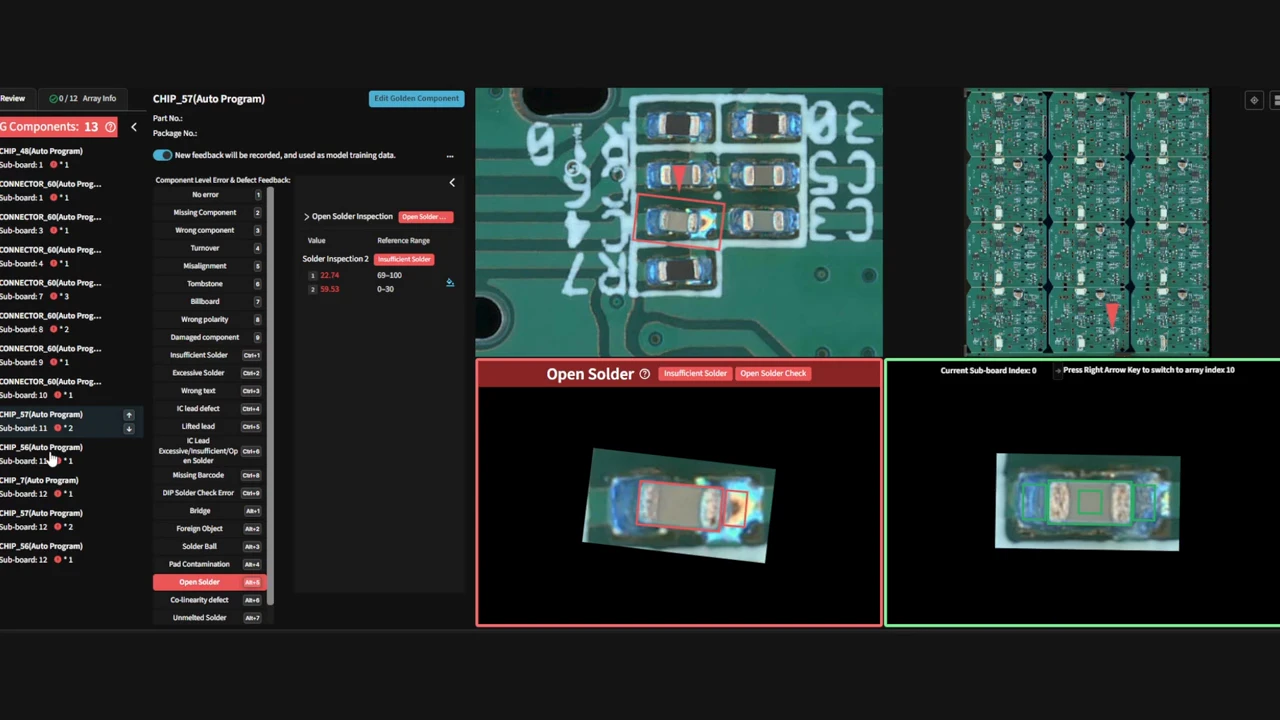
False calls that remain after programming are handled in review, which is covered in AOI false call review.
No. One verified board is enough to program. A second known-good board is a useful check: run it after programming and review any calls it gets.
Avoid it. Reworked joints and extra flux do not look like production joints, so good production boards get flagged, or rework-like joints are accepted as normal.
No. CAD is optional: a pick-and-place (XY) file adds reference designators and part numbers if you have one. No Gerber file or component library is required.
Every DaoAI AOI programs itself from one golden board in 30 seconds to 5 minutes, depending on the board.
The program learns the defect as normal and can pass it on later boards. Verify the board before programming and review the first production boards closely.
Send us one of your own boards and we'll test it free of charge. You will see the program built from your golden board, and the result on your board. See the DaoAI AOI range.
CAD 파일이나 부품 라이브러리 없이 구현되는 골든 보드 AI 프로그래밍의 단계별 실제 작동 방식과 기존 3–5시간 소요되던 AOI 워크플로와의 비교.
2026년 7월 21일
Program one sub-panel and let the AOI find, align and judge every other position on the panel. Here is how array inspection works, where it goes wrong, and why setup time matters on every panel.
2026년 9월 28일
An AI AOI cuts false calls by learning from reviewed calls, so the review decides the result. Labeling rules, when to run an AI update, and the mistakes to avoid.
2026년 11월 5일
AI 검사 인사이트, 제품 소식, 산업 분석. 불필요한 정보 없이 월 1회.
문의에 답변하기 위해 입력하신 정보를 사용합니다. 개인정보 처리방침 확인.