AOI 오검출(False Call) 줄이기: 근본 원인과 해결책
튜닝으로 잡을 수 있는 AOI 오검출과 임계값 계층 자체의 한계로 발생하는 오검출을 구분하고, 추가 튜닝 공수를 투입하기 전에 이를 명확히 판별하는 기준을 확인하십시오.
2026년 7월 28일
False call rate, escape rate and first pass yield describe how well an AOI performs, but only if everyone uses the same denominator. Formulas, measurement steps and what good looks like.
The three numbers that describe how well an AOI performs are the false call rate (good parts the machine flags as defective), the escape rate (real defects the machine lets through) and first pass yield (the share of boards that pass without rework). False calls cost review time, escapes cost quality, and first pass yield tells you how the process upstream of the AOI is doing.
These metrics only mean something if everyone uses the same denominator. This guide gives plain-text formulas, shows how to collect the data on your own line, and explains why lowering one number by loosening thresholds usually raises another.
Every inspection decision falls into one of four boxes. Each metric below is built from them.
| AOI says: defect | AOI says: good | |
|---|---|---|
| Part is actually defective | True call (correct detection) | Escape (missed defect) |
| Part is actually good | False call (false alarm) | Correct pass |
The AOI only knows its own decision. The operator's review verdict tells you which calls were true or false. Escapes can only be found later, at in-circuit test, functional test, rework, or at the customer.
A false call is a component, joint or region the AOI flags as defective that the reviewer confirms is acceptable. The false call rate is usually expressed in one of three ways, and quotes that use different ones cannot be compared directly.
The per-board count is the one operators feel, because it sets how often they stop the line or pull a board to review. The per-component rate is better for comparing machines across boards with different component counts. Always state which one you mean.
The escape rate measures what the AOI misses. It is the metric that protects your customer, and it is harder to measure because escapes are only found downstream.
Count only defects within the AOI's scope. A hidden BGA joint void found by X-ray is not an AOI escape, because an optical system cannot see it. Keep a separate list of defects that no inspection in your line covered.
First pass yield (FPY) is the percentage of boards that go through a process step correctly the first time, with no rework or repair.
The two are not the same. AOI pass rate is pulled down by false calls, so a machine that cries wolf makes your process look worse than it is. True FPY is calculated after review, counting only boards with confirmed defects as failures. When FPY drops, the AOI data should help you find the upstream cause: print, placement, or reflow.
| Metric | Formula (plain text) | Unit | Data source |
|---|---|---|---|
| False call rate (component) | false calls ÷ components inspected × 1,000,000 | ppm | AOI calls + review verdicts |
| False calls per board | false calls ÷ boards inspected | calls/board | AOI calls + review verdicts |
| Escape rate | escapes ÷ (true calls + escapes) × 100 | % | Test, rework and return records |
| Detection rate | 100 − escape rate | % | Derived |
| AOI pass rate | boards with no calls ÷ boards inspected × 100 | % | AOI results |
| First pass yield | boards with no confirmed defect ÷ boards inspected × 100 | % | AOI results + review verdicts |
| Review time | false calls per board × seconds per review × boards per shift ÷ 3,600 | h/shift | Time study at the review station |
We are not going to quote an industry benchmark, because the right figure depends on board density, component mix and your defect definitions. A useful test is qualitative:
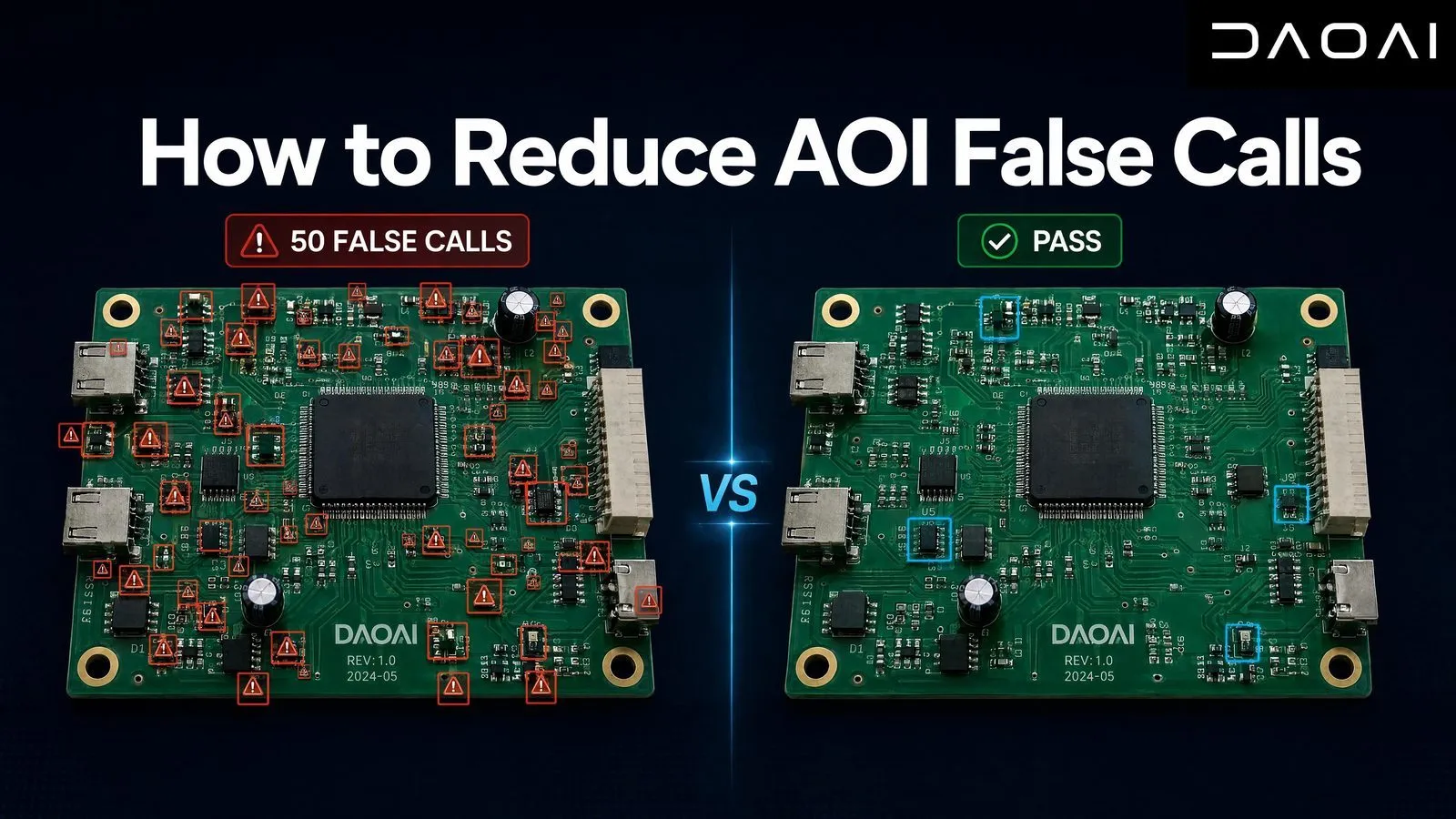
On a rule-based AOI, the usual way to stop a false call is to widen the acceptance threshold for that check. That widening applies to every component judged by the same parameter, so a real defect that falls inside the new band is now passed too. The false call rate drops and the escape rate quietly rises.
Our guide to reducing AOI false calls covers the other root causes, such as lighting, board warp and supplier variation.
DaoAI's feedback learning changes the model instead of the threshold. When an operator marks a false call as OK at the review screen, that image becomes a labelled example. Running an AI update retrains the model on it, so the component that looked unusual is now recognized as normal, while a defect near the same score still falls outside what is normal.
The operator chooses the scope of the correction: one position, a part number, a package or a class. Anything set by hand is kept, and an update can be undone. The same mechanism handles acceptable variation between suppliers, such as a different marking font or body color on the same part number.
For measurement, DaoAI's production integration reports first pass yield per whole board and per sub-panel, stores every inspection with its images and verdict, and exports results to your MES as CSV. Per-position yield in a panel points to where a stencil or reflow problem sits.
A false call is a component or joint the AOI flags as defective that a reviewer confirms is acceptable. It costs review time and, when frequent, trains operators to ignore calls.
A false call is a good part flagged as bad. An escape is a bad part passed as good, found later at test, rework or at the customer.
First pass yield equals boards that pass a step without any rework divided by boards entering that step, times 100%. For AOI, count only confirmed defects as failures, not false calls.
Report both if you can. Per board reflects operator workload; per component or per joint, in ppm, allows fair comparison across boards with different component counts.
Yes, if the fix teaches the system what an acceptable part looks like instead of widening a threshold. Feedback learning retrains the model on confirmed false calls and leaves the acceptance band for real defects in place.
The fastest way to see these numbers for your product is to measure them on your board. Send us one of your own boards and we will test it for you, free of charge, and review the false calls and detections with an engineer.
튜닝으로 잡을 수 있는 AOI 오검출과 임계값 계층 자체의 한계로 발생하는 오검출을 구분하고, 추가 튜닝 공수를 투입하기 전에 이를 명확히 판별하는 기준을 확인하십시오.
2026년 7월 28일
프로그래밍 시간과 가성 불량부터 인력 부담, 체인지오버 효율, 품질 가시성까지 — EMS 팀이 AI AOI를 평가해야 하는 기준을 제시합니다.
2026년 4월 14일
DaoAI vs Nordson YESTECH AOI: golden-board vs CAD-and-library programming, inline 3D, through-hole, on-machine AI, and how to test both on your boards.
2026년 10월 7일
AI 검사 인사이트, 제품 소식, 산업 분석. 불필요한 정보 없이 월 1회.
문의에 답변하기 위해 입력하신 정보를 사용합니다. 개인정보 처리방침 확인.