CAD 파일 없는 AOI 프로그래밍: 실제 작동 방식
CAD 파일이나 부품 라이브러리 없이 구현되는 골든 보드 AI 프로그래밍의 단계별 실제 작동 방식과 기존 3–5시간 소요되던 AOI 워크플로와의 비교.
2026년 7월 21일
When programming takes longer than the build, prototypes skip AOI. Golden-board AI programming makes the first board of an NPI build inspectable.
AOI only helps an NPI or prototype build if the inspection program is ready before the first board leaves reflow. With rule-based AOI, programming often takes longer than the build itself, so prototypes get a microscope and a checklist instead. Golden-board AI programming changes that: DaoAI writes an inspection program from one good board in 30 seconds to 5 minutes, with no CAD file required, and DaoAI auto-programming does not require a prebuilt component library, so you inspect the first board of a build rather than the hundredth of a production run. From golden board to a program ready for production inspection typically takes about 5 to 10 minutes (DaoAI-reported).
The problem is lead time, not value. On a rule-based machine, an engineer typically needs 3 to 5 hours to teach a new board variant, and several days for a board with thousands of components. Before that can start, CAD or centroid data has to arrive, and every new package has to be added to the component library.
A prototype build of a few dozen boards can be placed and reflowed in less time than that. When setup takes longer than the run, which we call the NPI paradox, AOI is skipped and boards go to manual visual inspection.
That is an expensive trade. NPI is exactly when you want to find a polarity error in the placement program, a footprint that tombstones, or a package that bridges. Finding it at functional test, or at the customer, costs far more than finding it on the first board.
On a rule-based AOI, teaching a new board variant typically takes 3 to 5 hours, and several days for a board with thousands of components, before tuning on the first production boards. On DaoAI machines, auto-programming generates the program from one golden board in 30 seconds to 5 minutes, and a new board is typically ready for production inspection in about 5 to 10 minutes (DaoAI-reported). False calls then keep falling as operators mark them OK and the model retrains, so tuning continues during production instead of holding up the first run. Time it on your own board in a demo.
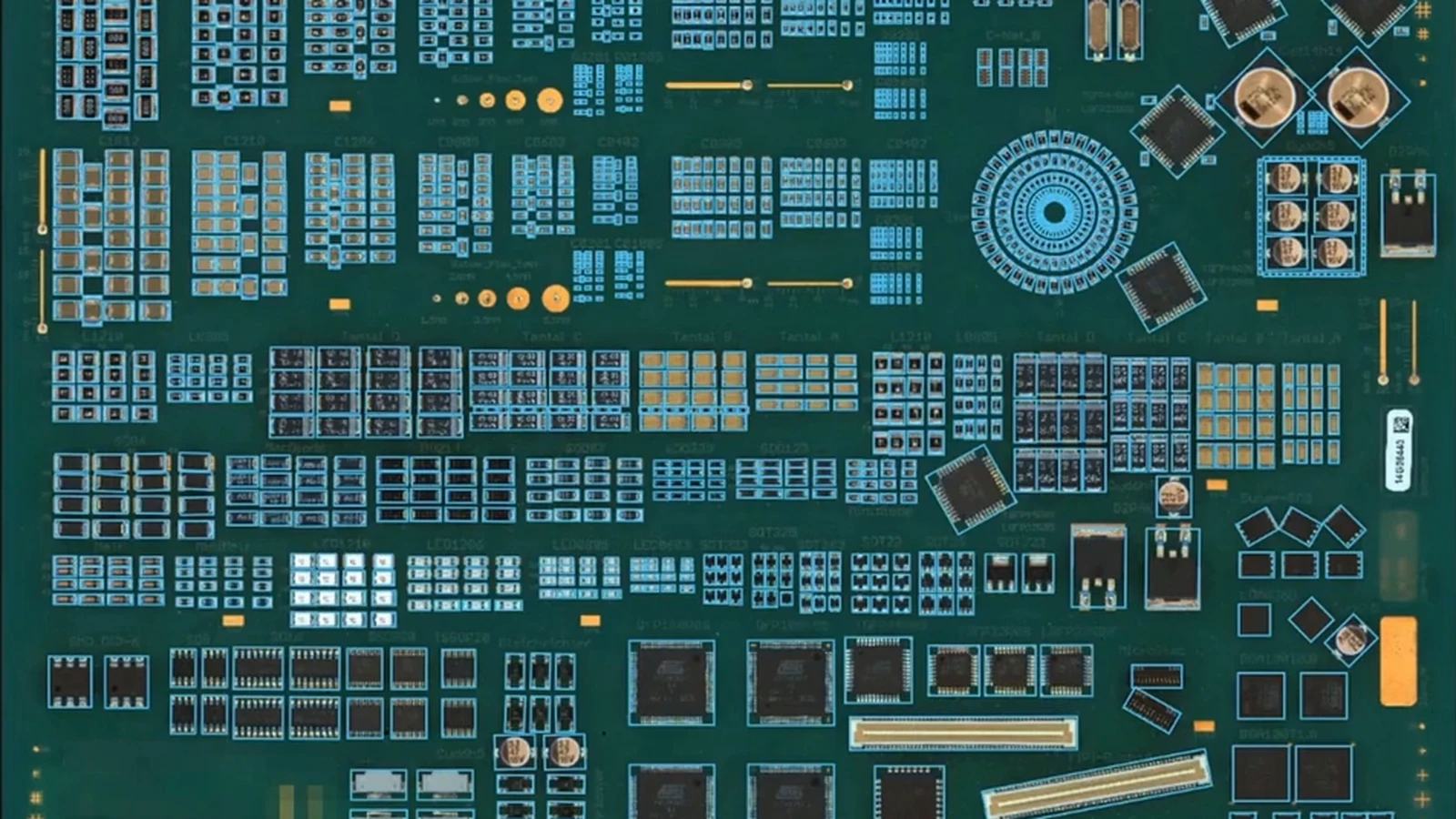
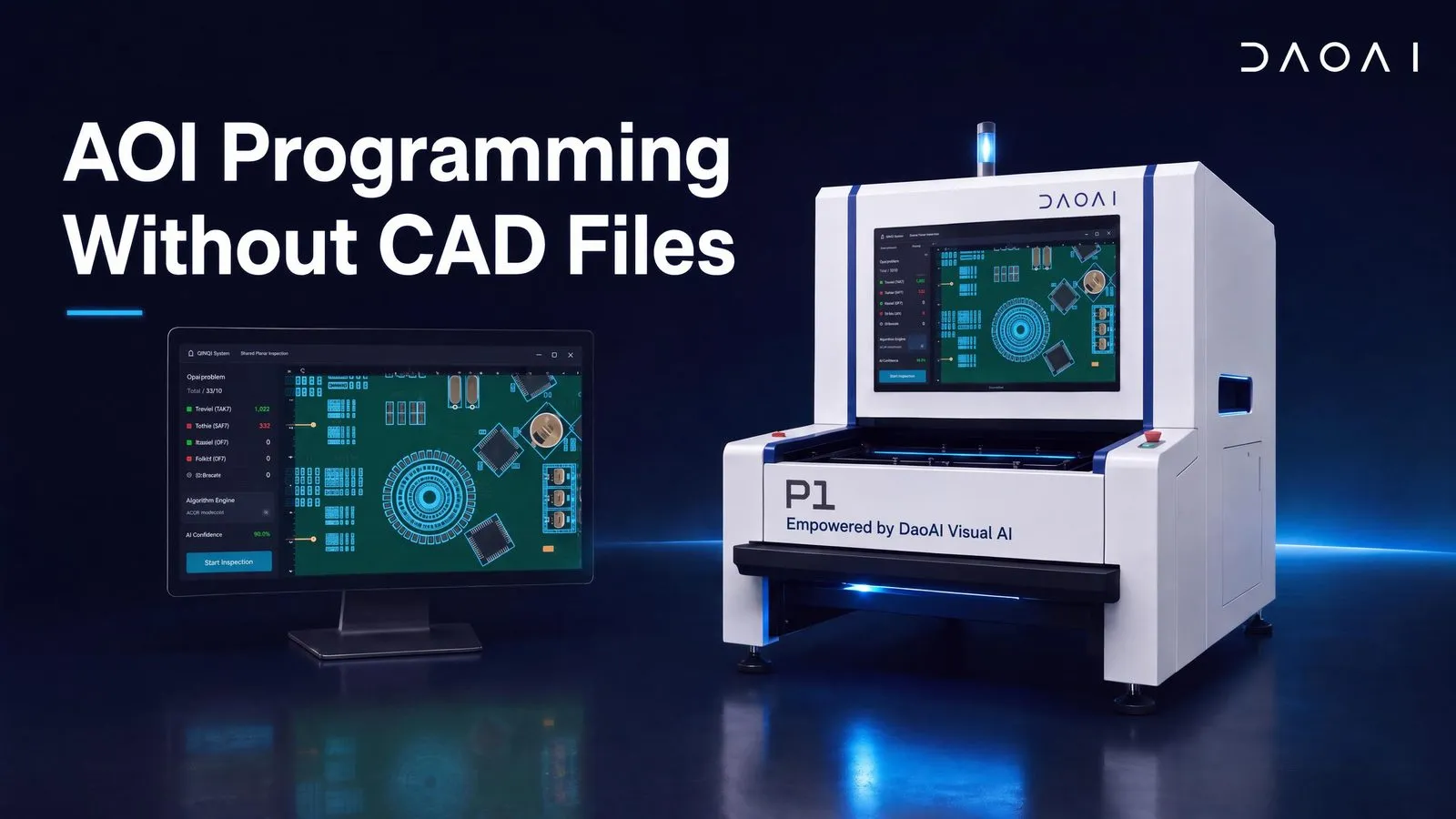
Golden-board programming uses one known-good assembled board as the whole input. The AI identifies and models each component, generates the inspection boxes and sets thresholds from that board. Our guide to AOI programming without CAD files explains the method in detail.
NPI adds one obvious question: where does the golden board come from when no board has been built yet? The answer is to build the first board or two, verify one thoroughly, and make that board the reference.
CAD is optional. If a CAD or BOM file arrives later, import it to add designators and part numbers; it does not change programming quality, and your tuning is kept.
| NPI requirement | Rule-based AOI | DaoAI golden-board AOI |
|---|---|---|
| Inputs before programming | CAD or component list, plus a maintained package library | One verified good board; CAD optional |
| Programming time per board variant | 3 – 5 hr (days for thousands of components) | 30 s – 5 min |
| Time to a production-ready program | Hours to days, including tuning | About 5 – 10 min (DaoAI-reported) |
| A package never seen before | Added to the library by hand first | Detected and modeled from the board |
| Late or missing CAD | Programming waits | Programming starts; CAD can be added later |
| Revision change on a few parts | Reteach affected components by hand | Re-run auto-programming inside a drawn area only |
| False calls on early boards | Loosen thresholds | Operator marks OK; AI Update retrains |
NPI boards rarely stay on one revision. A Rev B might move a connector, change two passives and swap a regulator package. You do not want to rebuild a program that is otherwise tuned.
DaoAI lets you draw a box around the part of the board that changed and run auto-programming again inside it. Everything outside the box, including your edits, stays exactly as it was. Parameters you have locked stay fixed, and manual settings are preserved when auto-programming runs again.
Prototype builds also tend to use alternate parts from whichever supplier had stock. A different supplier can mean a different marking or body color for the same part number. Marking that variation OK teaches the AI it is acceptable across the component group, while lifted leads, bridges and missing parts remain inspection targets.
An inline machine inspects at conveyor speed, but it also ties NPI work to the production line. An offline, manually loaded machine beside the line lets you program and inspect prototype boards without holding the SMT line, which suits irregular job flow, short runs, labs and NPI.
It also makes programming a separate task from production. With DaoAI's offline programming, you program a product on a machine away from the line, export it, and import it on the production machine when the product ramps. Presets for package types can be exported to other machines too.
DaoAI's offline range has three machines, all manual load with auto-clamp and the same core AI software:
| Machine | Camera | Resolution | Board size range | NPI fit |
|---|---|---|---|---|
| P1 | 5 MP | 15 µm per pixel (≈ 0.591 mil) | 50 × 50 mm – 470 × 330 mm (≈ 1.97 × 1.97 in – 18.5 × 12.99 in) | General NPI, labs, short runs |
| P1L | 5 MP | 15 µm per pixel (≈ 0.591 mil) | 50 × 50 mm – 680 × 510 mm (≈ 1.97 × 1.97 in – 26.77 × 20.08 in) | Boards larger than the P1 accepts |
| P2 | 12 MP | 10 µm per pixel (≈ 0.394 mil) | 50 × 50 mm – 470 × 330 mm (≈ 1.97 × 1.97 in – 18.5 × 12.99 in) | More pixels on each small component |
All three accept boards 0.5 to 5 mm (≈ 0.0197 to 0.197 in) thick and inspect at 0.238 seconds per field of view.
Treat AOI as a standard step in the NPI traveler rather than an optional extra. A simple plan looks like this:
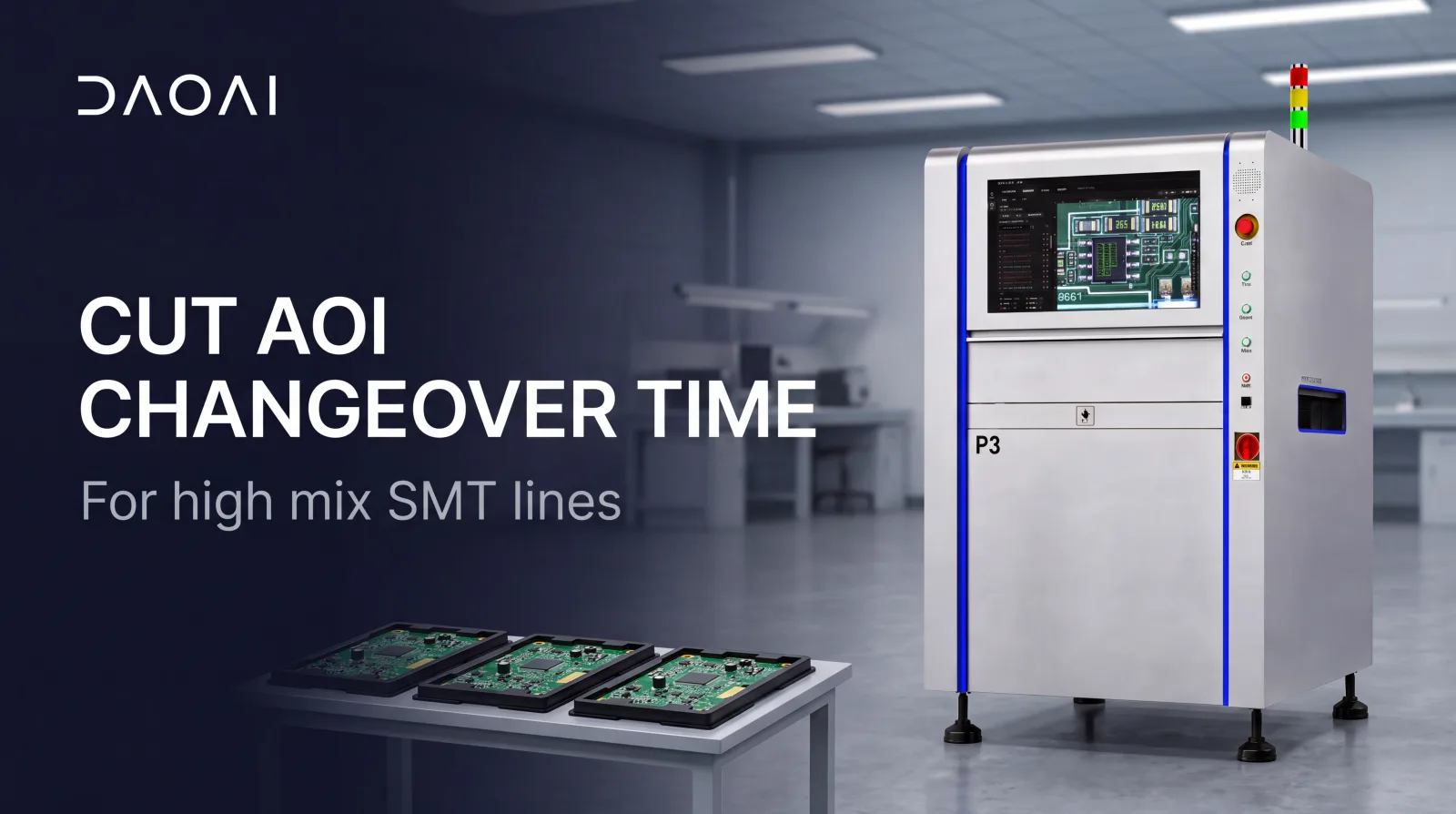
None of this is limited to prototypes: the same golden-board programming and feedback learning run on the inline P3 and P5 when the product moves to volume production. The same habits shorten changeovers once the product is in volume. See how to cut AOI changeover time on high-mix SMT lines for that side of the process.
Yes, if programming is fast enough. DaoAI auto-programs from one good board in 30 seconds to 5 minutes, which is short enough to inspect even a small prototype lot.
Build the first boards, verify one thoroughly by hand, and use that verified board as the reference. The AI generates the inspection program from it.
No. One golden board is enough. A CAD or BOM file can be added later for designators and part numbers without losing your tuning.
Yes. DaoAI supports offline programming: program on one machine, export it, and import it on the production machine.
The P1 covers most NPI and lab work up to 470 × 330 mm. The P1L takes boards up to 680 × 510 mm, and the P2 adds a 12 MP camera at 10 µm per pixel.
Bring your next NPI board to a live session with one of our engineers. Book a demo, or send us one of your own boards and we will test it for you, free of charge.
CAD 파일이나 부품 라이브러리 없이 구현되는 골든 보드 AI 프로그래밍의 단계별 실제 작동 방식과 기존 3–5시간 소요되던 AOI 워크플로와의 비교.
2026년 7월 21일
프로그램 준비, 초품 보드 검토, 양산 릴리스 단계를 분리하여 High Mix SMT 라인에서 실질적인 지연 요인을 파악하십시오.
DaoAI vs Nordson YESTECH AOI: golden-board vs CAD-and-library programming, inline 3D, through-hole, on-machine AI, and how to test both on your boards.
2026년 10월 7일
AI 검사 인사이트, 제품 소식, 산업 분석. 불필요한 정보 없이 월 1회.
문의에 답변하기 위해 입력하신 정보를 사용합니다. 개인정보 처리방침 확인.