AOI ROI 및 투자 회수 기간 산출 방법
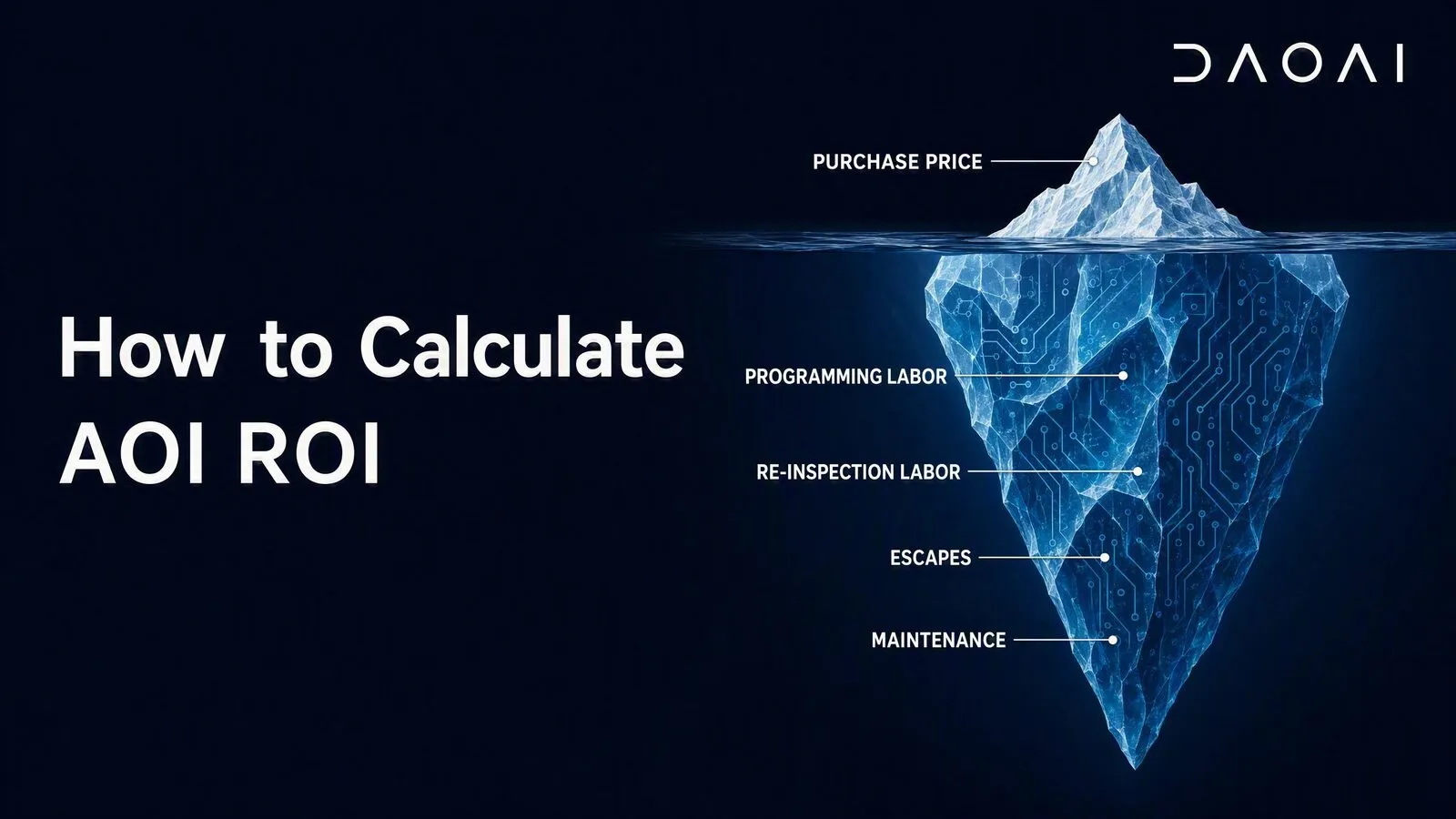
공급업체의 ROI 계산기는 자체적인 가정을 일방적으로 적용합니다. 8가지 비용 항목, 가성 불량 및 유출 절감 공식, 투자 타당성이 없는 조건을 포함한 2가지 실제 산출 시나리오 등 전체 모델을 확인하십시오.
2026년 8월 25일
AOI price is set by imaging, handling and software terms, but programming and false-call review labor often decide the real cost. Here is how to compare quotes on total cost of ownership.
An AOI machine's price is set mainly by its imaging (2D or 3D, camera resolution), its handling (offline, inline single lane or dual lane) and what the software licence includes. The purchase price is only part of the cost, though. Programming labor, false-call review, training and service often decide whether the machine pays for itself.
We do not list prices here, because a useful number depends on your board sizes, line speed and product mix. Use the cost drivers below to make every vendor quote against the same checklist.
Most of the hardware price comes from four choices: how the machine sees the board, how the board gets to it, how fine the image is, and how big a board it takes. Software terms add a second layer.
A 2D AOI judges the board from color images taken under several lighting angles. A 3D AOI adds a height measurement, usually by projecting structured light onto the board, so it can measure lifted leads, coplanarity and solder volume instead of inferring them from shading.
The 3D sensor, its calibration and the extra processing make a 3D machine the more expensive option in any vendor's range. The question to ask is whether your defects actually need height data. Boards with fine-pitch leaded parts or tight high-reliability requirements often do; many consumer and industrial boards are well served by a good 2D machine.
An offline (bench-top) machine is loaded by hand beside the line. It has no conveyor, no line-integration work and a smaller footprint, which keeps its price at the low end. It suits prototypes, NPI, short runs and labs.
An inline machine sits in the SMT conveyor and inspects every board at line speed. The conveyor, board handling, SMEMA-style line communication and pass/fail routing add cost. A dual-lane machine inspects two conveyor tracks in one frame, which costs more than a single-lane unit but less floor space and usually less money than two separate machines.
Higher camera resolution (more megapixels) and a finer pixel size (fewer µm per pixel) let the machine judge smaller parts such as 0201 or 01005 chips (imperial sizes) and fine-pitch ICs. Telecentric lenses, global-shutter cameras and multi-channel lighting all add cost, and they also affect how many images the machine needs per board, which feeds into cycle time.
Buy the resolution your smallest component needs, not the highest on the price sheet. A larger maximum board size also raises cost, because the gantry and conveyor get bigger.
This is where quotes differ most. Some vendors sell a base package and charge separately for features such as offline programming stations, OCR, SPC or MES interfaces, extra seats, or AI modules. Others include everything. Some charge annual software maintenance for updates.
Ask for a list of every software option, what it costs now, and what it will cost to add later. At DaoAI, auto-programming, feedback learning, model training and offline operation are standard on every machine, with the same core AI software across the range; the machines differ in optics and handling, not in which features you pay for.
Running costs are driven by labor, and labor is driven by how the machine is programmed and how often it raises false alarms. These are the lines that make two machines with similar purchase prices end up with very different total costs.
On a rule-based AOI, an engineer builds each program from CAD data and a component library, then tunes thresholds one at a time. That typically takes 3 to 5 hours per board variant, and several days on a board with thousands of components. In a high-mix plant with many new part numbers a month, this becomes a standing cost for one or more engineers.
AI auto-programming changes that line item. DaoAI's auto-programming generates an inspection program from one golden board in 30 seconds to 5 minutes, with no CAD file required, and DaoAI auto-programming does not require a prebuilt component library. The saving applies to every new program and revision, in volume and high-mix production alike. Count your new boards and revisions per month and multiply by the hours each system needs; the difference is often larger than the difference in machine price.
Every false call is a board an operator has to stop and look at. If the machine calls too many good joints bad, you pay for review time on every shift, and you pay a hidden cost too: operators start passing calls without looking, so real defects slip through.
The usual fix on a rule-based machine is to loosen thresholds, which trades false calls for escapes. Feedback learning takes a different route: an operator marks a false call as OK and the model retrains on that example, so the rate comes down without widening the accept band for everything else. Our guide on reducing AOI false calls covers the root causes in more detail.
Budget for training at installation and whenever staff turn over; a machine that needs a specialist to program ties you to that specialist. Service costs include the warranty term, extended service contracts, response time, remote support, calibration and replacement parts.
Ask where the nearest engineer is and how fast a line-down call gets answered. Downtime on an inline machine stops the line, so response time has a real cost even if it never appears on the quote.
Use the table below to structure a like-for-like comparison. Fill in your own volumes and labor rates; the units column tells you what to measure.
| Cost category | Type | What drives it | How to estimate (unit) |
|---|---|---|---|
| Machine hardware | One-time | 2D or 3D, offline or inline, single or dual lane, camera resolution, max board size | Quoted price (currency) |
| Software licences and options | One-time and/or annual | Which features are included vs sold separately; seats; offline programming stations | Price per option; annual maintenance (currency/year) |
| Installation and line integration | One-time | Conveyor interface, MES connection, site preparation | Vendor quote plus internal hours (h) |
| Programming labor | Recurring | New boards and revisions per month; CAD and library preparation | Engineer hours per new board × boards per month (h/month) |
| Tuning and debug | Recurring | How long a new program takes to reach an acceptable false call rate | Engineer hours per program (h) |
| False-call review | Recurring | False calls per board × boards per shift × seconds per review | Operator hours per shift (h/shift) |
| Escapes | Recurring | Defects the AOI misses that are found at test, rework or at the customer | Escapes per month × cost per escape (currency/month) |
| Training | One-time and recurring | Staff count, turnover, complexity of the software | Hours per person (h) |
| Service and support | Annual | Warranty length, service contract, response time, calibration | Contract price (currency/year); expected downtime (h/year) |
Once you have these figures, the payback calculation is straightforward. Our AOI ROI and payback period guide shows how to turn labor savings and avoided escapes into a payback period.
Not necessarily. A lower purchase price can be outweighed within the first year by programming hours and review labor, especially in high-mix production where programs change weekly. The reverse is also true: paying for 3D or a dual-lane frame you do not need adds cost with no return.
Start from your defect list and your product mix, then choose the least machine that covers them, and weigh the labor lines as heavily as the hardware line.
A 3D AOI adds a height-measurement sensor, usually structured-light projectors, plus calibration and processing. That hardware lets it measure lifted leads, coplanarity and solder volume directly, which a 2D machine can only infer.
Generally yes, because an offline machine has no conveyor or line-integration hardware. It is loaded by hand, so it suits prototypes, NPI and short runs rather than inspecting every board at full line speed.
Labor. Programming hours per new board and operator time spent reviewing false calls recur every month, and in high-mix production they can exceed the difference in purchase price between two machines.
No. Auto-programming, feedback learning, model training and offline operation are standard on every DaoAI machine. The models differ in optics and board handling.
Book a demo and tell us your board sizes, smallest component and line layout. An engineer will recommend a machine and the sales team will quote against it.
The most reliable way to compare cost is on your own product. Send us one of your own boards and we will test it for you, free of charge. You will see the programming time and the false calls on your board before you compare a single quote.
공급업체의 ROI 계산기는 자체적인 가정을 일방적으로 적용합니다. 8가지 비용 항목, 가성 불량 및 유출 절감 공식, 투자 타당성이 없는 조건을 포함한 2가지 실제 산출 시나리오 등 전체 모델을 확인하십시오.
2026년 8월 25일
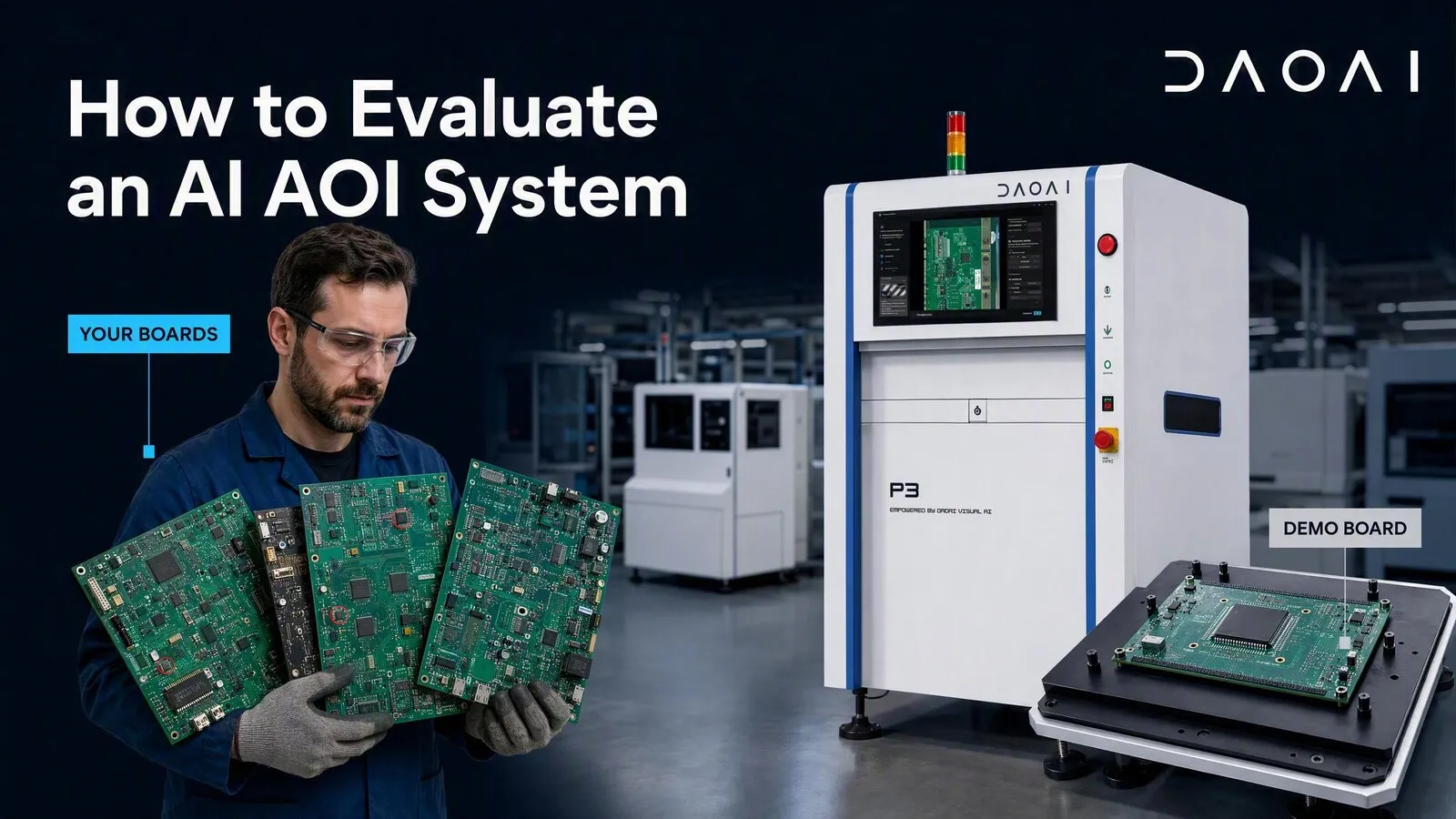
벤더의 정확도 수치는 자체 보드에서 직접 재현하기 전까지는 아무 의미가 없습니다. 준비해야 할 6가지 보드, 측정해야 할 5가지 항목, 그리고 합격 판정 기준을 정리했습니다.
2026년 8월 11일
DaoAI vs Nordson YESTECH AOI: golden-board vs CAD-and-library programming, inline 3D, through-hole, on-machine AI, and how to test both on your boards.
2026년 10월 7일
AI 검사 인사이트, 제품 소식, 산업 분석. 불필요한 정보 없이 월 1회.
문의에 답변하기 위해 입력하신 정보를 사용합니다. 개인정보 처리방침 확인.