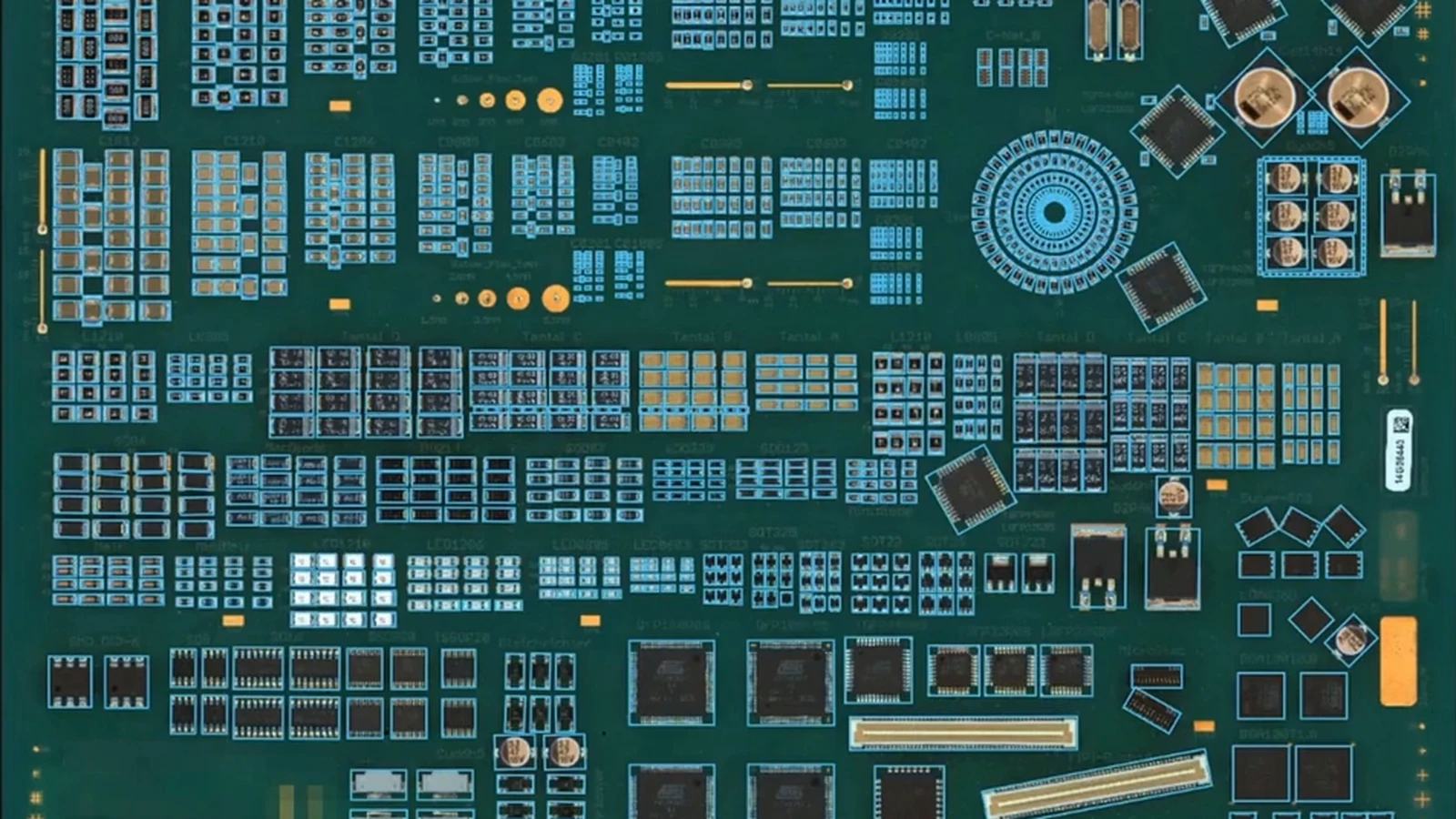
Component shift is a placement defect in which a part is offset in X or Y from its pads, and skew is a rotational misalignment in which the part sits at an angle to its land pattern. Beyond the overhang allowed by IPC-A-610 for the product class, a shifted or skewed part has reduced joint area and can bridge to a neighboring pad or open on one side.
What causes component shift and skew?
Parts can be placed off-center, or placed correctly and then move before or during reflow. The common process causes are:
- Placement: drifting placement accuracy, worn nozzles, incorrect body dimensions in the package data that throw off vision centering, fiducial recognition errors, and poor board clamping.
- Solder paste: dried paste with low tack does not hold the part, and a tall deposit lets the part float and drift once the solder melts.
- Stencil: a print offset from the pads; small chips tend to follow the paste during reflow, so a shifted print becomes a shifted part.
- Reflow profile and conveyor: vibration or jolts on the conveyor, and high convection airflow on very small parts. Molten solder pulls light chips back toward center, but heavier parts and those with uneven paste may drift further off instead.
- Component and pad design: oversized pads let a part swim on molten solder, and asymmetric pads or unequal copper pull it toward one side.
The same imbalance that drags a small chip sideways can also stand it on end, which is covered in tombstoning.
How is component shift and skew detected?
Manual inspection spots gross shifts but cannot judge a small overhang against a class limit consistently. SPI does not see parts, but it measures print offset relative to the pads, one of the upstream causes.
2D AOI measures each part's X/Y offset and rotation relative to its pads or the reference board, and a pre-reflow AOI catches placement errors while the part can still be nudged into place. 3D AOI helps where the body has low contrast against the board, and on parts whose terminations are hard to locate from above. AXI is used for hidden joints, such as a BGA shifted off its pads.
In DaoAI's inspection coverage, item 02, Placement, Orientation & Polarity, covers X/Y offset, skew or rotation. Each component gets a score rather than just a pass or fail, so you can see how far it deviates from the reference and where the threshold sits. On panelized boards, each sub-panel is aligned against its own features, which helps reduce false calls caused by panel misalignment.
Offsets are also process data. With DaoAI's production integration, built-in Gauge R&R and Cpk analysis cover placement accuracy on three measurements the machine already takes: X offset (mm), Y offset (mm) and rotation angle (degrees). Per-position yield in a panel shows where a stencil or reflow problem sits.
How to prevent component shift and skew
Trend offsets instead of waiting for failures: a placement head that is slowly drifting is a maintenance task, not yet a defect. The table maps each cause to its prevention and what to measure.
| Cause | Prevention | What to measure |
|---|
| Placement accuracy drift | Run placement calibration on a schedule and after crashes or nozzle changes. | X/Y offset (µm) and rotation (°) per head |
| Wrong package data | Check body dimensions in the placement library against the datasheet for new parts. | Body length and width (mm) |
| Print offset | Verify stencil alignment and fiducial recognition at the printer. | Paste offset from pad (µm) in SPI |
| Low paste tack | Use paste within stencil life and limit time between print and placement. | Time from print to reflow (min) |
| Conveyor jolts | Reduce conveyor acceleration and check transfer points between machines. | Offset trend after each transfer |
| Oversized or asymmetric pads | Size pads to IPC-7351 land patterns and balance copper on both terminations. | Pad and termination dimensions (mm) |
See how offsets on your own product are measured and reported. Send us one of your own boards and we will test it for you, free of charge.
FAQ
How much component shift is acceptable?
IPC-A-610 sets side and end overhang limits as a fraction of the termination or pad width, with tighter limits for Class 3 than for Class 1 and 2. Use the current revision of the standard and your customer's requirements for the exact figures.
Does reflow correct component shift?
Partly. Surface tension pulls small, light chips back toward center, but heavier parts and parts with uneven paste may not self-align, and a large shift can still end in a bridge or an open.
Should shift be inspected before or after reflow?
Both have a role. A pre-reflow check lets you correct the part without rework, and a post-reflow check confirms where the part finally settled.
What is the difference between skew and a rotation error?
Skew is a small angular misalignment, usually a few degrees, from placement or movement in reflow. A rotation error is a part placed at the wrong orientation, such as 90° or 180°, usually from program data.