Reversed Polarity Components: How AOI Catches Orientation Errors
A reversed diode, capacitor or IC can kill a board at power-up. Here is what causes polarity errors, how AOI checks orientation, and the controls that prevent them.
2026年9月28日
Missing parts are usually a pick-and-place problem; wrong parts are usually a material setup problem. Here is how each is caught by inspection and how to prevent both.
A missing component is an empty placement position where a part should be, and a wrong component is a part that is present but has the wrong value, part number or package. Both defects come mostly from pick-and-place and material setup rather than from soldering, and a wrong part can pass a simple presence check because something is sitting on the pads.
Missing parts are usually a pick or hold problem, while wrong parts are usually a material problem. The common causes, grouped by process step, are:
A related placement error is a part that is present and correct but rotated, covered in reversed polarity components.
Manual inspection finds an empty position reasonably well on a sparse board. It cannot tell a 10 kΩ resistor from a 100 kΩ one if the markings are tiny, and many chip capacitors carry no marking at all.
SPI runs before placement, so it does not see components. Feeder verification with barcode scanning at setup is the main upstream control for wrong parts.
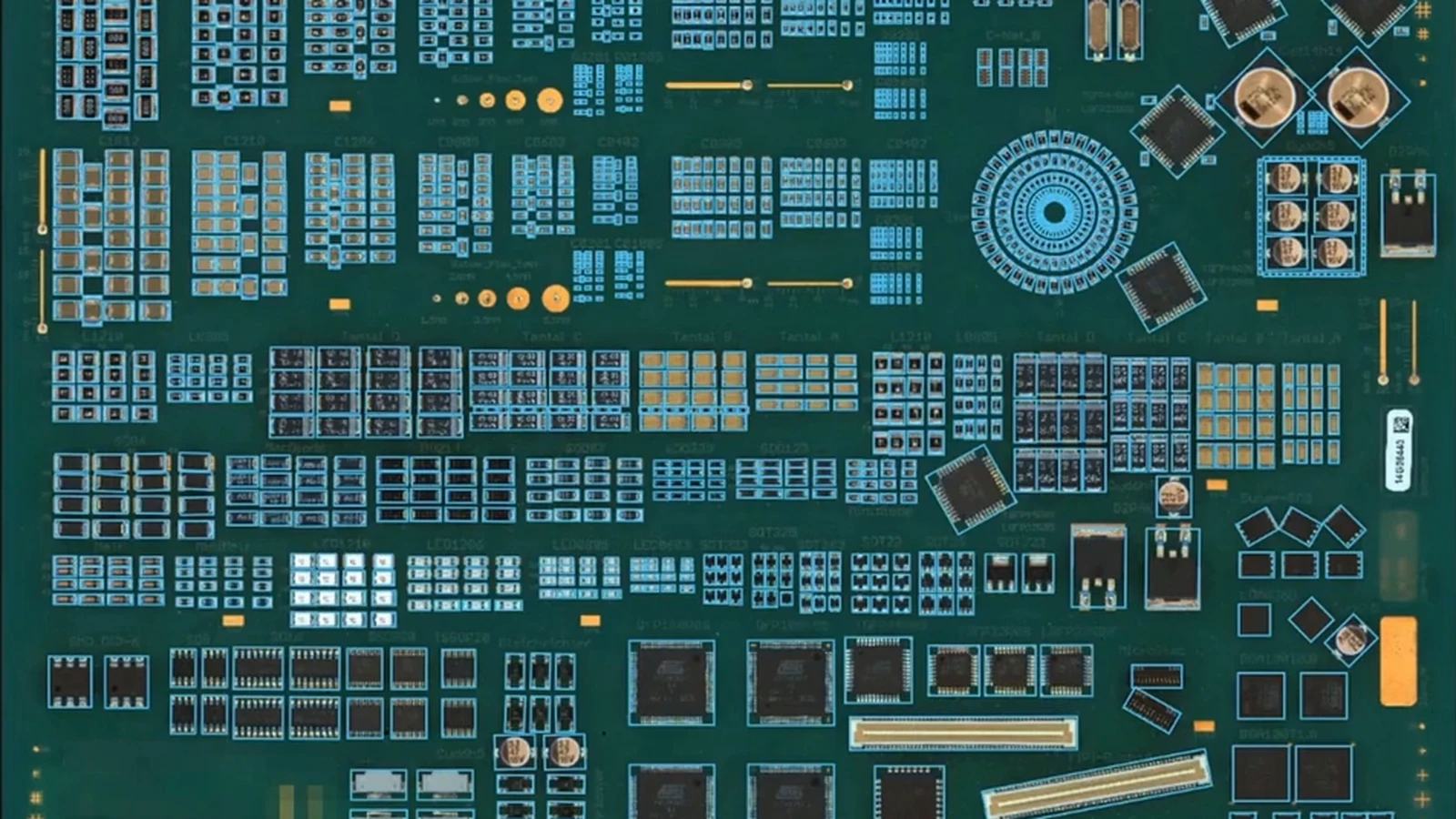
2D AOI checks presence against the reference and identifies wrong parts by body size, color, shape and marking. Reading the marking with OCR, or verifying it against expected text with OCV, is what catches a wrong part in the right package. 3D AOI adds body height, which separates packages that look alike from above. Unmarked parts with the wrong value are only caught electrically, by in-circuit or flying-probe test. AXI is not normally used for this defect.
In DaoAI's inspection coverage, item 01, Component Presence & Identification, checks for missing or incorrect components. Item 10 adds AI OCR and OCV: OCR reads component codes, date codes and markings without being told the text first, and OCV confirms that the expected text is present, correct and legible. Character equivalence groups, such as 0 and O or 8 and B, help reduce false calls from look-alike characters.
A different supplier for the same part number can mean a different body color or marking font, which is not a defect. Operators mark that variation as acceptable so the AI learns it across the component group, while missing components remain inspection targets. On through-hole assemblies, the DaoAI A3 checks component bodies for missing, wrong and reversed parts in both pre-wave and post-wave inspection, covering both sides of the board with one machine. The P3 and P5 also support DIP / through-hole inspection.
Most prevention happens before the first board is placed. The table maps each cause to its usual control.
| Cause | Prevention |
|---|---|
| Wrong reel in a feeder | Scan reel and feeder barcodes against the setup list at every load and splice. |
| Pick failures | Clean and inspect nozzles on a fixed schedule, and check vacuum levels per nozzle. |
| Parts dropped or knocked off | Verify placement Z height, conveyor acceleration and board support; confirm feeder pitch (for example 2 mm or 4 mm) matches the tape. |
| Low paste tack | Use paste within its stencil life and keep time between print and placement short. |
| Small parts blown off | Check reflow fan speed settings against the paste and component supplier guidance. |
| Wrong through-hole part inserted | Use kitted bins, clear labels and a pre-wave inspection before soldering locks it in. |
Catch the wrong reel on the first board, not the hundredth. Send us one of your own boards and we will test it for you, free of charge.
AOI can identify a wrong part when it differs in size, color, shape or marking, and OCR or OCV can read the marking directly. It cannot measure the electrical value of an unmarked chip capacitor, which needs in-circuit or flying-probe testing.
OCR reads text the system has not been told about, such as a date code or serial number. OCV checks printed text against the expected content and confirms that it is present and correct.
It can, because the same part number from another supplier may have a different body color or marking font. With DaoAI, an operator marks the new variation as acceptable and the AI learns it for that component group.
As early as possible: a pre-reflow check lets you place the missing part without rework. Post-reflow AOI still catches parts lost during transport or reflow.
A reversed diode, capacitor or IC can kill a board at power-up. Here is what causes polarity errors, how AOI checks orientation, and the controls that prevent them.
2026年9月28日
DaoAI vs Nordson YESTECH AOI: golden-board vs CAD-and-library programming, inline 3D, through-hole, on-machine AI, and how to test both on your boards.
2026年10月7日
DaoAI vs CyberOptics (Nordson) SQ-series 3D AOI: golden-board vs library-based programming, inline 3D, through-hole, on-machine AI and how to test both.
2026年10月7日
AI検査の知見、製品ニュース、業界分析。月一回、必要な情報だけをお届け。
お問い合わせへの回答のためにお客様の情報を使用します。 プライバシーポリシーをご確認ください。