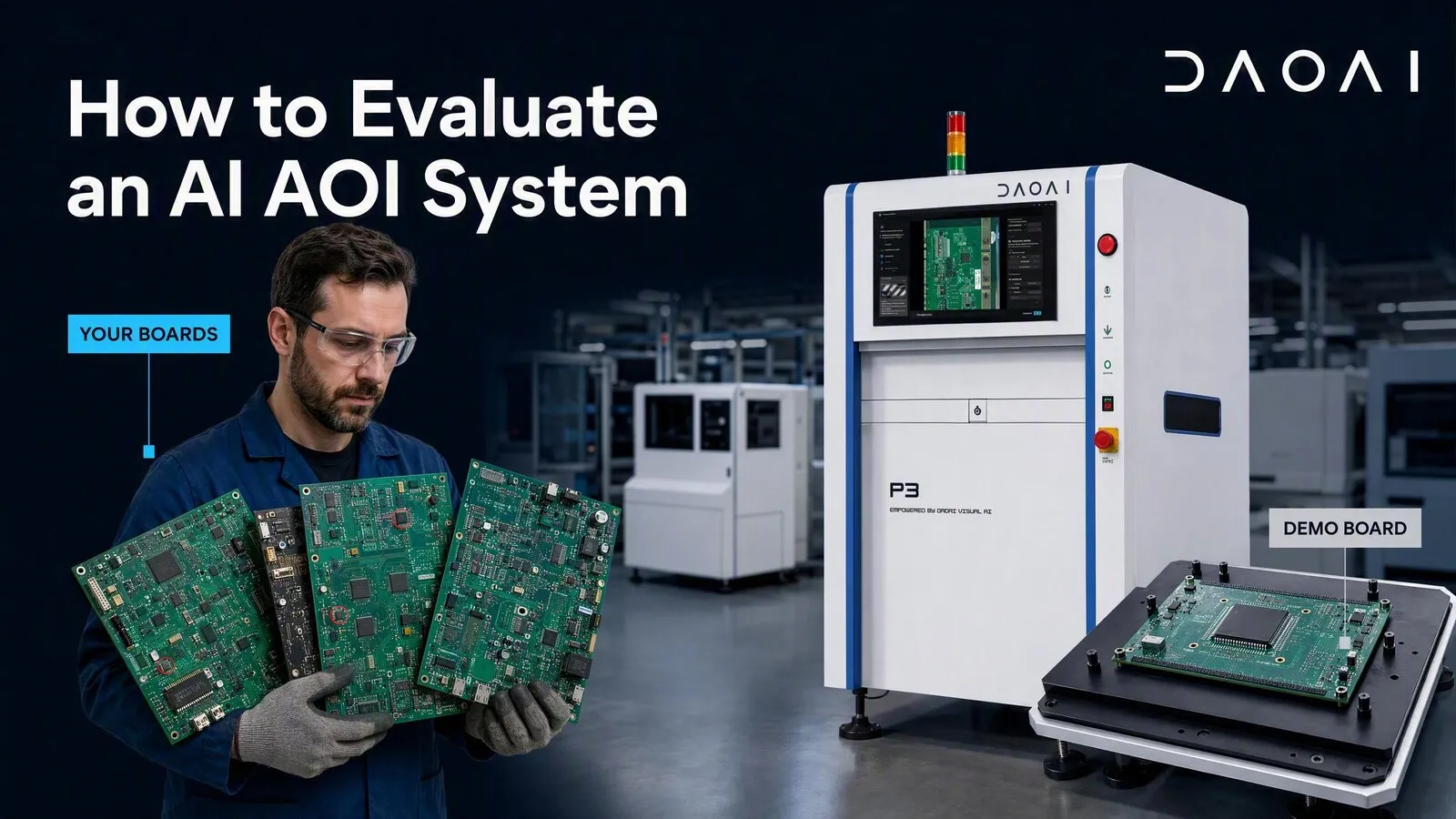
購入前にAI AOIシステムを評価する方法
自社の基板で再現できない限り、ベンダの精度数値には何の意味もありません。持ち込むべき6枚の基板、測定すべき5つの項目、そして合格ラインの具体像。
2026年8月11日
A sourced comparison of DaoAI and Omron VT-S530 / VT-S1080 3D AOI: programming, 3D specifications, AI features and data handling, plus a checklist for testing both on your own boards.
DaoAI is an alternative to Omron's VT-S series 3D AOI: its machines build an inspection program from one verified golden board in 30 seconds to 5 minutes, without CAD files or a prebuilt component library, and its P5 and P5D inline 3D machines are available for delivery now. According to Omron's published materials, the VT-S530 and VT-S1080 combine multi-direction, multi-color lighting with phase-shift 3D measurement, and use AI for automatic component recognition, inspection-window adjustment and reference-value setting. Sources are linked at the end.
| Topic | DaoAI (per daoai.com) | Omron VT-S series (VT-S530, VT-S1080, per vendor materials) |
|---|---|---|
| Programming inputs | One verified golden board; AI auto-programming in 30 s to 5 min. CAD/BOM optional; it adds designators and part numbers only. Auto-programming does not require a prebuilt component library. | Offline program generation "without interrupting production" and a "Global Library" shared across sites. Omron's site lists AI automatic component recognition, inspection-window adjustment and reference-value setting. |
| 3D method | P5 and P5D inline 3D: four structured-light projection units, one per direction. | VT-S1080: MDMC multi-direction/multi-color lighting, Micro Phase Shift projectors from four directions, four oblique cameras. VT-S530: Color Highlight 3D with DLP projectors. |
| Height measurement range | 25 mm (P5, P5D). | VT-S530: 25 mm max height inspection. VT-S1080: not stated on the pages reviewed. |
| Published height metric | ≤ 6 µm height accuracy with the calibration tool (P5, P5D). | Not stated as a single figure on the pages reviewed. |
| Camera / optical resolution | 21 MP, 10 µm (P5). | VT-S1080: 25 Mpix, 12.5 µm. VT-S530: 12 Mpix, 10 or 15 µm. |
| AI features | Per-component AI scoring, feedback learning from operator reports, custom model training on the machine. | "AI-assisted qualitative inspection", AI self-optimization of inspection logic and criteria, automatic defect image acquisition. |
| Offline options | P1, P1L (680 × 510 mm) and P2 offline machines with the same software. | Omron's 3D AOI pages list inline models. Check with the vendor for benchtop options. |
| Through-hole (THT) | A3: one machine performs pre-wave and post-wave inspection and can inspect both sides of the board. P3 and P5 also support DIP/through-hole inspection. | Not stated on the pages reviewed. Check with the vendor. |
| Deployment and data | All models run on-premise with no internet connection required. Remote support is optional and off unless the customer enables it; the system has no backdoor access. | M2M links to Omron's Qup software tools are described. Check with the vendor on data handling. |
DaoAI hardware figures are reference (typical) values from daoai.com, not guaranteed limits. Omron figures are as stated in its published materials.
Omron describes VT-S1080 programming around offline program generation, a global library shared across sites, and AI tools for "skill-less" tuning and self-optimization. Its site also lists AI for automatic component recognition, inspection-window adjustment and reference-value setting.
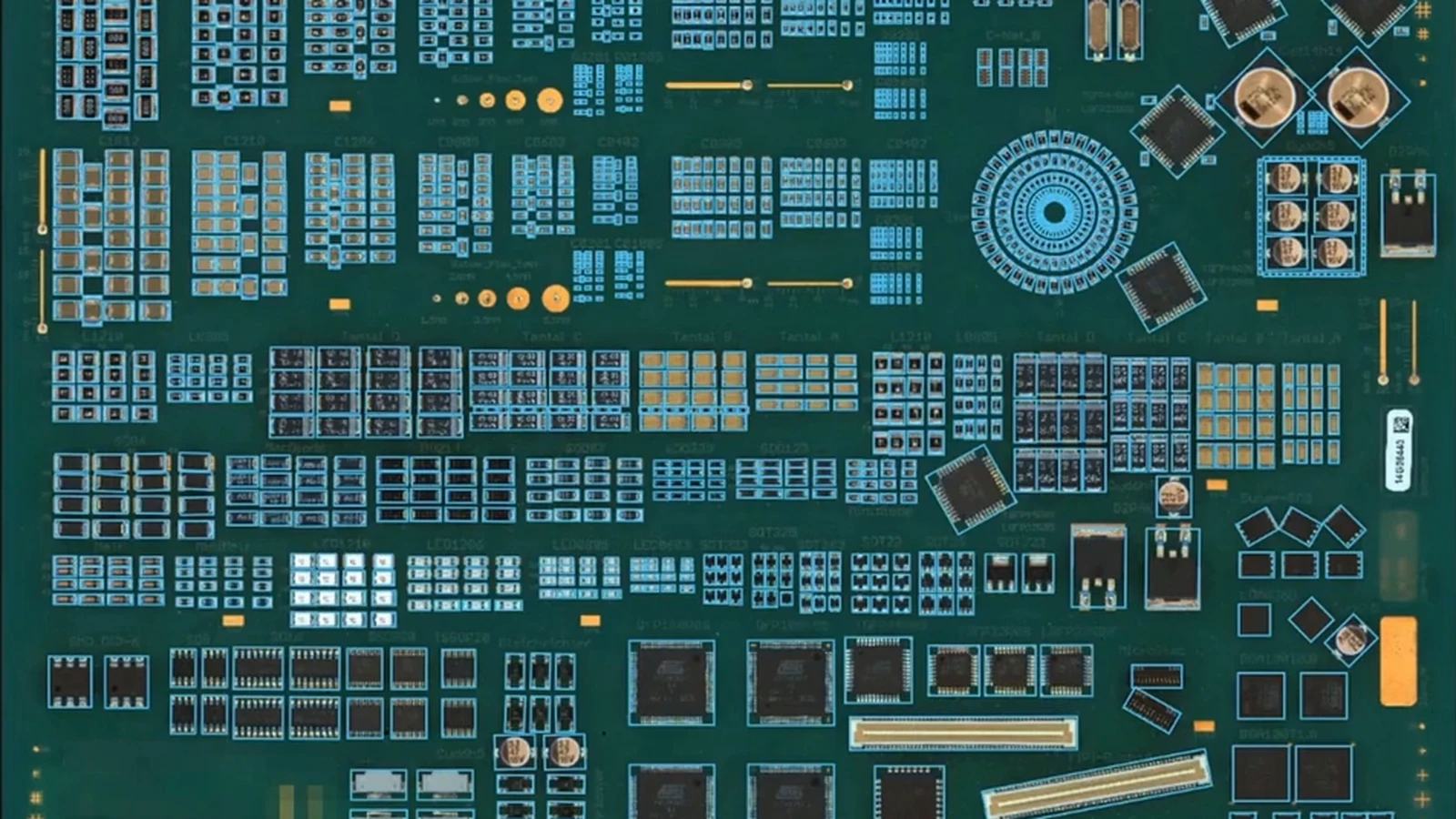
DaoAI starts from the board. The machine images one verified golden board, detects and models every component, draws the inspection windows and sets thresholds itself. A CAD or BOM file can be imported later to add designators and part numbers, but it does not change what is detected or how it is judged. A new package is modelled from the board in front of it, with no library entry to create first.
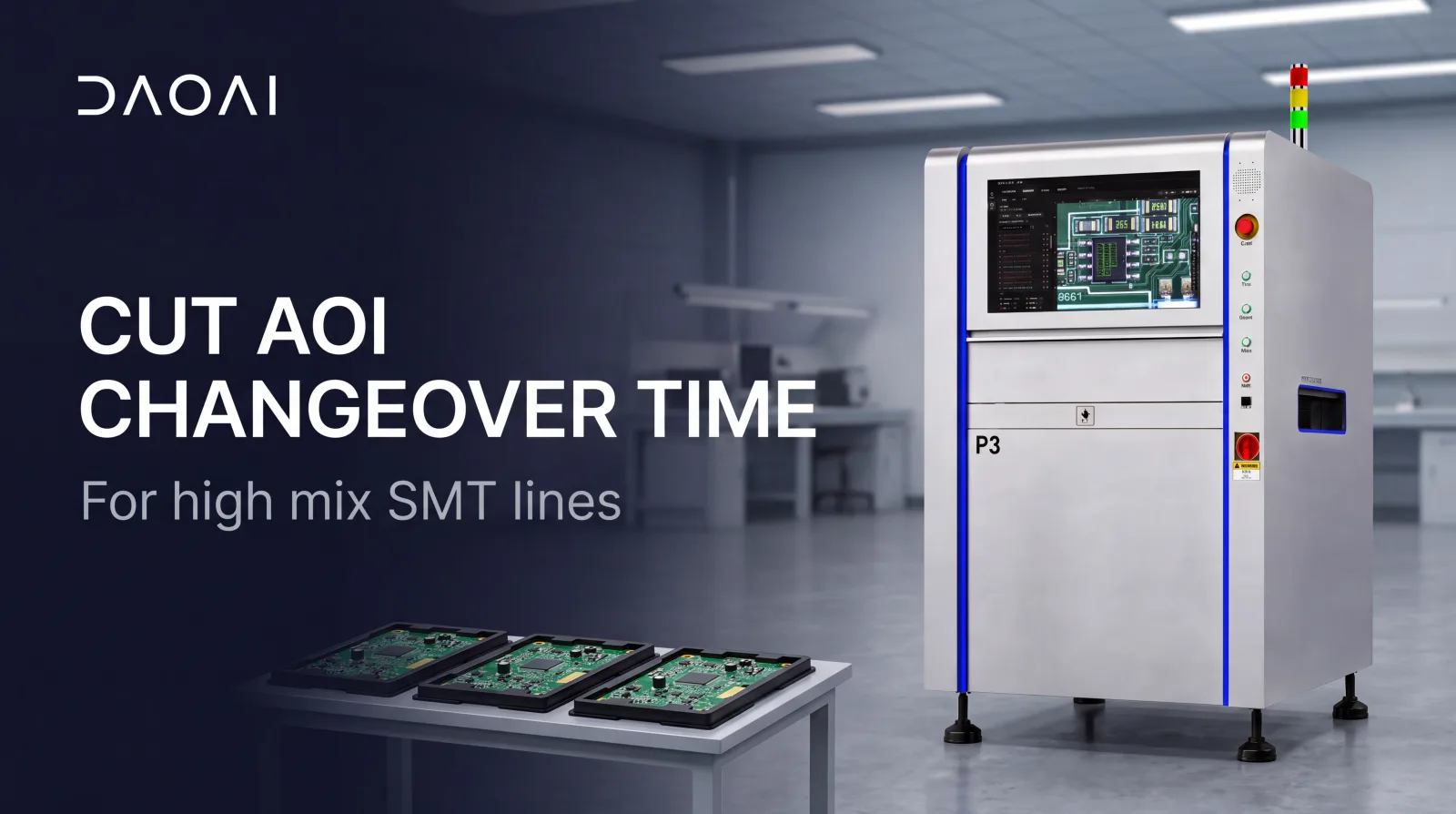
Engineering hours per changeover add up on any line, whether it runs several new part numbers a week or a few long builds. We explain the method in AOI programming without CAD files and how to cut AOI changeover time.
Omron says its AI tools support labor-saving tuning and self-optimization of inspection logic and criteria, and that the VT-S1080 acquires defect images automatically. Ask Omron to demonstrate how that works on your own boards.
DaoAI uses feedback learning. An operator marks a call as OK or NG at the review screen, and an AI update retrains the model on that example instead of widening a threshold for every part judged by it. Manual settings take priority, updates can be undone, and the line does not stop while it retrains. DaoAI states the false-call rate can reach about 1% after tuning; it depends on the board and process.
Omron's pages describe full 3D, IPC-based inspection, angle-view inspection of hidden solder joints, and lighting designed to reduce shadow and secondary reflection.
DaoAI covers 16 inspection capabilities across components, solder joints and leads, markings, barcodes (1D, QR and Data Matrix), through-hole joints and the whole board. Component height and coplanarity use the P5 and P5D; open solder joints are available in both 2D and 3D configurations. The whole-board pass looks for solder balls and foreign objects on bare laminate, not only inside component windows. The range runs from offline 2D benches to inline 2D, inline 3D and the A3 for through-hole lines, all on the same core software.
Over a machine's life, engineering time and false calls usually cost more than the purchase price. Compare these on your own product mix:
Our AOI ROI and payback guide shows how to put numbers on each item.
Run the same boards through both systems under the same conditions and record results side by side (see how to evaluate an AI AOI system before you buy):
No. DaoAI programs from one verified golden board in 30 seconds to 5 minutes, and auto-programming does not require a prebuilt component library. CAD or BOM data is optional and only adds designators, part numbers and grouping.
Yes. The P5 and P5D inline 3D machines are available for delivery now. They measure component height with four structured-light projection units, one per direction.
Yes. The A3 performs pre-wave and post-wave inspection in one machine and can inspect both sides of the board. The P3 and P5 also support DIP/through-hole inspection.
No. All DaoAI models run on-premise with no internet connection required. Remote support is optional and off unless the customer enables it; the system has no backdoor access.
Competitor information was checked on the pages below on September 27, 2026. Specifications and features change; confirm details with the vendor.
With DaoAI, you can create an inspection program from one verified golden board without CAD files or a prebuilt component library. For inline 3D inspection, the P5 is available for delivery. Send us your board to evaluate programming time, inspection coverage and false-call review workload.
自社の基板で再現できない限り、ベンダの精度数値には何の意味もありません。持ち込むべき6枚の基板、測定すべき5つの項目、そして合格ラインの具体像。
2026年8月11日
プログラム準備、初品基板の確認、生産リリースを明確に切り分けることで、多品種SMTラインにおける本質的な遅延要因を特定します。
DaoAI vs Nordson YESTECH AOI: golden-board vs CAD-and-library programming, inline 3D, through-hole, on-machine AI, and how to test both on your boards.
2026年10月7日
AI検査の知見、製品ニュース、業界分析。月一回、必要な情報だけをお届け。
お問い合わせへの回答のためにお客様の情報を使用します。 プライバシーポリシーをご確認ください。