多品種SMTラインにおけるAOI段取り替え時間を短縮する方法
プログラム準備、初品基板の確認、生産リリースを明確に切り分けることで、多品種SMTラインにおける本質的な遅延要因を特定します。
Program one sub-panel and let the AOI find, align and judge every other position on the panel. Here is how array inspection works, where it goes wrong, and why setup time matters on every panel.
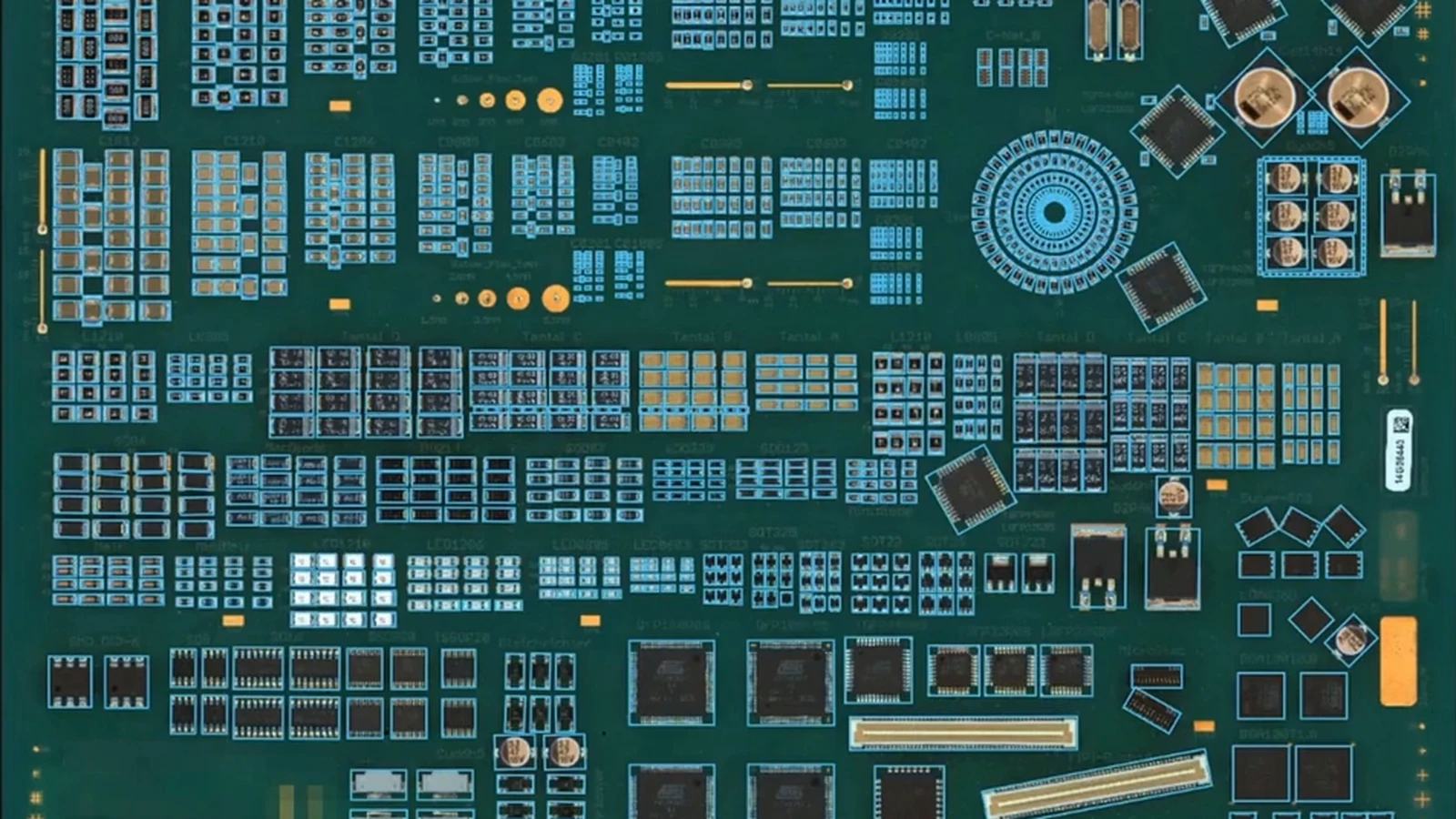
Panel (array) AOI inspection means programming one board position and letting the machine apply that program to every position on the panel, with each position aligned, judged and reported on its own. Done well, a 12-up panel becomes one programming job instead of twelve, and every individual board stays traceable after depaneling. On DaoAI machines you draw a box around one sub-panel and the software finds the rest of the array from the image.
Small boards are usually built as an array of identical boards on one panel, held together by breakaway tabs or V-score lines, so the line handles one larger panel instead of many small boards.
The AOI machine sees one panel, but your customer receives individual boards. The inspection program therefore has to do two jobs: judge every component on every position, and keep the result for each position separate so it can follow that board after depaneling.
A few terms come up in every panel setup:
On a rule-based AOI, teaching one board variant typically takes an engineer 3 to 5 hours, and several days on a board with thousands of components. A panel adds its own setup on top of that: entering rows, columns and pitch, setting rotation for mirrored positions, and then checking that the inspection windows land correctly on the far corner of the panel.
In high-volume production that cost is spread over months of running, but every new panel and revision still pays it. In high-mix production, when a line sees several new panels a week and some runs are only a few dozen panels long, setup can take longer than the run itself.
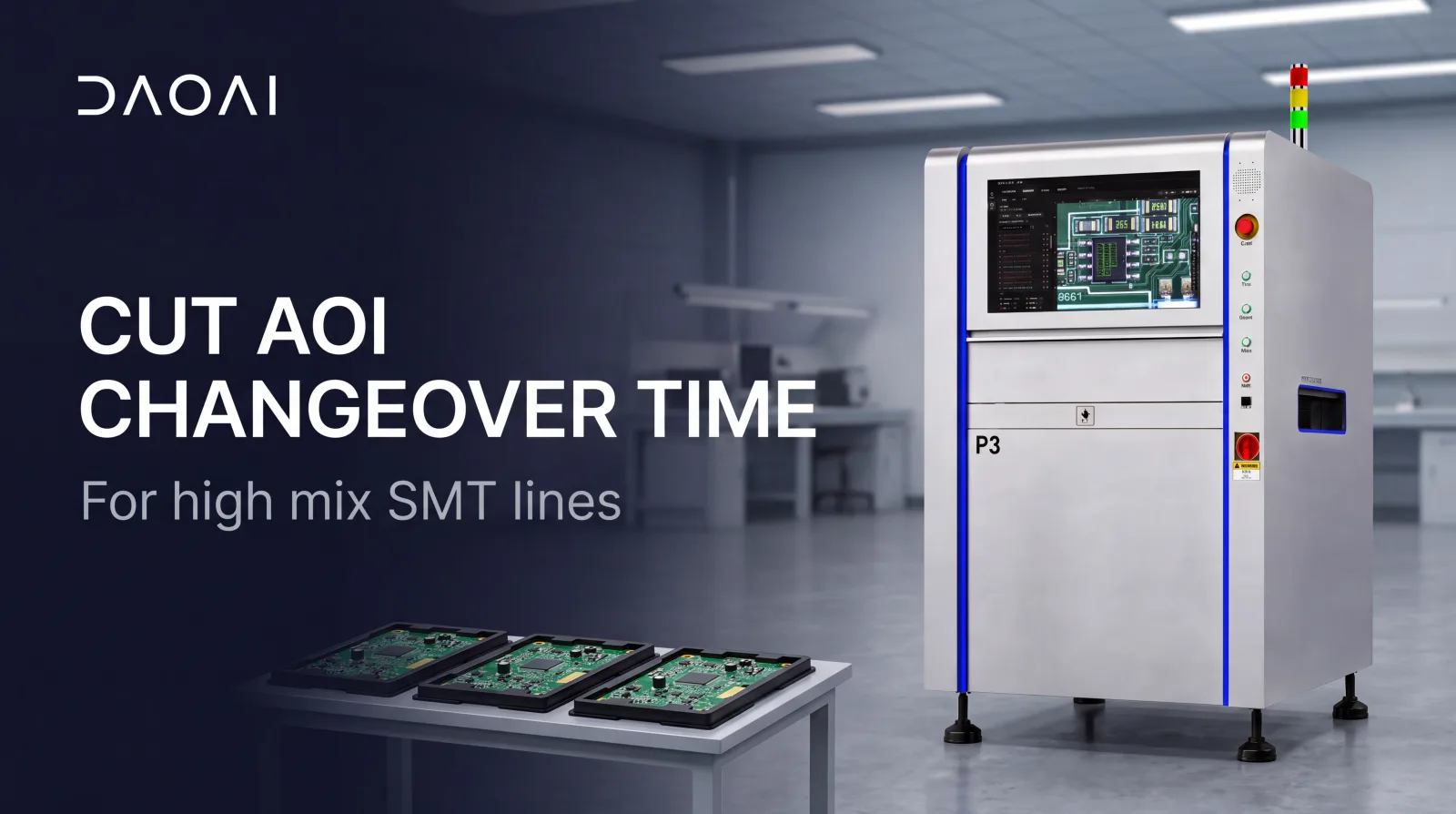
Small layout errors also turn into false calls. If the pitch you entered is slightly off, windows drift further from their components with every position, and the positions furthest from the origin generate a stream of calls that operators learn to ignore. For more on why that matters, see how to cut AOI changeover time on high-mix SMT lines.
DaoAI treats the panel layout as something to detect from the image rather than something to type in. The panel inspection workflow runs like this:
A panel also gives the AI more to learn from. Matching components across sub-panels provide training examples for the same model, and a shared edit made on one position applies across matching positions without repeating the work.
Fiducials exist because no panel sits in exactly the same place twice. Global fiducials correct for panel-level shift and rotation; local fiducials correct for smaller errors near individual boards or fine-pitch parts.
The weak point of a single global correction is that panels are not perfectly rigid. Laminate stretch, tab flex and fixture wear mean position 1 can be aligned perfectly while position 12 is off by enough to trigger shift calls on small passives.
DaoAI aligns each sub-panel against its own features, not against the panel as a whole, which helps reduce false calls caused by misalignment. Alignment marks are placed for you, or you can click their centers yourself. After a fixture change, you can re-align without touching the inspection program.
When a board position is rejected before assembly, for example at bare-board electrical test, it is usually marked with ink, a sticker or a scratched-out area. Placement machines read that bad mark and skip the position. The AOI has to know about the skip too, or it will call every missing component on a board that was never meant to be populated.
Handled badly, one X-out position floods the review station with "missing component" calls and drags down yield for a board scrapped upstream. Good practice:
DaoAI recognizes bad marks automatically, with multiple bad-mark recognition algorithms available, so you can pick the one that suits your fabricator's ink, sticker or scratch-out style.
Once the panel is routed apart, a result that says "panel 4471 passed" is not much use. Each board needs its own record. DaoAI links each sub-panel's barcode or serial number to its inspection results, so individual boards remain traceable after depaneling, and it reads 1D barcodes, QR codes, other 2D codes such as Data Matrix, and serial numbers during inspection.
Per-position data is also a process tool. DaoAI's production integration reports first pass yield for the whole board and for each sub-panel. When one position fails more often than the others, that points to a stencil aperture, a support pin or a reflow profile problem at that spot on the panel rather than a component problem.
Not every panel is a clean grid. Some mix orientations to fit more boards on the panel; some have uneven spacing around tooling holes. For those, you configure the irregular spacing or mixed orientations manually, then save the layout for that product.
Customers also change panelization, for example from a 6-up prototype panel to a 10-up production panel. DaoAI reuses an existing sub-panel program on a different layout without programming the board again.
If one position genuinely differs, such as a variant with a different part fitted, you can edit that position independently while the others keep the shared program. Your manual settings are preserved when the program is regenerated.
For array work, maximum panel size is often the deciding spec. All DaoAI machines run the same core AI software; they differ in optics and handling.
| Machine | Type | Max board / panel size | Resolution / camera |
|---|---|---|---|
| P1 | Offline 2D | 470 × 330 mm (≈ 18.5 × 12.99 in) | 15 µm per pixel |
| P1L | Offline 2D, large format | 680 × 510 mm (≈ 26.77 × 20.08 in) | 15 µm per pixel |
| P2 | Offline 2D flagship | 470 × 330 mm (≈ 18.5 × 12.99 in) | 10 µm per pixel |
| P3 | Inline 2D, single track | 500 × 600 mm (≈ 19.69 × 23.62 in) | 10 µm per pixel |
| P3D | Inline 2D, dual track | 500 × 325 mm (≈ 19.69 × 12.8 in) per track | 10 µm per pixel |
| P5 | Inline 3D, single track | 500 × 600 mm (≈ 19.69 × 23.62 in) | 10 µm optical |
| P5D | Inline 3D, dual track | 500 × 300 mm (≈ 19.69 × 11.81 in) per track | 10 µm optical |
| A3 | Through-hole, straddles the line | 420 × 420 mm (≈ 16.54 × 16.54 in) | 26 MP camera |
Minimum board size is 50 × 50 mm (≈ 1.97 × 1.97 in) on every model listed.
No. You draw a box around one sub-panel and auto-detection finds the remaining positions, including rows, columns and spacing, from the image. Irregular layouts can be configured manually and saved for that product.
Yes. Each sub-panel is aligned against its own features, inspected with the shared program, and has its results recorded separately, including first pass yield per position.
Yes. An existing sub-panel program can be reused on a different panel layout without programming the board again.
Each sub-panel's barcode or serial number is linked to its own inspection results. The record follows the individual board, not just the panel.
A position that fails consistently usually points to something location-specific, such as a stencil aperture, board support or reflow profile at that spot. Per-position yield data makes that pattern visible.
Want to see it on your own array? Book a demo and bring your panel layout, or send us one of your own boards and we will test it for you, free of charge.
プログラム準備、初品基板の確認、生産リリースを明確に切り分けることで、多品種SMTラインにおける本質的な遅延要因を特定します。
DaoAI vs Nordson YESTECH AOI: golden-board vs CAD-and-library programming, inline 3D, through-hole, on-machine AI, and how to test both on your boards.
2026年10月7日
DaoAI vs CyberOptics (Nordson) SQ-series 3D AOI: golden-board vs library-based programming, inline 3D, through-hole, on-machine AI and how to test both.
2026年10月7日
AI検査の知見、製品ニュース、業界分析。月一回、必要な情報だけをお届け。
お問い合わせへの回答のためにお客様の情報を使用します。 プライバシーポリシーをご確認ください。